
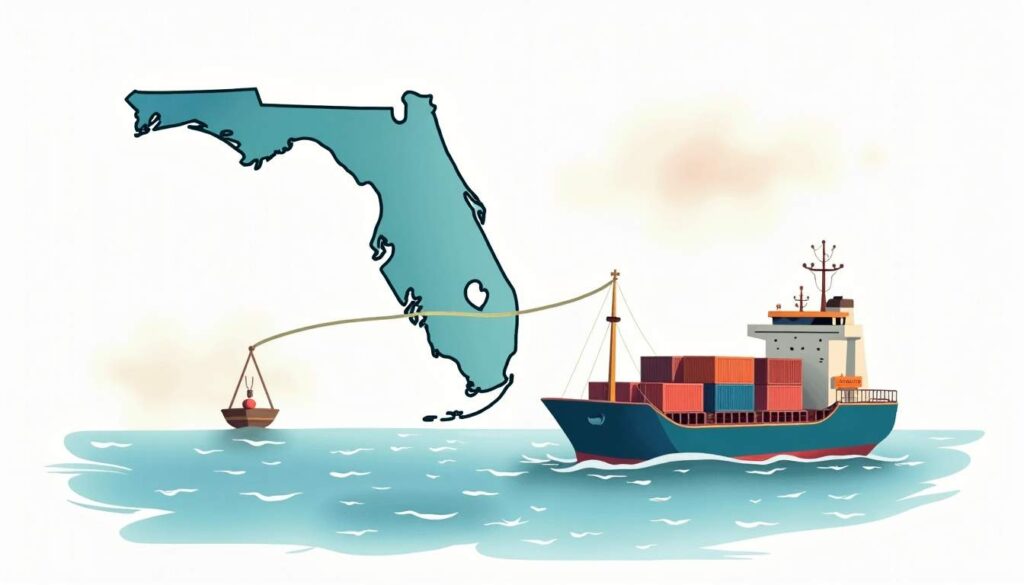
Anyone shipping regular loads from Florida to Puerto Rico can feel it in the freight quotes: the Jones Act is always there in the background, whether it is mentioned by name or not. Even as global freight prices have surged since the pandemic, a major Ernst & Young study found that between January 2019 and December 2021, global shipping rates rose 27 times more than rates on Jones Act–covered Caribbean routesErnst & Young analysis for the Transportation Institute. That kind of detail matters if your business depends on stable, predictable ocean costs.
For shippers moving freight between Florida ports and San Juan, the Jones Act is not an abstract policy debate in Washington. It shapes which carriers you can use, how you structure routes, how often you can sail, and the way your landed costs build up. There is no simple “it’s good” or “it’s bad” answer. Some studies say the law hardly touches retail prices on the island, while others claim it adds hundreds of millions of dollars a year to shipping and consumer costs. Understanding what those studies actually say, and what that means for your shipping decisions, is the difference between fighting the Jones Act and learning to work profitably within it.
Quick refresher: what the Jones Act actually is
The Jones Act is the common name for a section of U.S. maritime law that governs “cabotage” – the movement of goods between two U.S. points by water. For your Florida to Puerto Rico freight, this means cargo shipped directly between those ports must move on U.S.-built, U.S.-owned, U.S.-flagged vessels, crewed primarily by U.S. mariners. Those requirements affect everything from vessel costs and financing to labor rules and safety standards.
For most shippers, the immediate effect is felt in the carrier list. When planning Florida–Puerto Rico moves, the pool of eligible ocean carriers is far smaller than what you might be used to for Asia-to-U.S. or Latin America-to-U.S. routes, where foreign-flag ships dominate. The market is concentrated, schedules are more structured, and the way carriers price capacity reflects that regulated environment.
Because Puerto Rico is a U.S. territory, Jones Act requirements apply even though it is an island in the Caribbean rather than a state on the mainland. That unique status is why the island shows up in so many economic studies: analysts often use Puerto Rico to ask what happens when an isolated market depends heavily on coastal shipping that has to comply with U.S. rules.
Does the Jones Act really raise Puerto Rico shipping costs?
Debate over the Jones Act often starts with a simple question: does it make life more expensive in Puerto Rico? A detailed report by Reeve & Associates and Estudios Técnicos, Inc. in 2018 concluded that the law has no measurable impact on retail prices or the overall cost of living on the islandReeve & Associates and Estudios Técnicos report summarized by the Seafarers International Union. That study argued that transportation is just one small piece of a product’s final shelf price, and that competition among Jones Act carriers keeps freight rates relatively aligned with comparable Caribbean services.
Other analysts have reached very different conclusions. A 2019 analysis by John Dunham & Associates, cited by the Cato Institute, estimated that the Jones Act raises the cost of shipping cargo to Puerto Rico by about $568.9 million each year and results in roughly $1.1 billion in higher prices for goods than would exist without the lawJohn Dunham & Associates findings reported by the Cato Institute. Those numbers come from modeling how much cheaper foreign-built and foreign-crewed vessels might operate if they were allowed to serve the same domestic lanes.
For Florida-based shippers, the key takeaway is not that one side must be completely right and the other totally wrong. The two views are looking at different layers of the same onion. At the macro level, economists are asking how the law affects the island’s entire economy and consumer price structure. At the operational level, whether the Act “costs” you money depends on your freight profile: the commodities you move, how often you ship, how much volume you control, and how creatively you structure your logistics network.
How the Jones Act shapes your Florida–Puerto Rico freight budget
Even without pinning everything on big headline numbers, the Jones Act clearly shapes the cost mix for Florida–Puerto Rico traffic. A 2019 report from Advantage Business Consulting, commissioned to look specifically at food and beverage imports, estimated that Jones Act requirements add about a 7.2 percent cost burden to those categories, or roughly $367 million a year in extra costs for that slice of the island’s importsAdvantage Business Consulting figures as cited by the Cato Institute. If your business ships temperature-controlled groceries, ingredients, or packaged drinks out of Florida, those kinds of figures highlight why ocean rates feel so sensitive.
From a budgeting standpoint, the Act influences your freight spend in a few practical ways. First, vessel and crewing rules tend to raise carriers’ fixed costs, which get reflected in base ocean rates and surcharges. Second, a smaller set of eligible carriers usually means fewer sailing options, so you build your inventory and distribution strategies around a relatively rigid weekly or biweekly schedule. Third, the same law that adds cost may also build resilience, since Jones Act vessels and crews operate under consistent U.S. safety, labor, and security rules that can reduce certain kinds of operational risk.
For shippers that control significant volume, there is room to offset some of those structural costs. Committing to steady lanes between Florida ports and Puerto Rico can unlock better contract terms, access to capacity in tight seasons, or bundled services like drayage, cross-docking, and warehousing on either side of the water. The more predictable your volume and lead times, the more leverage you have in a freight environment where carriers must play by the same regulatory rulebook.
Service reliability and carrier performance: a quiet upside
Cost often dominates the Jones Act conversation, but service reliability is just as important if your business runs lean inventories. A study released in August 2022 by the Transportation Institute, based on research from Ernst & Young, reported that across multiple performance metrics, shippers overwhelmingly associated better carrier performance with Jones Act carriers than with non–Jones Act operators in the regionTransportation Institute summary of the Ernst & Young study. On lanes where freight must arrive on time to keep store shelves stocked or factories running, those perceptions translate directly into real business value.
The same Ernst & Young analysis highlighted a striking trend in freight prices: between January 2019 and December 2021, global shipping rates increased 27 times more than rates in the Caribbean market that includes Puerto Rico and other Jones Act routesErnst & Young analysis for the Transportation Institute. For companies that lived through the chaos of container shortages, rolled bookings, and volatile spot rates, a relatively stable Florida–Puerto Rico lane during that period was a concrete advantage, even if base rates were not the world’s lowest to begin with.
From a practical planning angle, this relative stability lets you make bolder commitments on inventory placement and service levels. If your mainland DCs sit in Florida or neighboring states, a dependable ocean schedule to Puerto Rico can support tighter reorder points, smaller safety stocks on the island, and predictable replenishment cycles, all of which help offset higher per-container freight charges.
Building a smart shipping strategy under the Jones Act
Since the law is not going away any time soon, the question for Florida shippers is how to thrive within it. The first step is mapping your true landed cost to Puerto Rico. That means breaking out ocean freight, port and terminal fees, drayage on both ends, warehousing, customs brokerage for any foreign-origin goods, and last-mile delivery on the island. Once those components are visible, it becomes easier to see where Jones Act–driven constraints pinch you and where more flexible levers exist.
Mode and equipment decisions matter as well. If you often ship partial truckloads from Florida, working with a consolidator that specializes in the Florida–Puerto Rico lane can convert irregular small shipments into steady full-container or full-trailer loads. That not only improves freight cost per unit but also aligns better with fixed sailing schedules. For heavier or high-value cargo, paying for consistent, well-documented Jones Act capacity can be cheaper in the long run than chasing the very lowest rate through more fragmented arrangements.
Risk planning should sit alongside rate negotiations. Hurricane season, port disruptions, and mainland supply shocks all affect this lane. A sound Jones Act strategy includes backup routings, multi-port options in Florida when possible, and clear communication channels with your carriers for schedule changes. Because the carrier base is smaller and relationships are longer term, collaborative planning tends to pay off more here than on anonymous spot lanes.
Key takeaways for Florida shippers to Puerto Rico
When zooming out to the island’s broader economy, some analysts argue that the Jones Act drags on growth. The same 2019 Cato Institute work that highlighted higher shipping and consumer costs also estimated that the law results in about 13,250 fewer jobs in Puerto Rico, with potential wages of roughly $337.3 million and over $1.5 billion in additional economic activity that might exist in a different regulatory environmentCato Institute discussion of John Dunham & Associates modeling. Those numbers fuel calls for reform, and it is worth tracking that policy debate if your long-term business plans are tightly tied to the island.
At the company level, though, the law is a fixed constraint rather than a variable you can change this year. The practical move is to treat Jones Act compliance as part of the lane’s basic physics, then focus on how to win within those boundaries. That means choosing carriers with strong performance records, designing your Florida and Puerto Rico facility network around reliable sailing schedules, and using data to fine-tune order cycles and safety stocks.
The research points in different directions on the Jones Act’s net economic impact, but it delivers a clear message for shippers: costs and risks on this lane are knowable, manageable, and, with the right strategy, often more stable than on some supposedly “freer” trade routes. By understanding how the law influences pricing, capacity, and reliability, Florida businesses can turn a contested piece of maritime policy into a competitive advantage in their Puerto Rico supply chains.