Nobel Relocations | 2026 Edition
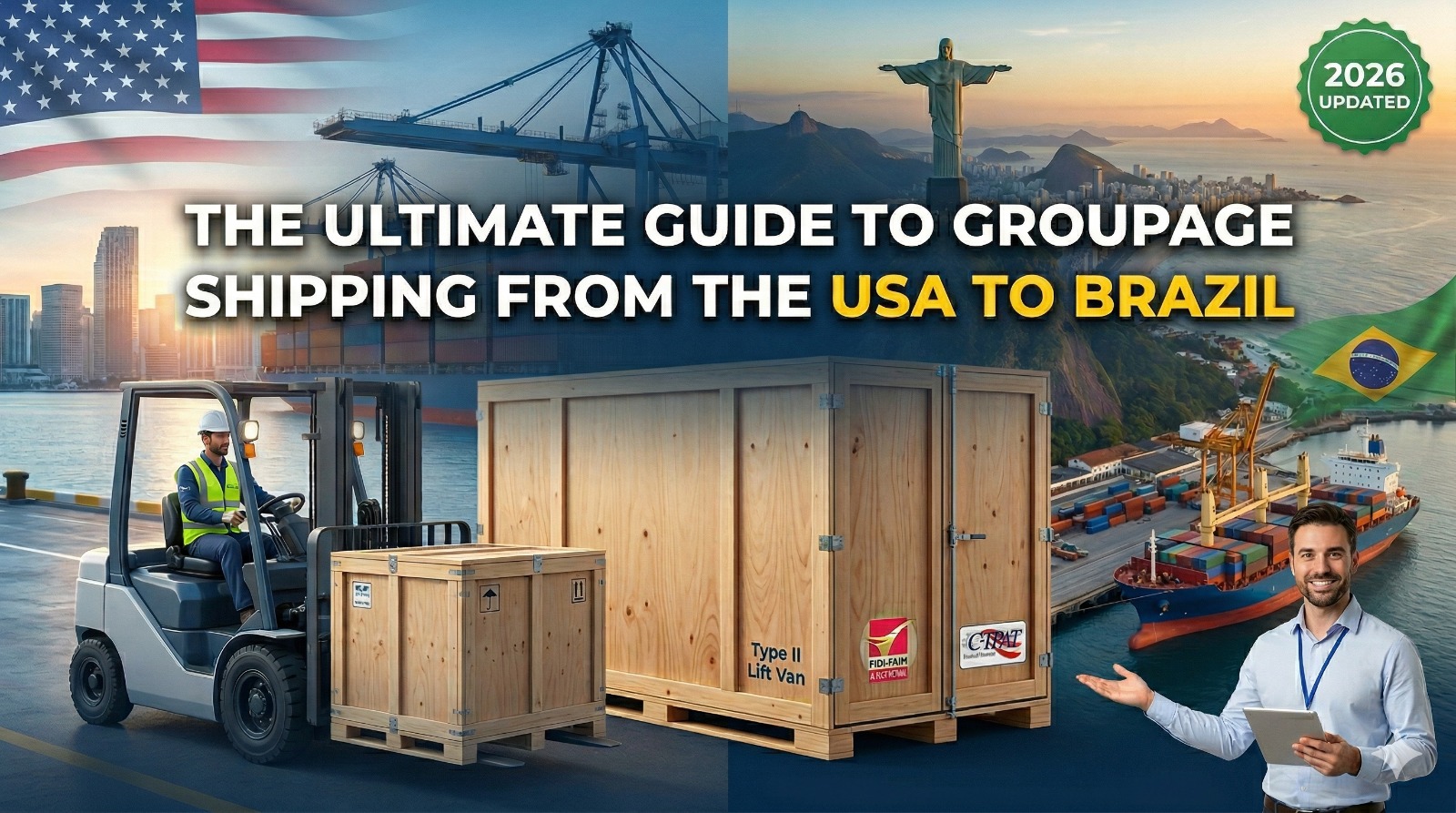
The Ultimate Guide to Groupage Shipping from the USA to Brazil
Everything you need to know about shared container shipping, bagagem desacompanhada customs provisions, Siscomex filing, Brazil’s 2026 tax reform, and Nobel’s certified process for relocating to Brazil.
C-TPAT Trusted Trader
FMC Licensed OTI
Licensed Despachante Aduaneiro Network
In This Guide
- Introduction: The USA-Brazil Relocation Corridor in 2026
- Understanding Groupage Shipping in 2026
- The Lift Van Advantage
- Nobel’s Expertise and Dedicated Coordination
- The USA-Brazil Corridor: Customs, Ports and Transit
- Costs, Insurance and the Value Equation
- Your Step-by-Step Timeline with Nobel
- Authoritative Resources
- Glossary of Key Terms
- Frequently Asked Questions
- About Nobel Relocations
Introduction: The USA-Brazil Relocation Corridor in 2026
Brazil is a dynamic and complex destination for international household goods shipments from the United States. Whether you are a Brazilian citizen returning after years abroad, a foreign professional relocating to São Paulo or Rio de Janeiro, or a family reuniting across the Americas, the journey for your personal effects involves navigating what is widely regarded as one of the world’s most intricate customs environments.
In 2026, that environment is undergoing structural change. Brazil’s landmark tax reform — replacing multiple overlapping indirect taxes (PIS, COFINS, IPI, ICMS, and ISS) with the consolidated IBS (Imposto sobre Bens e Serviços) and CBS (Contribuição sobre Bens e Serviços) — has reshaped the duty calculation framework for imported goods. For personal effects shipments, understanding how the reform interacts with the bagagem desacompanhada exemption framework is now essential. At the same time, the U.S. Customs and Border Protection (CBP) March 2026 IOR verification update has introduced new compliance requirements on the American export side.
Nobel Relocations has the expertise, the Brazilian customs broker network, and the FIDI-FAIM certification to manage both sides of this equation — ensuring your goods arrive correctly declared, cleared at the best available duty rate, and delivered safely to your Brazilian address.
Why Groupage for Brazil?
Most individual household moves to Brazil — typically under 800 cubic feet — do not fill a dedicated container. Nobel’s groupage model consolidates multiple clients’ sealed Lift Vans into a single container, spreading ocean freight costs without compromising on security or white-glove handling standards. Given the complexity of Brazilian customs, having a specialist mover manage the entire consolidation loop is not a luxury — it is a risk management decision.
Section 1: Understanding Groupage Shipping in 2026
True Groupage vs. Standard LCL
Standard LCL shipping consolidates your household goods loosely with commercial freight at a public Container Freight Station — no dedicated handling team, no accountability for positioning or packing standards, and no single party managing the full consolidation chain.
Nobel’s True Groupage service controls every step: volume assessment, Lift Van construction and packing at our own CFS, container loading and documentation, and delivery coordination at destination. Your effects travel in a sealed, individually identified Lift Van — never mixed with commercial freight. Every shipment meets FIDI-FAIM 3.4 quality standards.
The March 2026 CBP IOR Update
CBP’s March 2026 Importer of Record verification update has created “Consolidation Holds” for containers where IOR documentation is incomplete — delays that affect every household sharing a container. Nobel’s in-house compliance team and C-TPAT trusted trader status ensures our containers process without this risk.
Nobel’s Verified Certifications
✓ FIDI-FAIM 3.4
Independently audited quality standard
✓ FMC Licensed OTI
Verifiable at fmc.dot.gov
✓ C-TPAT Trusted Trader
U.S. CBP expedited processing
✓ IAM Member
International Association of Movers
Section 2: The Lift Van Advantage — Critical at Santos
What Is a Lift Van?
A Lift Van is a custom-built wooden crate — approximately 7 feet long by 4 feet wide by 6 feet tall (~170 cubic feet) — that houses one household’s personal effects as a sealed, individually identified unit throughout the entire shipment. Nobel uses Type II Lift Vans built from FSC-certified timber compliant with ISPM 15 heat-treatment standards. Brazil enforces ISPM 15: non-compliant wooden packaging is subject to fumigation, re-export, or destruction at port.
Why Lift Vans Matter More at the Port of Santos
The Port of Santos has physical examination rates for personal effects containers that can reach 20-30% of shipments. In a standard LCL container, a customs examination hold affects every shipper in the box. With Nobel’s Lift Van system:
- Each household’s goods are examined individually — other families’ Lift Vans can be released while one is under examination
- The sealed, tamper-evident Lift Van provides physical evidence of the goods’ undisturbed condition from packing to examination
- Nobel’s detailed inventory documentation — prepared before departure — gives Receita Federal officers a complete reference against which to assess the shipment
- FSC-certified, ISPM 15-compliant timber eliminates the risk of wooden packaging seizure at Santos
Section 3: Nobel’s Expertise — Documentation and Dedicated Coordination
Accurate Volume Assessment and Inventory Preparation
Nobel’s experienced move consultants conduct thorough surveys to produce an accurate cubic footage estimate and detailed itemised inventory. For Brazil, this inventory is not simply a packing list — it is the primary document reviewed by Receita Federal officers during the Siscomex customs assessment, and its accuracy directly affects duty determination and the probability of physical examination.
Your Dedicated Nobel Coordinator and Despachante Network
Brazil requires that all import customs declarations be filed by a licensed despachante aduaneiro (customs broker). Nobel maintains a vetted network of licensed despachantes at the Port of Santos and other Brazilian ports. Your coordinator oversees:
- Bagagem desacompanhada documentation: CPF registration, proof of residence abroad, itemised inventory, and declaration of return date
- Siscomex filing: Electronic Declaração de Importação (DI) filed by Nobel’s licensed despachante ahead of vessel arrival
- Receita Federal liaison: Managing any queries or examination orders from Brazilian customs authorities
- Delivery coordination throughout Brazil — São Paulo, Rio de Janeiro, Brasília, Belo Horizonte, and beyond
Section 4: The USA-Brazil Corridor — Customs, Ports and Transit
Bagagem Desacompanhada: Brazil’s Personal Effects Framework
Bagagem desacompanhada — “unaccompanied baggage” — is the Brazilian customs framework governing household goods that arrive by sea freight separately from their owner. Under this framework, returning Brazilian citizens and qualifying foreign residents may import used personal effects at reduced or nil duty rates, provided the declaration is made through Siscomex by a licensed despachante and the shipment meets Receita Federal eligibility criteria.
Key eligibility requirements under current Receita Federal guidance:
- The applicant must be a returning Brazilian citizen or qualifying foreign resident transferring habitual residence to Brazil
- Goods must be used personal effects owned and used by the applicant — not new goods in original packaging
- The declaration must be made through Siscomex within the timeframe specified by Receita Federal from the date of the applicant’s return
- The CPF (Cadastro de Pessoas Físicas — Brazilian tax ID) must be active and in good standing
⚠ Brazil’s 2026 Tax Reform: What Changes for Household Goods
Brazil’s 2026 tax reform replaces PIS, COFINS, IPI, ICMS, and ISS with consolidated IBS and CBS. The personal effects exemption under bagagem desacompanhada has been preserved for qualifying returning citizens. However, any items not qualifying — new goods, commercial items — are now assessed under the IBS/CBS framework, which changes the calculation basis. Nobel’s despachante network is fully current on 2026 reform implications for every declaration.
Port of Santos: Brazil’s Primary Gateway
The Port of Santos — the largest port in Latin America — handles the overwhelming majority of household goods shipments from the United States to Brazil. Key 2026 operational facts:
- Physical examination rate: Receita Federal examination rates at Santos for personal effects range from 20-30% depending on documentation quality and risk profiling
- Dwell time: Standard Siscomex processing is 5-10 business days after vessel arrival; physical examination adds 5-14 days
- Documentation quality is paramount: Complete, accurate, professionally prepared declarations consistently result in faster clearance and lower examination rates
- Rio de Janeiro (Port of Rio): Available as an alternative for shipments destined for Rio state; Nobel can route accordingly
Transit Times: USA to Brazil (2026)
| Route | Transit Time |
|---|---|
| New York / New Jersey to Port of Santos | 14-18 calendar days |
| US Gulf Coast ports to Port of Santos | 10-14 calendar days |
| Total door-to-door (customs clearance and delivery) | 6-10 weeks |
Prohibited and Restricted Items: Brazil-Specific Rules
- Firearms and ammunition: Prohibited without Exercito Brasileiro (Brazilian Army) import permits obtained well in advance
- New goods in original packaging: Not eligible for bagagem desacompanhada exemption — subject to full Brazilian import duties under the 2026 tax reform framework
- Medications: Controlled substances require ANVISA (Brazilian health authority) import authorisation
- Plants and agricultural products: Subject to MAPA (Ministry of Agriculture) phytosanitary inspection
- Electronic equipment: Brazil operates on a mixed voltage system (127V and 220V depending on region) — confirm voltage compatibility for all appliances
- Alcoholic beverages: Limited quantities permitted under personal effects rules; large quantities attract standard import duties
Section 5: Costs, Insurance and the Value Equation
A Nobel groupage quote for the USA-Brazil corridor is based on cubic footage and encompasses:
- Origin packing, Lift Van construction, and CFS loading
- Ocean freight — your proportional share of container costs
- Bagagem desacompanhada documentation and Siscomex DI filing via Nobel’s licensed despachante
- Port handling charges at Santos
- Brazilian customs clearance fees (excluding duties on non-exempt items)
- Final delivery to your Brazilian address
Nobel strongly recommends All Risk marine cargo insurance. Brazil’s customs examination process — involving physical inspection of Lift Van contents — adds a handling event that makes comprehensive cover particularly important. Insure at full replacement value in the Brazilian market, not depreciated US value.
Section 6: Your Step-by-Step Timeline with Nobel
Contact Nobel Relocations. A specialist coordinator will assess your bagagem desacompanhada eligibility, explain the groupage process, and arrange a thorough volume survey.
Receive your detailed volume estimate and itemised quote, with a clear breakdown of Brazilian documentation requirements.
Confirm booking and provide your CPF, residence proof, and return documentation. Nobel’s compliance team begins preparing the Siscomex DI filing package with your despachante aduaneiro.
Nobel’s pack team arrives at your US address. Goods packed into your dedicated Lift Van(s), sealed, and transported to Nobel’s CFS.
Container loaded and Bill of Lading issued. Your coordinator confirms sailing date and estimated arrival at the Port of Santos.
Shipment in transit. Nobel’s despachante files the Siscomex Declaração de Importação ahead of vessel arrival to minimise Santos port dwell time.
Customs clearance at Santos. Nobel’s despachante manages Receita Federal assessment. Your coordinator provides regular updates throughout the clearance process.
Delivery to your Brazilian address. Nobel’s local partners unpack your Lift Van, place items in designated rooms, and remove all packing materials.
Section 7: Authoritative Resources and Regulatory References
- FIDI Global Alliance (fidi.org): FAIM 3.4 quality standard — verify Nobel’s certification directly
- Federal Maritime Commission (fmc.dot.gov): Verify Nobel’s OTI licence
- CBP C-TPAT Program (cbp.gov): US trusted trader status and 2026 IOR verification update
- Receita Federal do Brasil (gov.br/receitafederal): Official guidance on bagagem desacompanhada and Siscomex declarations
- International Maritime Organization (imo.org): IMO 2026 container safety and VGM rules
Glossary of Key Terms
| Term | Definition |
|---|---|
| Bagagem Desacompanhada | Brazilian customs framework for unaccompanied personal baggage arriving by sea freight — allows returning citizens to import used effects at reduced or nil duty rates. |
| Siscomex | Sistema Integrado de Comércio Exterior — Brazil’s mandatory electronic trade and customs filing platform. All import declarations are filed through Siscomex. |
| Declaração de Importação (DI) | The formal Brazilian import declaration filed through Siscomex by the licensed despachante aduaneiro for all incoming household goods. |
| Despachante Aduaneiro | Licensed Brazilian customs broker required by law to file all import declarations, including bagagem desacompanhada declarations, through Siscomex. |
| Receita Federal | Brazil’s Federal Revenue authority — the customs and tax body that processes all import declarations and conducts physical examinations at Brazilian ports. |
| CPF | Cadastro de Pessoas Físicas — Brazil’s individual taxpayer registry number, required for all customs declarations by individuals. |
| IBS / CBS | The new consolidated taxes introduced under Brazil’s 2026 tax reform, replacing PIS, COFINS, IPI, ICMS, and ISS for most goods transactions. |
| Port of Santos | Latin America’s largest port, near São Paulo — the primary gateway for household goods shipments from the USA to Brazil. |
| Lift Van | Custom-built wooden crate (~170 cubic feet) protecting one household’s personal effects in a shared container. |
| Groupage | Consolidation of multiple households’ goods into one shared container, each in separate sealed Lift Vans. |
| FIDI-FAIM 3.4 | International quality standard for moving companies — independently audited by the FIDI Global Alliance. |
| C-TPAT | Customs-Trade Partnership Against Terrorism — US CBP trusted trader programme giving Nobel expedited export processing. |
| IOR | Importer of Record — the party legally responsible for customs compliance on imported goods. |
| ISPM 15 | International standard requiring heat treatment and certified stamping of wooden packaging — enforced at all Brazilian ports. |
| CFS | Container Freight Station — Nobel’s bonded facility where Lift Vans are loaded and containers sealed for export. |
Frequently Asked Questions
What is bagagem desacompanhada and how does it work for shipping to Brazil?
Bagagem desacompanhada is the Brazilian customs framework for unaccompanied household goods arriving by sea. Returning Brazilian citizens and qualifying foreign residents may import used personal effects at reduced or nil duty rates. Nobel’s licensed despachante aduaneiro manages the Siscomex declaration and Receita Federal documentation.
What is Siscomex and why does it matter for my shipment to Brazil?
Siscomex is Brazil’s mandatory electronic customs filing platform. All import declarations must be filed as a Declaração de Importação (DI) by a licensed despachante before goods can clear at Santos. Nobel’s despachante network files ahead of vessel arrival to minimise port dwell time.
How long does groupage shipping from the USA to Brazil take in 2026?
New York / New Jersey to Port of Santos is 14-18 calendar days. US Gulf Coast to Santos is 10-14 days. Total door-to-door including customs clearance and delivery is typically 6-10 weeks from US origin collection.
How does Brazil’s 2026 tax reform affect household goods shipments?
Brazil’s 2026 reform consolidates PIS, COFINS, IPI, ICMS, and ISS into IBS and CBS. The bagagem desacompanhada exemption is preserved for qualifying returning citizens. Non-exempt items — new goods, commercial items — are assessed under the new IBS/CBS framework. Nobel’s despachante network is fully current on 2026 reform implications.
What is a despachante aduaneiro and why is one required for shipping to Brazil?
A despachante aduaneiro is a licensed Brazilian customs broker required by law to file all import declarations through Siscomex. Nobel maintains a vetted network of licensed despachantes at Santos and other Brazilian ports who handle all Receita Federal correspondence on behalf of our clients.
Ready to Plan Your Move to Brazil?
Speak With a Nobel Groupage Specialist Today
Brazil’s customs environment is among the most complex in the world. The experts at Nobel Relocations — backed by FIDI-FAIM certification and a licensed despachante network — handle every detail. Contact us today to discuss your groupage shipping requirements to Brazil.
www.nobelrelocations.com
About Nobel Relocations
Nobel Relocations is a specialist international moving company with deep expertise in household goods shipments across the world’s most demanding corridors. Our dedicated coordinators, in-house compliance team, and vetted network of international customs agents — including licensed despachantes aduaneiros throughout Brazil — deliver white-glove service on every shipment.
Nobel is certified to FIDI-FAIM 3.4 standards, verifiable at fidi.org. We hold an FMC Ocean Transportation Intermediary licence and C-TPAT trusted trader status with U.S. Customs and Border Protection. Our expertise in Brazilian customs compliance — including the 2026 tax reform and bagagem desacompanhada framework — makes Nobel the trusted choice for anyone shipping household goods from the United States to Brazil.
Nobel Relocations. Moving Lives. Protecting Legacies.