<!– PASTE INSTRUCTIONS:
1. Add a Custom HTML block in WordPress (Gutenberg) or switch to Text tab (Classic Editor)
2. Paste this entire file into the post body
3. The JSON-LD
Nobel Relocations | 2026 Edition
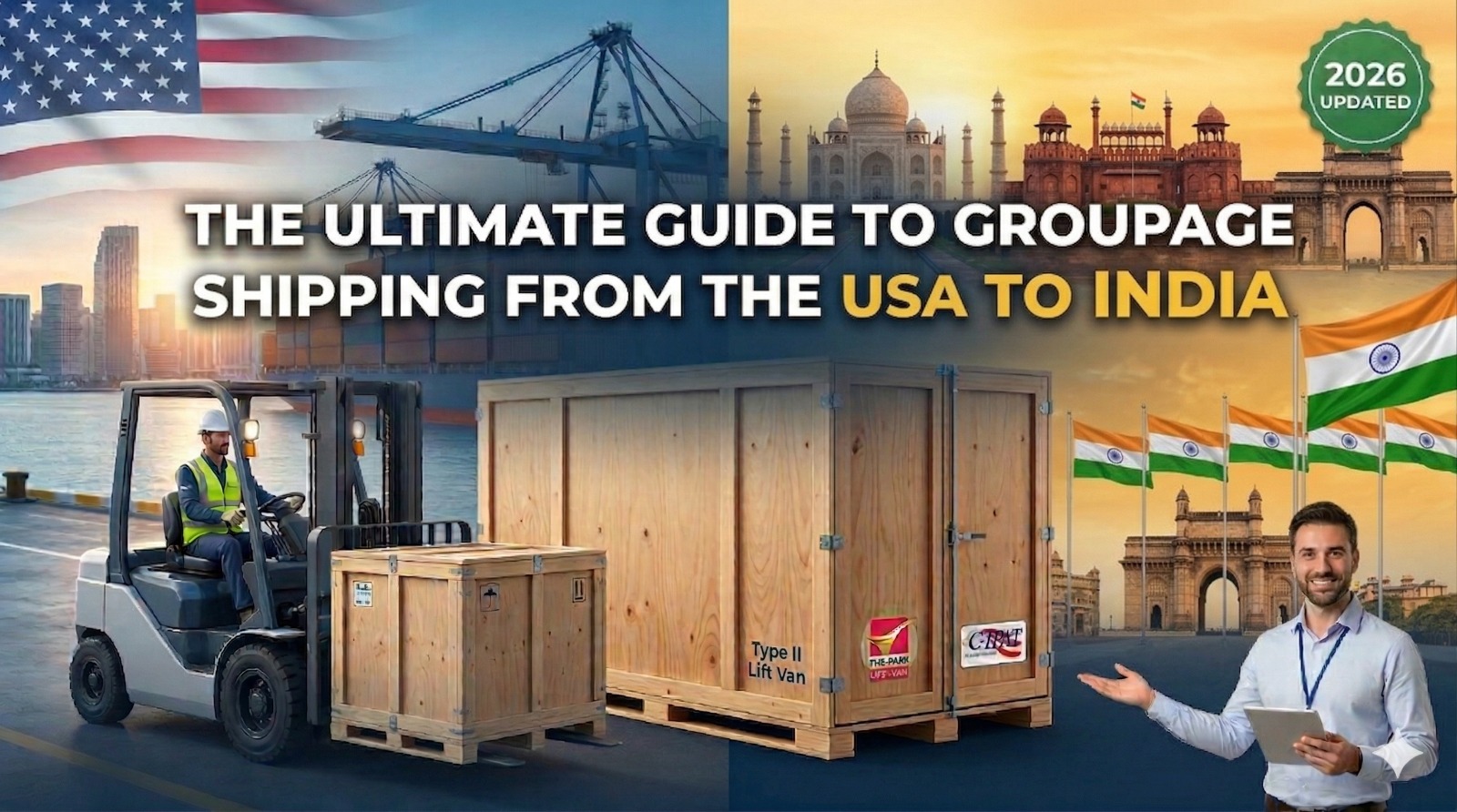
The Ultimate Guide to Groupage Shipping from the USA to India
Everything you need to know about shared container shipping, Transfer of Residence customs provisions, Lift Van technology, and Nobel's certified process for relocating from the United States to India.
C-TPAT Trusted Trader
FMC Licensed OTI
CBIC Licensed Indian Customs Agents
In This Guide
- Introduction: The USA-India Relocation Corridor in 2026
- Understanding Groupage Shipping in 2026
- The Lift Van Advantage
- Nobel's Expertise and Dedicated Coordination
- The USA-India Corridor: Customs, Ports and Transit
- Costs, Insurance and the Value Equation
- Your Step-by-Step Timeline with Nobel
- Authoritative Resources
- Glossary of Key Terms
- Frequently Asked Questions
- About Nobel Relocations
Introduction: The USA-India Relocation Corridor in 2026
India is one of the most significant destinations for international household goods shipments originating in the United States. Whether you are an NRI returning after years abroad, a professional completing a multi-year assignment, or a family reuniting across continents, moving your personal effects from the US to India means navigating one of the world's more demanding customs environments.
In 2026, India's ICEGATE electronic customs platform is fully operational across all major ports, and the Central Board of Indirect Taxes and Customs (CBIC) has refined its guidance on Transfer of Residence (TR) provisions — the most powerful duty-relief tool available to returning residents. Simultaneously, the U.S. Customs and Border Protection (CBP) March 2026 Importer of Record (IOR) verification update has introduced new compliance requirements on the American export side that directly affect personal effects consolidations at US ports.
This guide is Nobel Relocations' definitive 2026 reference for the USA-India groupage corridor. It covers the shared container model that makes the move affordable, the Lift Van technology that protects your goods, and the specific customs procedures that determine what you pay — and what you don't.
Why Groupage? The Cost-Smart Choice for 2026
Most individual household moves to India — typically under 800 cubic feet — do not justify the cost of a dedicated full container. Nobel's groupage model consolidates multiple clients' Lift Vans into a single container, spreading ocean freight costs while maintaining complete separation between shipments. The result is white-glove international moving at a fraction of the full-container price.
Section 1: Understanding Groupage Shipping in 2026
True Groupage vs. Standard LCL: A Critical Distinction
Standard LCL shipping consolidates your goods loosely with commercial freight from multiple shippers at a public Container Freight Station — no dedicated handling team, no single party controlling the consolidation loop.
True Groupage, as practised by Nobel Relocations, is a specialist residential moving service. Nobel controls every step: volume assessment, Lift Van construction at our own CFS, container loading, documentation, and destination delivery. Your effects never mix with commercial freight, and every shipment meets FIDI-FAIM 3.4 quality standards.
The March 2026 CBP IOR Update
CBP's March 2026 Importer of Record verification update has created "Consolidation Holds" for containers where IOR documentation cannot be immediately verified — delays that affect every household in a shared container. Nobel's in-house compliance team and C-TPAT trusted trader status ensures our containers clear without this risk.
Nobel's Verified Certifications
✓ FIDI-FAIM 3.4
Independently audited quality standard
✓ FMC Licensed OTI
Verifiable at fmc.dot.gov
✓ C-TPAT Trusted Trader
U.S. CBP expedited processing
✓ IAM Member
International Association of Movers
Section 2: The Lift Van Advantage — Security on the Long India Run
What Is a Lift Van?
A Lift Van is a custom-built wooden crate — approximately 7 feet long by 4 feet wide by 6 feet tall (~170 cubic feet) — that houses one household's entire personal effects as a sealed, individually identified unit. Nobel uses Type II Lift Vans constructed from FSC-certified timber compliant with ISPM 15 heat-treatment standards. India enforces ISPM 15 strictly: non-compliant wooden packaging is subject to treatment, re-export, or destruction at port. Every Nobel Lift Van arrives fully compliant.
Protection That Standard LCL Cannot Provide
- Individually numbered and documented on the Bill of Lading
- Sealed with tamper-evident security banding at Nobel's Container Freight Station
- Braced within the container to prevent shifting during the long Pacific or Atlantic voyage
- Subject to individual CBIC examination if selected — without triggering delays for other families
Why this matters at Indian ports: JNPT can order physical examination of containers at higher rates than many Western ports. The Lift Van system means a customs examination of one household's goods does not delay the release of others sharing the same container.
Section 3: Nobel's Expertise — Documentation and Dedicated Coordination
Accurate Volume Assessment
Nobel's experienced move consultants conduct thorough surveys to produce an accurate cubic footage estimate and a detailed itemised inventory — the primary document reviewed by CBIC officers during TR customs assessment. Accuracy at this stage prevents over-volume surcharges at Indian ports and ensures your customs filing reflects reality.
Your Dedicated Nobel Coordinator
From booking, you have a single named coordinator managing your shipment end to end:
- TR documentation package: Passport copies, visa history, foreign residence proof, itemised inventory for CBIC submission
- Licensed C&F agent liaison: Nobel's Indian customs broker network handles ICEGATE Bill of Entry filing at JNPT, Chennai, or Mundra
- Sailing and container loading confirmation
- Delivery coordination to Mumbai, Delhi, Bengaluru, Chennai, Hyderabad, Pune, and beyond
Section 4: The USA-India Corridor — Customs, Ports and Transit
Transfer of Residence (TR): India's Most Valuable Duty Relief
The Transfer of Residence (TR) provision under India's Customs Act 1962 allows individuals who have lived outside India for at least two years to import their used household goods at concessional or nil duty rates. Qualifying correctly for TR is one of the primary reasons working with a specialist mover is essential on this corridor.
Key TR eligibility conditions under current CBIC guidance:
- Minimum two years of continuous residence outside India immediately before return
- Goods must be the applicant's own used personal effects — not new items in original packaging
- TR benefit not availed in the preceding three years
- Genuine transfer of residence — temporary visits do not qualify
- All goods must arrive within six months of the applicant's arrival in India
⚠ Critical Timing: Six-Month Window
India's TR provisions require household goods to arrive within six months of your own arrival. Missing this window results in standard import duties being applied. Nobel calculates sailing schedules to meet this requirement and advises on the Commissioner's extension process where necessary.
Indian Ports: JNPT, Chennai, and Mundra
| Port | Serves | Notes |
|---|---|---|
| JNPT (Nhava Sheva) | Mumbai, Pune, Delhi, North & West India | Primary hub — highest frequency of Nobel sailings |
| Chennai Port | Chennai, Bengaluru, Hyderabad, South India | Preferred for South India destinations |
| Mundra Port | Ahmedabad, Gujarat, Rajasthan | Growing alternative for western India |
Transit Times: USA to India (2026)
| Route | Transit Time |
|---|---|
| New York / New Jersey to JNPT | 28-35 calendar days |
| Los Angeles / Long Beach to JNPT | 18-24 calendar days |
| Either coast to Chennai Port | Add 3-5 days to above |
| Total door-to-door (customs clearance and delivery) | 8-14 weeks |
Prohibited and Restricted Items: India-Specific Rules
- Firearms: Prohibited without specific Indian government import permits
- Satellite phones: Prohibited under Indian telecommunications law
- Gold and silver bullion: Restricted — limits apply and must be declared
- New goods in original packaging: Do not qualify for TR concessional duty
- Certain pharmaceuticals: Require medical documentation and import licences
- Electronic equipment: India operates on 230V/50Hz — US 110V appliances require transformers
Section 5: Costs, Insurance and the Value Equation
A Nobel groupage quote for the USA-India corridor is based on cubic footage and encompasses:
- Origin packing, Lift Van construction, and CFS loading
- Ocean freight — your proportional share of container costs
- TR documentation preparation and ICEGATE filing support
- Port handling charges at JNPT, Chennai, or Mundra
- Indian customs clearance fees (excluding duties on non-TR items)
- Final delivery to your Indian address
Nobel strongly recommends All Risk marine cargo insurance at full replacement value in India. The USA-India transit involves extended voyage times and multiple handling points. Insure at what it would cost to replace each item new in the Indian market — not depreciated US value.
Section 6: Your Step-by-Step Timeline with Nobel
Contact Nobel Relocations. Speak with a specialist coordinator who will assess your TR eligibility, explain the groupage process, and arrange a detailed volume survey of your household goods.
Receive your detailed volume estimate and itemised quote, including a review of TR documentation requirements specific to your situation.
Confirm your booking and provide TR documentation. Nobel's compliance team begins preparing the complete CBIC submission package with your licensed Indian C&F agent.
Nobel's pack team arrives at your US address. Goods are packed into your dedicated Lift Van(s), sealed, and transported to Nobel's Container Freight Station.
Container loaded, Bill of Lading issued. Your coordinator confirms vessel name, sailing date, and estimated arrival at your chosen Indian port.
Shipment in transit. Nobel monitors the voyage and prepares the ICEGATE Bill of Entry ahead of vessel arrival to minimise dwell time at port.
Customs clearance at Indian port. Nobel's licensed C&F agent manages CBIC assessment. TR-eligible shipments are cleared at concessional or nil duty. Your coordinator provides regular updates.
Delivery to your Indian address. Nobel's vetted local delivery team unpacks your Lift Van, places items in designated rooms, and removes all packing materials.
Section 7: Authoritative Resources and Regulatory References
- FIDI Global Alliance (fidi.org): FAIM 3.4 quality standard — verify Nobel's certification directly
- Federal Maritime Commission (fmc.dot.gov): Verify Nobel's OTI licence in the public database
- CBP C-TPAT Program (cbp.gov): US trusted trader status and 2026 IOR verification update
- Central Board of Indirect Taxes and Customs — CBIC (cbic.gov.in): Official Indian customs guidance including TR provisions
- ICEGATE (icegate.gov.in): India's electronic customs gateway for Bill of Entry filing
- International Maritime Organization (imo.org): IMO 2026 container safety and VGM rules
Glossary of Key Terms
| Term | Definition |
|---|---|
| Transfer of Residence (TR) | India Customs Act 1962 provision allowing returning residents to import used household goods at concessional or nil duty rates after residing abroad for at least two years. |
| CBIC | Central Board of Indirect Taxes and Customs — India's customs authority governing all import declarations and duty assessments. |
| ICEGATE | Indian Customs Electronic Gateway — mandatory platform for all customs declarations including Bills of Entry for personal effects. |
| Bill of Entry (BoE) | The formal customs declaration filed through ICEGATE for all goods arriving in India. |
| C&F Agent | Clearing and Forwarding Agent — CBIC-licensed customs broker managing port clearance and ICEGATE filings in India. |
| JNPT (Nhava Sheva) | Jawaharlal Nehru Port Trust, Mumbai — India's primary deep-water container port and main gateway for household goods. |
| NRI | Non-Resident Indian — an Indian citizen residing outside India, typically eligible for TR provisions on return. |
| Groupage | Consolidation of multiple households' goods into one shared container, each household's effects kept separate within Lift Vans. |
| Lift Van | Custom-built wooden crate (~170 cubic feet) protecting one household's personal effects within a shared container. |
| LCL | Less than Container Load — standard freight term for shipments that do not fill a full container. |
| CFS | Container Freight Station — Nobel's bonded facility where Lift Vans are loaded and containers sealed. |
| FIDI-FAIM 3.4 | International quality standard for moving companies administered by the FIDI Global Alliance — requires independent annual auditing. |
| C-TPAT | Customs-Trade Partnership Against Terrorism — US CBP trusted trader programme giving Nobel expedited export processing. |
| IOR | Importer of Record — party legally responsible for customs compliance on imported goods. |
| ISPM 15 | International standard for wooden packaging — requires heat treatment and certified stamping, strictly enforced at Indian ports. |
Frequently Asked Questions
What is Transfer of Residence (TR) and how does it reduce customs duties when shipping to India?
TR is a provision under India's Customs Act 1962 allowing individuals who have lived abroad for at least two years to import used household goods at concessional or nil duty rates. Nobel prepares all TR documentation, coordinates with CBIC-licensed C&F agents, and manages ICEGATE filing for a smooth clearance.
How long does groupage shipping from the USA to India take in 2026?
East Coast US to JNPT is 28-35 calendar days; West Coast is 18-24 days. Door-to-door including customs and delivery is typically 8-14 weeks from origin collection.
What is ICEGATE and how does it affect my shipment to India?
ICEGATE is India's mandatory electronic customs filing system. All import declarations must be filed as a Bill of Entry before goods can clear. Nobel's licensed C&F agents manage ICEGATE filing ahead of vessel arrival to minimise port dwell time.
Which Indian ports handle household goods shipments from the USA?
JNPT (Nhava Sheva, Mumbai) is the primary port. Chennai Port serves South India. Mundra Port serves western India including Gujarat. Nobel delivers from all three ports throughout India.
What items are prohibited when shipping household goods to India?
India prohibits firearms without government permits, satellite phones, and certain pharmaceuticals without documentation. Gold and silver bullion require declaration. New goods in original packaging do not qualify for TR concessional duty. India operates on 230V/50Hz — US 110V appliances need transformers.
Ready to Plan Your Move to India?
Speak With a Nobel Groupage Specialist Today
Navigating Transfer of Residence provisions, ICEGATE compliance, and Indian port logistics requires specialist expertise. The experts at Nobel Relocations handle it all — contact us today to discuss your groupage shipping to India.
www.nobelrelocations.com
About Nobel Relocations
Nobel Relocations is a specialist international moving company with deep expertise in household goods shipments across the world's most demanding corridors. Our dedicated coordinators, in-house compliance team, and vetted network of international customs agents — including CBIC-licensed C&F agents throughout India — deliver white-glove service on every shipment.
Nobel is certified to FIDI-FAIM 3.4 standards, verifiable at fidi.org. We hold an FMC Ocean Transportation Intermediary licence and C-TPAT trusted trader status with U.S. Customs and Border Protection. Our expertise in Transfer of Residence compliance makes Nobel the trusted choice for NRIs and returning residents shipping from the United States to India.
Nobel Relocations. Moving Lives. Protecting Legacies.