Nobel Relocations | 2026 Edition
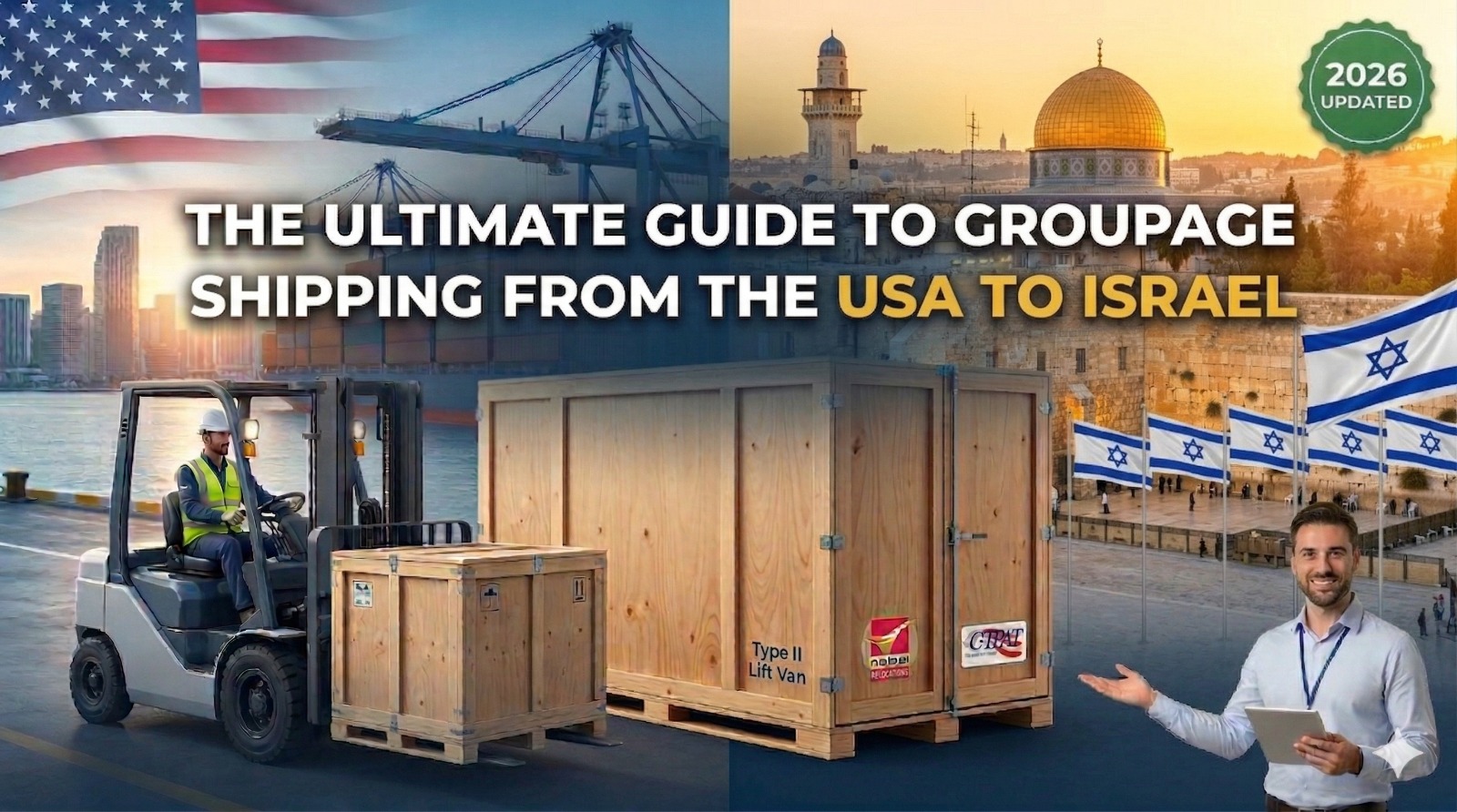
The Ultimate Guide to Groupage Shipping from the USA to Israel
Everything you need to know about shared container shipping, Teudat Oleh customs benefits, Lift Van technology, and Nobel’s certified process for the world’s most specialised relocation corridor.
C-TPAT Trusted Trader
FMC Licensed OTI
98%+ Teudat Oleh Clearance Rate
In This Guide
- Introduction: The USA–Israel Relocation Corridor in 2026
- Understanding Groupage Shipping in 2026
- The Lift Van Advantage — Security Inside a Shared Container
- Nobel’s Expertise & Client Process
- The USA–Israel Corridor — Customs, Ports & Transit
- Costs, Insurance & the Value Equation
- Your Step-by-Step Timeline with Nobel
- Authoritative Resources & Regulatory References
- Glossary of Key Terms
- Frequently Asked Questions
- About Nobel Relocations
Introduction: The USA–Israel Relocation Corridor in 2026
Moving from the United States to Israel is one of the most emotionally significant and logistically complex relocations a family can undertake. Whether you are making Aliyah under the Law of Return, accepting a professional assignment in Tel Aviv, or returning to family in Jerusalem, the shipping of your personal effects involves a web of Israeli customs law, port logistics, and carrier relationships that demand specialised expertise.
In 2026, that complexity has deepened. The Israel Customs Authority (ICA) has fully integrated its ASYCUDA World electronic filing platform, meaning all shipments must arrive with complete pre-clearance documentation before the vessel calls at the Port of Haifa. Simultaneously, the U.S. Customs and Border Protection (CBP) March 2026 Importer of Record (IOR) verification update has created new compliance checkpoints on the American export side — checkpoints that Nobel Relocations is uniquely positioned to navigate.
This guide is Nobel Relocations’ definitive 2026 reference for this corridor. It covers the groupage shipping model that makes international moves affordable, the Lift Van technology that keeps your belongings secure inside a shared container, the digital tools that give you real-time transparency, and the specific customs procedures — including the all-important Teudat Oleh benefit — that shape every shipment we manage to Israel.
Why Groupage? The Cost-Smart Choice for 2026
With full-container ocean freight costs elevated by 2025–2026 supply chain pressures, most individual household moves under 1,000 cubic feet do not justify the cost of a dedicated 20-foot container. Nobel’s groupage model consolidates multiple clients’ Lift Vans into a single container — spreading the ocean freight cost while maintaining complete separation and security for each household’s goods. The result: white-glove international moving at a fraction of the full-container price.
Section 1: Understanding Groupage Shipping in 2026
True Groupage vs. Standard LCL: A Critical Distinction
The terms “groupage” and “LCL” (Less than Container Load) are frequently used interchangeably in the shipping industry, but they represent fundamentally different service levels — a distinction that matters enormously when your irreplaceable household goods and personal documents are in transit across the Atlantic.
Standard LCL shipping is a commodity freight service. Your boxes are handed to a freight forwarder, consolidated loosely with commercial cargo from dozens of other shippers, and packed into a container at a public Container Freight Station (CFS). There is no dedicated handling team, no accountability for how goods are positioned relative to heavy commercial freight, and no single party controlling the entire consolidation loop.
True Groupage, as practised by Nobel Relocations, is a specialist residential moving service. Nobel controls every step of the consolidation loop: inventory surveys, Lift Van construction and packing at our own facility, container loading, documentation, and destination delivery. Your household effects never mix with commercial freight. Every Nobel shipment is packed to FIDI-FAIM 3.4 quality standards — the international benchmark for the moving industry.
The March 2026 CBP IOR Update: Why Compliance Now Matters More Than Ever
In March 2026, U.S. Customs and Border Protection issued updated guidance on Importer of Record (IOR) verification for outbound personal effects shipments under household goods exemptions. This update requires that the exporting party provide enhanced documentation confirming the identity and eligibility of the IOR for each consolidated shipment.
For uncertified brokers and ad-hoc consolidators, this update has created a new category of port delay known as a “Consolidation Hold.” When CBP cannot immediately verify an IOR, the entire consolidated container can be held at the port of export — delaying not just one client’s shipment, but every household whose goods are packed in the same container.
Nobel Relocations’ in-house compliance team manages IOR documentation as a standard component of every shipment. Our C-TPAT (Customs-Trade Partnership Against Terrorism) trusted trader status means our containers are flagged for expedited processing rather than routine holds.
Nobel’s Verified Certifications
✓ FIDI-FAIM 3.4
International quality standard for movers — independently audited
✓ FMC Licensed OTI
Ocean Transportation Intermediary — verifiable at fmc.dot.gov
✓ C-TPAT Trusted Trader
U.S. CBP expedited processing status
✓ IAM Member
International Association of Movers
Section 2: The Lift Van Advantage — Security Inside a Shared Container
What Is a Lift Van?
A Lift Van is a custom-built wooden crate engineered specifically for the international transport of household goods. Nobel uses Type II Lift Vans — standardised units measuring approximately 7 feet long by 4 feet wide by 6 feet tall, with a capacity of roughly 170 cubic feet. Each Lift Van is the exclusive property of one household for the duration of the shipment.
The Lift Van concept dates to the late 19th century, when trans-Atlantic passenger lines needed a standardised system for moving wealthy passengers’ trunks and furniture. In 2026, the technology has evolved considerably, but the core principle remains: your household goods travel in a dedicated, sealed, individually identifiable unit — not loose inside a shared container.
How Lift Vans Protect Your Belongings
In a Nobel groupage container moving to Israel, a typical 40-foot High Cube container holds between 8 and 14 Lift Vans, depending on each household’s volume. Each van is:
- Individually numbered and documented on the Bill of Lading with a unique Lift Van identifier
- Sealed with security banding and tamper-evident tape before leaving Nobel’s Container Freight Station (CFS)
- Packed by Nobel’s trained relocation specialists using professional packing materials
- Positioned and secured within the container to prevent shifting during the voyage
- Subject to individual customs examination at Haifa — meaning an ICA inspection of your van does not delay the release of other families’ goods
This last point is critical for the Israel corridor. ICA customs examination rates for personal effects can exceed 30%. When goods are packed loose in a standard LCL container, an examination hold affects every shipper in that box. With Nobel’s Lift Van system, inspections are surgical — targeted at individual vans without disrupting the release of cleared shipments.
Sustainability: FSC-Certified Timber and 2026 Compliance
Nobel’s Lift Vans are constructed from FSC (Forest Stewardship Council) certified timber, sourced from sustainably managed forests. All timber complies with the International Plant Protection Convention’s ISPM 15 standard — requiring heat treatment and certified stamping. Non-compliant wooden packaging can be seized and destroyed at the Israeli port of entry.
For shipments transiting through European relay ports, our Lift Vans also align with the EU’s Carbon Border Adjustment Mechanism (CBAM) reporting requirements — now in full effect in 2026. Nobel’s documented timber supply chain meets CBAM traceability standards without requiring any additional action from clients.
Section 3: Nobel’s Expertise — Precision Documentation & Dedicated Coordination
Accurate Volume Assessment: The Foundation of Every Quote
Volume estimation is the foundation of an accurate international moving quote — and nowhere is precision more important than the USA–Israel corridor, where ICA pre-clearance documentation must be submitted before the vessel departs. Nobel’s experienced move consultants conduct thorough in-home or on-site surveys to ensure your cubic footage estimate is accurate before any commitment is made.
A precise survey benefits you in three concrete ways:
- Your quote reflects the actual space your shipment will occupy — no surprise port surcharges for over-volume
- The resulting itemised inventory forms the basis of your ICA customs submission and, where applicable, your Teudat Oleh Hebrew inventory (Reshimat Chafatzim)
- Accurate volume data allows Nobel to allocate the correct number of Lift Vans and confirm your place on the weekly consolidation sailing schedule
Your Dedicated Nobel Coordinator
From the moment your booking is confirmed, you are assigned a dedicated Nobel coordinator who manages every stage of your shipment. This is not a call centre — it is a single, named point of contact who knows your file, understands your timeline, and is accountable for the outcome.
Your coordinator oversees:
- Documentation management: Bill of Lading, packing lists, Teudat Oleh correspondence, and ICA pre-clearance forms
- Sailing schedule confirmation: Vessel booking, container loading, and departure notifications
- Customs liaison: Direct communication with Nobel’s Israeli customs agent throughout the Haifa clearance process
- Delivery coordination: Scheduling and confirming final delivery to your Israeli address
Section 4: The USA–Israel Corridor — Customs, Ports & Transit
The Teudat Oleh Benefit: Your Most Valuable Immigration Asset
For Jewish immigrants making Aliyah — facilitated by the Jewish Agency for Israel and organisations such as Nefesh B’Nefesh — the Teudat Oleh (Certificate of Immigrant) entitles new immigrants to bring their household goods to Israel completely free of customs duties and import taxes, provided specific ICA conditions are met.
The ICA conditions include:
- Goods must be owned and used by the immigrant prior to their Aliyah date
- The shipment must arrive within three years of first entry to Israel under Aliyah status
- A detailed Hebrew inventory must be submitted and ICA pre-approved before the shipment departs the US
- The Teudat Oleh must be valid and the immigrant registered in Israel’s Interior Ministry database
Nobel Relocations has a dedicated Teudat Oleh compliance team with direct working relationships with ICA clearance officers in Haifa. We prepare your Hebrew inventory, coordinate with your Jewish Agency or Nefesh B’Nefesh advisor, obtain ICA pre-approval before your container is loaded, and manage all customs correspondence. Our Teudat Oleh clearance rate exceeds 98% on first submission.
⚠ Critical Timing Alert: ICA Pre-Approval Before Sailing
Unlike many customs regimes where documents are submitted on arrival, ICA requires that Teudat Oleh shipments receive pre-approval before the vessel departs the United States. Nobel begins the ICA pre-approval process 4–6 weeks before your target loading date. Do not book a groupage slot without confirming this lead time with your Nobel coordinator.
Port of Haifa: Israel’s Primary Gateway for Household Goods
The vast majority of household goods shipments to Israel arrive at the Port of Haifa on Israel’s northern Mediterranean coast. Key operational facts for 2026:
- Dwell time after arrival: ICA typically initiates customs processing within 3–5 business days of vessel arrival. Physical examination, when ordered, typically adds 2–4 days.
- Examination rates: Personal effects containers from FIDI-certified movers experience lower examination rates than those from uncertified brokers.
- Jewish holiday scheduling: Nobel’s Israel desk proactively manages port calendars around Jewish holidays, which significantly affect Haifa port operations.
- Onward delivery: Nobel coordinates delivery throughout Israel — Tel Aviv, Jerusalem, Be’er Sheva, Eilat, and all northern and southern regions.
Transit Times: New York to Haifa (2026)
| Route | Transit Time |
|---|---|
| New York to Haifa — direct service | 28–32 calendar days |
| New York to Haifa — via Piraeus or Malta | 34–42 calendar days |
| Total door-to-door (including customs clearance & delivery) | 8–12 weeks |
Prohibited and Restricted Items: Israel-Specific Rules
- Firearms and weapons: Absolutely prohibited without Israeli Police import permits obtained well in advance
- Plants and soil: Prohibited by the Israeli Ministry of Agriculture — Israel’s biosecurity regime is exceptionally strict
- Prescription medications: Should travel in checked baggage with documentation, not in shipped household goods
- Electronic equipment: Israel operates on 220V/50Hz — single-voltage 110V appliances require a transformer
- New items in original packaging: Not eligible for Teudat Oleh relief — subject to standard Israeli import duties
Section 5: Costs, Insurance & the Value Equation
Understanding Your Groupage Quote
A Nobel groupage quote is based primarily on the cubic footage your shipment occupies. It encompasses:
- Origin packing, Lift Van construction, and CFS loading in the United States
- Ocean freight — your proportional share of the container’s total freight cost
- Documentation, Teudat Oleh coordination, and ICA pre-clearance filing
- Port handling charges at Haifa
- Israeli customs clearance fees (excluding any duties on non-Teudat Oleh items)
- Final delivery to your Israeli address
Marine Cargo Insurance: An Essential, Not an Optional Extra
Nobel strongly recommends All Risk marine cargo insurance for all shipments to Israel. All Risk coverage protects your goods against physical loss or damage from any external cause during the entire transit — from packing at your US origin address through to delivery at your Israeli home.
We recommend insuring at full replacement value — the cost to replace each item new in Israel, not depreciated value. Nobel works with specialist marine cargo insurers who understand the household goods sector and the specific risk profile of the Israel corridor.
Section 6: Your Step-by-Step Timeline with Nobel
Here is what a Nobel USA–Israel groupage shipment looks like from first contact to delivery in your Israeli home:
Contact Nobel Relocations to discuss your move. Speak with a specialist coordinator who will guide you through the groupage process and arrange a detailed volume survey of your household goods.
Receive your detailed volume estimate and itemised quote. Nobel’s consultant prepares a thorough inventory that forms the basis of your ICA customs submission and, where applicable, your Teudat Oleh Hebrew inventory.
Confirm your booking and provide Teudat Oleh documentation. Nobel’s compliance team begins ICA pre-clearance preparation immediately.
Nobel’s pack team arrives at your origin address. Goods are packed into your dedicated Lift Van(s), sealed, and transported to Nobel’s New Jersey CFS.
ICA pre-approval received. Your container is loaded, the Bill of Lading is issued, and your coordinator confirms sailing details and your vessel’s estimated arrival at Haifa.
Your shipment is in transit. Your Nobel coordinator monitors the vessel’s Haifa ETA and keeps you informed of progress, preparing customs clearance documentation ahead of arrival.
Customs clearance at Haifa. For Teudat Oleh shipments, clearance typically completes within 5–10 business days of arrival. Nobel’s Israeli customs agent manages the process and communicates milestones directly to your coordinator.
Delivery to your Israeli address. Nobel’s delivery team unpacks your Lift Van, places furniture and boxes in designated rooms, and removes all packing debris. Your new Israeli home is move-in ready.
Section 7: Authoritative Resources & Regulatory References
Nobel encourages all clients to consult primary regulatory sources directly. The following are the key authorities governing USA–Israel household goods shipments:
- FIDI Global Alliance (fidi.org): Administers the FAIM 3.4 quality standard — verify Nobel’s certification directly on the FIDI website
- Federal Maritime Commission (fmc.dot.gov): Licenses Ocean Transportation Intermediaries — Nobel’s OTI status is publicly searchable
- CBP C-TPAT Program (cbp.gov): U.S. Customs trusted trader status and the 2026 IOR verification update
- Israel Customs Authority (gov.il): Official guidance on Teudat Oleh benefits, prohibited imports, and ASYCUDA World declarations
- Nefesh B’Nefesh (nbn.org.il): North America’s primary Aliyah support organisation — detailed guidance on Teudat Oleh pre-immigration planning
- International Maritime Organization (imo.org): IMO 2026 rules on container weight verification (VGM) and mandatory safety reporting
Glossary of Key Terms
| Term | Definition |
|---|---|
| Groupage | The consolidation of multiple households’ goods into a single shared ocean container — each household’s goods packaged separately within the container. |
| LCL (Less than Container Load) | A standard freight term for shipments that do not fill a full container. Nobel’s True Groupage service is a specialist residential form of LCL. |
| Lift Van | A custom-built wooden crate (~170 cubic feet) used to segregate and protect a single household’s personal effects within a shared container. |
| Teudat Oleh | Certificate of Immigrant issued to Jewish immigrants making Aliyah — entitles them to import household goods to Israel free of customs duties under ICA regulations. |
| ICA | Israel Customs Authority — responsible for customs clearance, import duties, and enforcement at all Israeli ports. |
| ASYCUDA World | ICA’s electronic customs declaration platform. All shipments to Israel must be pre-declared before vessel departure. |
| CFS (Container Freight Station) | The bonded warehouse where Nobel’s specialists load and stuff shared containers. Nobel’s primary CFS is in New Jersey. |
| FIDI-FAIM 3.4 | The international quality standard for moving companies, administered by the FIDI Global Alliance — requires independent auditing of operations, finance, and compliance. |
| C-TPAT | Customs-Trade Partnership Against Terrorism — U.S. CBP programme recognising certified companies as trusted traders, entitling them to expedited processing. |
| FMC OTI | Federal Maritime Commission Ocean Transportation Intermediary licence — a legal requirement for companies booking cargo space on US-origin ocean vessels. |
| IOR (Importer of Record) | The party legally responsible for ensuring imported goods comply with all laws and regulations. For household goods, typically the client. |
| ISPM 15 | International Plant Protection Convention standard for wooden packaging in international trade — requires heat treatment and certified stamping to prevent spread of plant pests. |
| TEU | Twenty-foot Equivalent Unit — the standard measure of container capacity. A 40-foot container equals 2 TEU. |
| AEO | Authorised Economic Operator — EU equivalent of C-TPAT, recognising secure and compliant supply chain partners. Relevant to Nobel’s EU transit operations. |
| CBP IOR Update (March 2026) | The CBP regulatory update requiring enhanced Importer of Record verification for personal effects consolidations — managed in-house by Nobel for every shipment. |
Frequently Asked Questions
What is groupage shipping and how does it work for moves from the USA to Israel?
Groupage shipping is the consolidation of multiple households’ personal effects into a single shared ocean container. Nobel Relocations packs each household’s goods into dedicated Type II Lift Vans — sealed wooden crates of approximately 170 cubic feet — which are then loaded together into a 40-foot container. Each family’s goods remain completely separate and secure throughout the voyage. This model makes international moving to Israel significantly more affordable than booking a dedicated full container, while maintaining white-glove standards of care and security.
What is a Teudat Oleh and how does it reduce customs duties when shipping to Israel?
A Teudat Oleh is the Certificate of Immigrant issued to Jewish immigrants making Aliyah to Israel under the Law of Return. It entitles new immigrants to import their used household goods completely free of customs duties and import taxes. Nobel Relocations has a dedicated Teudat Oleh compliance team that prepares the required Hebrew inventory, coordinates ICA pre-approval before the shipment departs the US, and manages all customs correspondence. Nobel’s Teudat Oleh clearance rate exceeds 98% on first submission.
How long does groupage shipping from the USA to Israel take in 2026?
Transit times from New York to the Port of Haifa are 28–32 calendar days on direct services, or 34–42 days via transshipment at Piraeus or Malta. Including customs clearance and final delivery to your Israeli address, the total door-to-door timeline is typically 8–12 weeks from collection at your US origin address.
What is a Lift Van and why does Nobel use them for shipments to Israel?
A Lift Van is a custom-built wooden crate, approximately 7 feet long by 4 feet wide by 6 feet tall (around 170 cubic feet), used to contain and protect one household’s personal effects within a shared container. Nobel uses Type II Lift Vans made from FSC-certified, ISPM 15 heat-treated timber. Each van is individually numbered, sealed with tamper-evident security banding, and packed by Nobel’s trained specialists. Crucially, they allow ICA inspections to be targeted at individual vans without delaying other families’ clearances — critical in a market where examination rates can exceed 30%.
What is the March 2026 CBP IOR update and how does it affect shipping to Israel?
In March 2026, U.S. Customs and Border Protection updated its Importer of Record (IOR) verification requirements for outbound personal effects in consolidated containers. Uncertified brokers have experienced “Consolidation Holds” — port delays affecting every household in a container. Nobel Relocations’ in-house compliance team and C-TPAT trusted trader status ensures our documentation meets the new standard and our containers clear without delay.
Does Nobel Relocations hold FIDI-FAIM certification?
Yes. Nobel Relocations is certified to FIDI-FAIM 3.4 standards — the international quality benchmark for moving companies, independently audited by the FIDI Global Alliance. Nobel is also FMC-licensed as an Ocean Transportation Intermediary (OTI) and holds C-TPAT trusted trader status with U.S. Customs and Border Protection. All certifications are independently verifiable through their respective issuing bodies.
What items are prohibited or restricted when shipping household goods to Israel?
Absolutely prohibited items include firearms without Israeli Police permits and all plants and soil. Prescription medications should travel in checked baggage with documentation. New items in original packaging are not eligible for Teudat Oleh duty exemption. Electronic equipment requires attention as Israel operates on 220V/50Hz — single-voltage 110V appliances need a transformer.
What does marine cargo insurance cover for shipments to Israel?
Nobel recommends All Risk marine cargo insurance for all shipments to Israel. All Risk coverage protects goods against physical loss or damage from any external cause during the entire transit — from packing at your US origin through to delivery at your Israeli home. We recommend insuring at full replacement value to ensure complete financial protection throughout the journey.
Ready to Plan Your Move to Israel?
Speak With a Nobel Groupage Specialist Today
Moving to Israel is one of the most complex international shipping corridors in the world. The experts at Nobel Relocations have the certifications, the customs relationships, and the experience to make it seamless. Contact us today to discuss your groupage shipping requirements.
www.nobelrelocations.com
About Nobel Relocations
Nobel Relocations is a specialist international moving company with deep expertise in household goods shipments across the world’s most complex corridors. Founded on a commitment to white-glove service, technical excellence, and total client transparency, Nobel has built a reputation as one of the most trusted names in international relocation — particularly for the USA–Israel corridor, where our Teudat Oleh compliance team and long-standing relationships with the Israel Customs Authority set us apart.
Nobel is certified to FIDI-FAIM 3.4 standards — independently audited and publicly verifiable at fidi.org. We are licensed by the Federal Maritime Commission as an Ocean Transportation Intermediary and hold C-TPAT trusted trader status with U.S. Customs and Border Protection. Our dedicated coordinators, in-house compliance team, and vetted network of Israeli customs agents mean that every shipment we manage is handled with the same rigour and accountability we would apply to our own family’s belongings.
Nobel Relocations. Moving Lives. Protecting Legacies.