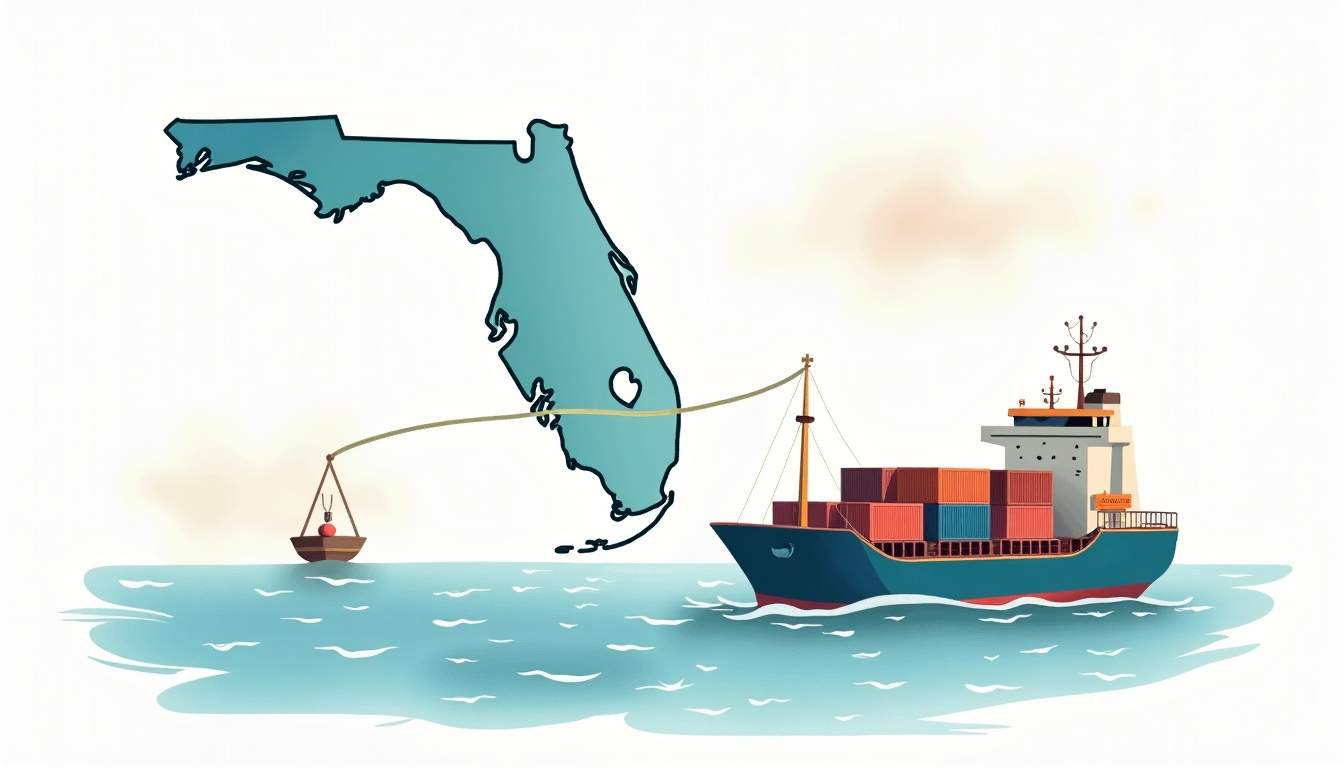
A surprising amount of freight bound for store shelves and job sites in Puerto Rico starts its trip on a truck in Florida. From consumer goods leaving warehouses near Orlando to construction materials moving out of Miami, Florida has become a critical mainland gateway for this lane. The state’s freight economy is sizable, with the Florida Freight and Logistics Market estimated at $78.32 billion in 2025 and expected to reach $97.10 billion by 2030 at a 4.45% CAGR. That growth fuels more routes, more carriers, and more options-but also more complexity when choosing the right way to ship. For many shippers, less-than-truckload (LTL) from Florida to Puerto Rico hits the sweet spot between cost and service, as long as the details are handled correctly. This guide breaks down how the lane works, what drives pricing, how to manage risk, and what to do before booking your next shipment.
How LTL Shipping from Florida to Puerto Rico Works
LTL is designed for freight that is too large for parcel but not enough to fill an entire truck. Think palletized cartons of food, pharmaceuticals, home goods, or industrial supplies. Instead of paying for a full trailer, you share space with other shippers moving freight in the same general direction. For Puerto Rico, that shared-capacity model usually combines a domestic LTL pickup in Florida with an ocean leg into San Juan, then a local delivery to the final consignee. It feels like a single move, but behind the scenes multiple handoffs and modes are involved.
A typical door-to-door move starts with a carrier picking up freight at your Florida facility and hauling it to a local terminal. There, pallets are checked, scanned, and loaded onto a linehaul bound for a port city such as Jacksonville, Port Everglades, or Miami. At the port, cargo is consolidated-often into containers or trailers that will travel by vessel to San Juan. Once the ship arrives, freight is deconsolidated and handed to a local carrier that handles deliveries across the island’s commercial and residential locations. The process is highly choreographed, and each transfer point is a place where good labeling, packaging, and documentation matter.
Even though Puerto Rico is a U.S. territory, shippers still need to treat it with the same discipline used for near-international shipments. Expect to provide a detailed commercial invoice, packing list, and clear product descriptions that match NMFC classifications on the bill of lading. Carriers and 3PLs will often ask about value for insurance or declared value, whether goods are stackable, and if any hazardous materials rules apply. Getting those details right up front reduces delays at consolidators and ports, and helps prevent reclass charges or documentation-related holds.
Why This Florida–Puerto Rico Lane Matters for Your Business
The Florida–Puerto Rico corridor is more than just a convenient geography pairing. Many brands choose to centralize inventory in Florida because it allows them to serve both mainland customers and Puerto Rico from the same regional distribution center. Ocean sailings and LTL linehauls between Florida ports and San Juan are frequent and well established, so capacity is typically easier to secure than from more distant states. For importers using Florida as their first U.S. entry point, simply extending that pipeline into Puerto Rico via LTL can be more efficient than building a second, separate supply chain.
This lane also sits inside a broader LTL market that is steadily expanding. The global LTL market was valued at $221.7 billion in 2024 and is projected to reach $293.7 billion by 2030, growing at a 4.8% CAGR. That kind of growth encourages carriers to invest in specialized services, island networks, and better technology, which directly benefits shippers moving freight between Florida and Puerto Rico. More competition typically means more service options, from economy door-to-terminal solutions to premium, high-visibility door-to-door offerings.
For many organizations, this corridor is also a strategic hedge. When truckload capacity on the mainland tightens, or when parcel networks become expensive for heavy cartons, LTL via Florida can absorb volume without blowing up transportation budgets. The ability to move mixed pallets-combining multiple SKUs and varied volumes in one shipment-gives planners flexibility to react to demand surges in Puerto Rico without overcommitting to full containers every time. That agility is especially useful for retailers with promotional spikes, seasonal product lines, or project-based shipments for construction and infrastructure work on the island.
LTL Pricing, Surcharges, and How to Keep Costs in Check
LTL pricing from Florida to Puerto Rico has more building blocks than a standard domestic move. Base linehaul rates are still driven by origin and destination, weight, freight class, and density, but carriers also layer in factors like port handling, ocean linehaul, and island delivery complexity. Accessorials-liftgate service, inside delivery, residential delivery, appointments, or limited access sites-add additional cost. Because so many elements are involved, quoted rates can diverge widely if two carriers or 3PLs make different assumptions about how freight will be handled at each step.

Recent commentary from industry experts suggests that overall LTL rates are not swinging wildly. Jason Miller, interim chair of the Department of Supply Chain Management at Michigan State University, has noted that “LTL pricing discipline appears to be holding”. For shippers, that relative stability means the biggest cost gains often come from better planning rather than chasing dramatic rate cuts. Optimizing pallet configuration to improve density, avoiding unnecessary accessorials, and shipping on a consistent schedule can all move the needle. Clear, accurate descriptions on the bill of lading also reduce the risk of costly reclassifications or corrections after the fact.
Transit, Service Options, and Technology Visibility
Transit from Florida to Puerto Rico has two main components: domestic LTL movement into the port, and the ocean crossing into San Juan. Published transit times often assume a smooth flow through each handoff, but real-world performance depends heavily on sailing schedules, space availability on vessels, and how early freight is tendered to the carrier. Expedited services can shorten total time in transit if freight can be prioritized onto earlier vessels and through-port operations, while economy services focus more on cost and consolidation efficiency. When comparing quotes, it helps to ask which sailings are used, how often they depart, and what cut-off times apply for getting freight onto a specific departure.
Visibility has improved dramatically on this lane thanks to better tracking and data sharing. According to industry research, approximately 82% of LTL carriers use telematics and GPS technology to track shipments, and that tracking often extends to port and vessel milestones. For shippers, that means more precise status updates-pickup confirmation, terminal arrival, container loading, vessel departure, San Juan arrival, and final delivery. Many carriers now combine scanned events with predictive ETAs, and some large networks are layering in AI tools to optimize routing and loading decisions behind the scenes. The practical impact is fewer surprises and more accurate delivery promises to customers on the island.
Service options have also broadened. In addition to standard dock-to-dock moves, carriers and 3PLs can often tailor solutions for store deliveries, job sites, or medical facilities, with equipment and delivery practices adjusted to local realities in Puerto Rico. White-glove options, inside threshold deliveries, and time-definite appointments are increasingly available, particularly in urban areas. Choosing the right service level is less about picking the fanciest option and more about matching what is truly required at the delivery point, so cost and service stay aligned.
Risk Management and Final Checklist Before You Ship
LTL from Florida to Puerto Rico involves multiple terminals, a port, an ocean crossing, and local delivery, so risk management deserves real attention. Weather is one of the biggest uncontrollable factors. A study on U.S. port disruptions under tropical cyclones found that ports along the Gulf of America show the greatest vulnerability, with disruptions escalating sharply at Saffir–Simpson Hurricane Category 4. While not every Florida–Puerto Rico sailing uses Gulf ports, the finding underscores how severe storms can cascade through port operations, vessel schedules, and downstream deliveries. During hurricane season, building extra slack into lead times, confirming contingency plans with carriers, and avoiding last-minute bookings is wise.
Beyond weather, most controllable risk sits with packaging, documentation, and expectations. Pallets should be structurally sound, with no overhanging cartons, and wrapped tightly enough to survive several touches between origin and final delivery. Labels need to be visible on multiple sides, clearly listing consignee details, reference numbers, and any special handling instructions. Bills of lading should match the physical freight in piece count, weight, and commodity description. Before tendering freight, double-check whether liftgate, residential, inside, or appointment services are required at origin or destination, and make sure they are on the quote and the BOL. Taking a moment to confirm these details turns what could be a stressful, multi-step move into a repeatable, reliable shipping pattern between Florida and Puerto Rico.