Nobel Relocations | 2026 Edition
The Ultimate Guide to Groupage Shipping from the US Mainland to the US Virgin Islands
Everything you need to know about shipping household goods to St. Thomas, St. Croix, and St. John — USVI customs territory, BIR excise tax, AES filing, hurricane season planning, and Nobel’s certified process for the Caribbean corridor.
C-TPAT Trusted Trader
FMC Licensed OTI
AES Filing and USVI BIR Compliance
In This Guide
- Introduction: The Mainland-USVI Corridor in 2026
- Understanding Groupage Shipping in 2026
- The Lift Van Advantage in the Caribbean
- Nobel’s Expertise and Dedicated Coordination
- The USVI Corridor: Customs, Ports, Islands and Transit
- Costs, Insurance and the Value Equation
- Your Step-by-Step Timeline with Nobel
- Authoritative Resources
- Glossary of Key Terms
- Frequently Asked Questions
- About Nobel Relocations
Introduction: The Mainland-USVI Corridor in 2026
The US Virgin Islands — St. Thomas, St. Croix, and St. John — represent one of the most misunderstood shipping destinations that Nobel Relocations serves. The single most common assumption made by people relocating from the US mainland to the USVI is that, because these are US territories, shipping is essentially domestic. It is not.
The US Virgin Islands are a US territory but are outside the US customs territory. This fundamental distinction means that shipping household goods from New York, New Jersey, Florida, or anywhere else on the US mainland to St. Thomas, St. Croix, or St. John is treated, for customs purposes, as an export from the United States and an import into USVI territory. This triggers Automated Export System (AES) filing requirements on the mainland side, and USVI Bureau of Internal Revenue (BIR) excise tax assessment on arrival — regardless of whether the goods are your own used personal effects.
Add to this the geography of the islands themselves — St. John has no container port, requiring transshipment via St. Thomas — and the seasonal reality of Atlantic hurricane season (June 1 to November 30), which introduces weather-related risks to shipping schedules and requires comprehensive marine insurance cover, and you have a corridor that rewards expert management far more than it might initially appear.
Nobel Relocations has the USVI-specific expertise, the compliance infrastructure, and the island delivery network to manage every element of this corridor. This guide is your 2026 reference for getting your household goods from the US mainland to your USVI home safely, correctly, and efficiently.
The Key USVI Distinction
The USVI operates under the Revised Organic Act of 1954, which established its customs territory separately from the US mainland. The USVI has its own tax and customs framework administered by the Bureau of Internal Revenue. Any household goods shipment from the mainland to the USVI is an international export-import transaction — and should be managed by a specialist mover with the certifications and compliance infrastructure to handle it correctly.
Section 1: Understanding Groupage Shipping in 2026
True Groupage vs. Standard LCL for the USVI
Standard LCL — commodity freight consolidated at a public CFS — handles the USVI corridor with the same processes it uses for any other Caribbean freight lane. There is no specialist handling of USVI customs compliance, no expert guidance on BIR excise exemptions, and no dedicated management of the AES filing that US export regulations require.
Nobel’s True Groupage for the USVI is built around the specific compliance and logistics requirements of the islands. Nobel manages AES filing, advises on BIR excise tax and available exemptions, packs your goods into dedicated sealed Lift Vans, and coordinates delivery on St. Thomas, St. Croix, and St. John — including the inter-island transshipment that St. John requires. Every shipment meets FIDI-FAIM 3.4 quality standards.
CBP March 2026 IOR Update: AES Compliance
CBP’s March 2026 Importer of Record verification update applies to USVI-bound shipments as exports from the US mainland. Nobel’s C-TPAT trusted trader status and in-house AES compliance team ensures USVI-bound containers process without the “Consolidation Holds” that affect non-certified operators.
Nobel’s Verified Certifications
✓ FIDI-FAIM 3.4
Independently audited quality standard
✓ FMC Licensed OTI
Verifiable at fmc.dot.gov
✓ C-TPAT Trusted Trader
U.S. CBP expedited processing
✓ IAM Member
International Association of Movers
Section 2: The Lift Van Advantage — Essential in the Caribbean
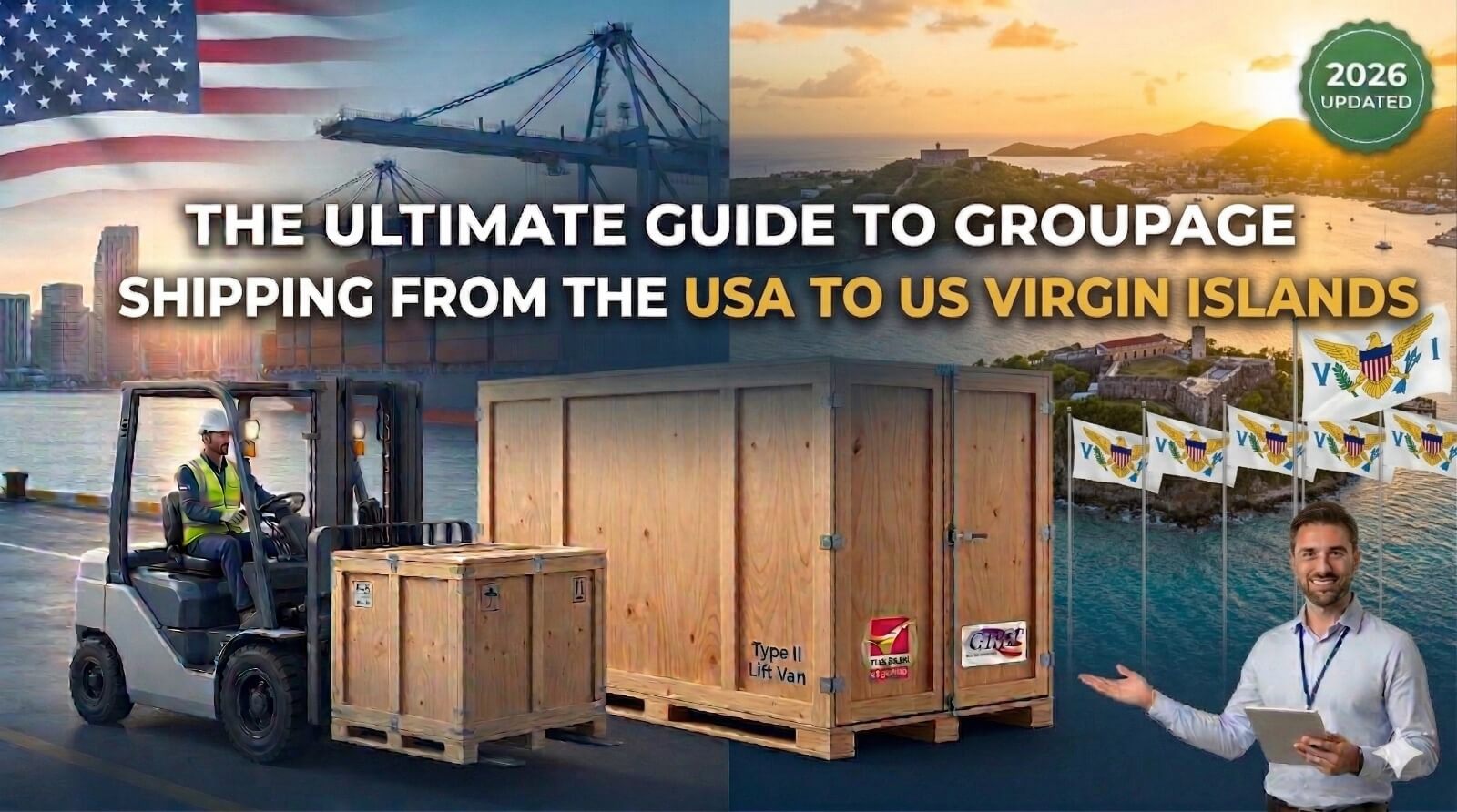
Nobel uses Type II Lift Vans — custom-built wooden crates approximately 7 feet long by 4 feet wide by 6 feet tall (~170 cubic feet), each sealed and individually numbered as the exclusive unit of one household’s personal effects. In the Caribbean shipping environment, the Lift Van’s protective advantages are amplified by a set of factors specific to the USVI corridor.
The Caribbean shipping environment presents specific challenges that make Lift Van protection particularly valuable:
- Humidity and salt air exposure: The Caribbean maritime environment is significantly more corrosive than North Atlantic routes. Nobel’s Lift Vans provide a sealed, moisture-resistant secondary envelope around your household goods — critical for furniture, electronics, and fabrics on Caribbean voyages.
- Inter-island transshipment for St. John: Goods destined for St. John must be transferred from a St. Thomas container terminal to the island by barge or ferry. The Lift Van’s rigid, sealed structure makes this secondary handling safer than loose-packed goods.
- Hurricane season resilience: During Atlantic hurricane season (June–November), vessels may experience severe weather. Lift Vans are braced within the container to prevent movement even in rough sea conditions.
- BIR examination: USVI customs inspection of containers is a possibility. The Lift Van system means an examination of one household’s goods does not hold up other families’ cleared shipments.
ISPM 15 Compliance for the USVI
Nobel’s Lift Vans are built from FSC-certified timber and comply with ISPM 15 heat-treatment and certification stamping requirements. The USVI Department of Agriculture enforces phytosanitary standards on wooden packaging — non-compliant materials are subject to treatment or destruction at the Charlotte Amalie or Frederiksted terminals. Every Nobel Lift Van arrives fully ISPM 15 compliant.
Section 3: Nobel’s Expertise — AES Filing, BIR Compliance and Island Coordination
Accurate Volume Assessment for the USVI Market
Nobel’s experienced move consultants conduct thorough surveys producing an accurate cubic footage estimate and detailed itemised inventory. For USVI shipments, this inventory forms the basis of both the AES Electronic Export Information filing on the US side and the BIR excise tax assessment on the USVI side. Accuracy here directly affects the excise tax calculation and any available exemption claim.
Your Dedicated Nobel Coordinator
From booking, you have a single named coordinator managing every phase of your USVI shipment:
- AES Electronic Export Information (EEI) filing: Mandatory US Census Bureau/CBP export filing for all USVI-bound shipments
- USVI BIR excise documentation: Nobel advises on excise tax exposure and prepares documentation supporting any personal effects exemption claim for qualifying USVI residents
- Island-specific delivery coordination: Charlotte Amalie terminal (St. Thomas), Frederiksted or Gallows Bay (St. Croix), and inter-island transshipment arrangements for St. John
- Hurricane season planning: Sailing schedule advice and timing recommendations to minimise weather-related exposure
Section 4: The USVI Corridor — Customs, Islands, Ports and Transit
USVI Customs Territory: Why It Matters
Under the Revised Organic Act of 1954, the US Virgin Islands operate outside the US customs territory established under 19 U.S.C. § 1202. This means:
- Shipments from the mainland to the USVI require AES Electronic Export Information (EEI) filing — the same export reporting required for international shipments
- Goods arriving in the USVI are subject to USVI Bureau of Internal Revenue assessment, including excise tax on the CIF (Cost, Insurance, and Freight) value of the shipment
- The Jones Act (Merchant Marine Act of 1920) applies to coastwise trade with US territories — Nobel manages carrier selection to ensure compliance
USVI BIR Excise Tax: Rates and Exemptions
The USVI Bureau of Internal Revenue assesses excise tax on imported goods at rates typically in the range of 4-6% of CIF value for most household goods categories. However, qualifying personal effects of bona fide USVI residents returning or relocating to the USVI may be eligible for excise tax exemption or reduction.
Key eligibility factors for USVI personal effects exemption:
- The applicant must be a bona fide USVI resident who has lived outside the USVI for at least one year
- Goods must be the applicant’s own used personal effects — not new goods in original packaging
- The exemption claim must be properly documented and filed with the BIR
⚠ Hurricane Season: June 1 to November 30
Atlantic hurricane season runs June through November, with peak activity August through October. Nobel’s planning team can help time your shipment around peak season where flexibility exists. For shipments that must move during hurricane season, Nobel recommends comprehensive All Risk marine insurance with specific hurricane cover — and can advise on the sailing schedules that minimise weather exposure. Do not underinsure a hurricane season USVI shipment.
Island-by-Island Port and Delivery Guide
| Island | Port / Terminal | Key Notes |
|---|---|---|
| St. Thomas | Charlotte Amalie Terminal (VIPA) | Primary container hub for all USVI shipments. Nobel delivers directly throughout St. Thomas. |
| St. Croix | Frederiksted Port and Gallows Bay | Some sailings serve St. Croix directly. Nobel coordinates delivery throughout the island. |
| St. John | No container port — transshipment from St. Thomas via barge/ferry | Nobel coordinates St. John delivery via vetted local transshipment partners from Charlotte Amalie. |
Transit Times: US Mainland to USVI (2026)
| Route | Transit Time |
|---|---|
| New York / New Jersey to St. Thomas (Charlotte Amalie) | 5-9 calendar days |
| Florida ports to St. Thomas | 3-6 calendar days |
| St. Thomas to St. John (barge/ferry transshipment) | Add 2-4 days |
| Total door-to-door (BIR clearance and island delivery) | 3-6 weeks |
Prohibited and Restricted Items: USVI-Specific Rules
- Firearms: USVI firearms laws differ from most US states — registration with the USVI Police Department is required. Transport firearms in accompanied baggage with proper documentation; do not include in household goods shipments without advance legal advice.
- New goods in original packaging: Do not qualify for personal effects exemption — subject to full BIR excise tax at standard rates
- Vehicles: Automobiles shipped to the USVI require AES filing and BIR excise assessment separately from household goods — Nobel handles vehicle shipping as a separate service
- Plants and agricultural products: USVI Department of Agriculture phytosanitary rules apply — certain mainland plants cannot be brought to the islands
- Alcoholic beverages: USVI has its own alcohol import regulations — quantities beyond personal consumption amounts attract excise tax
Section 5: Costs, Insurance and the Value Equation
A Nobel groupage quote for the US mainland to USVI corridor is based on cubic footage and encompasses:
- Origin packing, Lift Van construction, and CFS loading
- Ocean freight including the island-specific carrier surcharges for Caribbean routing
- AES Electronic Export Information filing
- USVI BIR excise documentation and exemption support
- Port handling charges at Charlotte Amalie or Frederiksted
- USVI customs clearance fees
- Island delivery — including St. John inter-island transshipment where applicable
Insurance: Non-Negotiable for the USVI
Nobel strongly recommends — and for hurricane season shipments, urges — All Risk marine cargo insurance at full replacement value in the USVI market. Replacing household goods in the USVI is substantially more expensive than in the US mainland: the island’s geographic isolation, import costs, and limited retail options mean that replacement costs for furniture, electronics, and appliances are typically 30-50% higher than equivalent mainland prices. Insure at USVI replacement value, not mainland depreciated value. For hurricane season shipments, ensure your policy specifically covers weather-related loss and damage events.
Section 6: Your Step-by-Step Timeline with Nobel
Contact Nobel Relocations. A specialist coordinator will assess your BIR excise exemption eligibility, discuss hurricane season timing if relevant, confirm your specific island delivery requirements (including St. John transshipment), and arrange a thorough volume survey.
Receive your detailed itemised quote including AES filing, BIR excise documentation, island-specific delivery, and All Risk insurance options.
Confirm booking and provide BIR exemption documentation if applicable — proof of USVI residency, period abroad, and ownership of goods.
Nobel’s pack team arrives at your mainland address. Goods packed into your dedicated ISPM 15-compliant Lift Van(s) and transported to Nobel’s CFS.
AES Electronic Export Information filed with the US Census Bureau/CBP. Container loaded and Bill of Lading issued. Your coordinator confirms sailing date and ETA at Charlotte Amalie or Frederiksted.
Shipment in transit to the USVI. Nobel monitors the voyage. For hurricane season sailings, your coordinator tracks weather conditions and any route adjustments.
USVI BIR customs clearance at Charlotte Amalie or Frederiksted. Nobel’s local agents manage excise assessment and any exemption processing. Your coordinator provides regular updates.
Island delivery. Nobel’s vetted local partners deliver to your USVI address. St. John shipments are transferred by barge from St. Thomas and delivered to your St. John home.
Section 7: Authoritative Resources and Regulatory References
- FIDI Global Alliance (fidi.org): FAIM 3.4 quality standard — verify Nobel’s certification
- Federal Maritime Commission (fmc.dot.gov): Verify Nobel’s OTI licence
- CBP C-TPAT Program (cbp.gov): US trusted trader status and 2026 IOR update
- US Census Bureau AES (census.gov): Automated Export System — Electronic Export Information filing requirements for USVI-bound shipments
- Virgin Islands Port Authority (viport.com): VIPA port operations, Charlotte Amalie and Frederiksted terminal information
- International Maritime Organization (imo.org): IMO 2026 container safety and VGM rules
Glossary of Key Terms
| Term | Definition |
|---|---|
| USVI Customs Territory | The US Virgin Islands are a US territory but outside the US customs territory — shipments from the mainland are treated as exports/imports requiring AES filing and BIR excise assessment. |
| AES / EEI | Automated Export System / Electronic Export Information — mandatory US Census Bureau/CBP export filing required for all shipments from the US mainland to the USVI. |
| USVI BIR | USVI Bureau of Internal Revenue — the USVI tax authority that assesses excise tax on goods imported into the territory, typically 4-6% of CIF value for household goods. |
| CIF Value | Cost, Insurance, and Freight value — the declared value of the goods plus shipping and insurance costs, used as the basis for BIR excise tax calculation. |
| VIPA | Virgin Islands Port Authority — manages the Charlotte Amalie (St. Thomas) and Frederiksted (St. Croix) container terminals. |
| Jones Act | Merchant Marine Act of 1920 — governs coastwise trade between US ports including US territories. Nobel manages Jones Act compliant carrier selection for all USVI shipments. |
| Lift Van | Custom-built wooden crate (~170 cubic feet) protecting one household’s personal effects in a shared container — essential for Caribbean humidity and inter-island transshipment. |
| Groupage | Consolidation of multiple households’ goods into one shared container, each in separate sealed Lift Vans. |
| FIDI-FAIM 3.4 | International quality standard for moving companies — independently audited by the FIDI Global Alliance. |
| C-TPAT | Customs-Trade Partnership Against Terrorism — US CBP trusted trader programme, essential for AES compliance and expedited processing on USVI-bound shipments. |
| FMC OTI | Federal Maritime Commission Ocean Transportation Intermediary licence — required for booking ocean cargo from US ports. |
| ISPM 15 | International standard requiring heat treatment and certified stamping of wooden packaging — enforced by USVI Department of Agriculture at VIPA terminals. |
| Charlotte Amalie | VIPA container terminal on St. Thomas — the primary hub for all USVI household goods shipments, including St. John transshipments. |
| Hurricane Season | Atlantic hurricane season runs June 1 to November 30. Nobel advises on timing and insurance for all USVI shipments during this period. |
| CFS | Container Freight Station — Nobel’s bonded facility where Lift Vans are loaded and containers sealed for export. |
Frequently Asked Questions
Is shipping to the US Virgin Islands the same as shipping within the United States?
No. The USVI are outside the US customs territory. Shipping from the mainland to the USVI requires AES Electronic Export Information filing on the US side and USVI BIR excise tax assessment on arrival. Nobel manages both sides of this compliance process for every shipment.
What is the USVI BIR excise tax and how much will I pay on my household goods?
BIR excise tax is typically 4-6% of CIF value for household goods. Qualifying bona fide USVI residents returning after one year abroad may be eligible for an exemption. Nobel advises on BIR exposure and prepares exemption documentation for eligible clients.
What is AES filing and why is it required for shipping to the US Virgin Islands?
AES (Automated Export System) is the mandatory US Census Bureau/CBP system for filing Electronic Export Information on all US exports — including shipments to the USVI. Nobel files all required AES/EEI documentation as part of its standard USVI groupage service.
How do I ship household goods to St. John, which has no container port?
All container shipments discharge at the Charlotte Amalie terminal on St. Thomas. Nobel’s local USVI partners then coordinate barge or ferry transfer to St. John. Nobel accounts for this transshipment in your quote and timeline.
Should I be concerned about hurricane season when shipping to the US Virgin Islands?
Yes. Hurricane season runs June 1 to November 30, with peak risk August-October. Nobel’s planning team can help time shipments to avoid peak season where possible and advises on comprehensive All Risk marine insurance with hurricane cover for all USVI shipments during this period.
Ready to Plan Your Move to the US Virgin Islands?
Speak With a Nobel Groupage Specialist Today
AES filing, USVI BIR excise compliance, hurricane season planning, and St. John inter-island delivery — the USVI corridor demands specialist expertise. The experts at Nobel Relocations handle every detail of your move to St. Thomas, St. Croix, or St. John. Contact us today.
www.nobelrelocations.com
About Nobel Relocations
Nobel Relocations is a specialist international moving company with deep expertise in household goods shipments across the world’s most demanding corridors. Our dedicated coordinators, in-house AES compliance team, and vetted USVI island delivery network manage every detail of the US mainland to St. Thomas, St. Croix, and St. John corridor — from pack date to front door.
Nobel is certified to FIDI-FAIM 3.4 standards, verifiable at fidi.org. We hold an FMC Ocean Transportation Intermediary licence and C-TPAT trusted trader status with U.S. Customs and Border Protection. Our understanding of USVI customs territory, BIR excise compliance, AES filing requirements, and Caribbean shipping logistics makes Nobel the trusted choice for anyone shipping household goods from the US mainland to the US Virgin Islands.
Nobel Relocations. Moving Lives. Protecting Legacies.