
The quote looks reasonable. The transit time seems right. You sign the booking form, hand over your household goods, and four weeks later you’re told there are ‘additional charges at destination.’ For international movers who haven’t worked with a transparent, credentialed operator before, this moment — the unwelcome surprise at destination — is one of the most common and most preventable frustrations of the international moving process.
This article catalogues the real costs you should expect, the ones that legitimate operators like Nobel disclose upfront, and the ones that appear unexpectedly when you work with uncertified consolidators.
Costs That Are Always Part of the Move
Origin Charges
- Packing labor and materials: Professional packing of household goods is required for marine cargo insurance coverage and recommended by all FIDI-certified movers
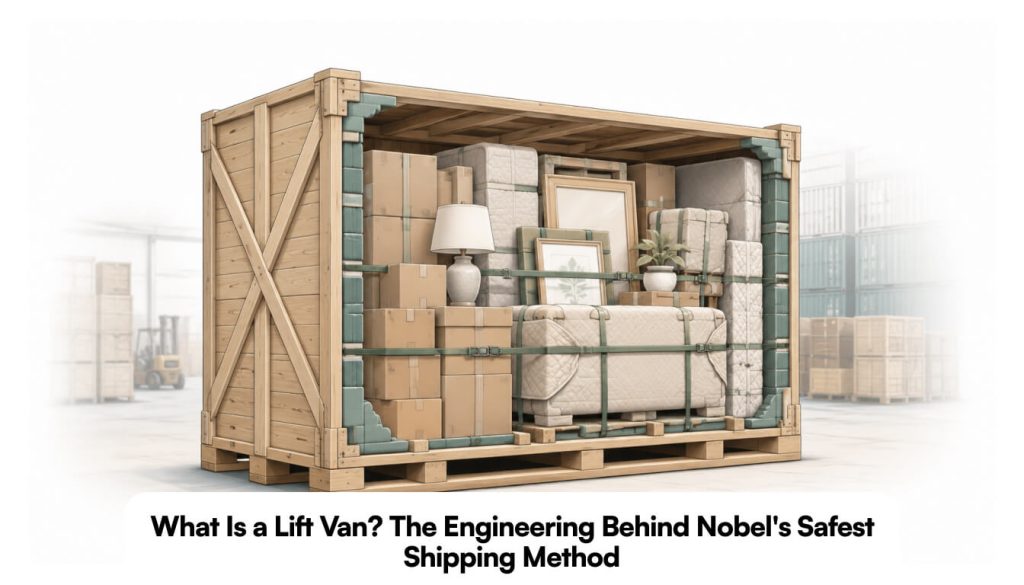
- Lift Van provision: Nobel’s Lift Vans are included as part of the groupage service; non-FIDI operators may charge separately
- AES (Automated Export System) filing: Required by U.S. CBP for all international household goods exports; should be included in mover’s service
- Origin documentation: Packing list, Bill of Lading, Shipper’s Export Declaration — all required, all should be included in a full-service quote
Ocean Freight
Nobel charges ocean freight on the actual volume of your goods, measured in cubic feet or cubic meters. The quote should specify the rate per unit and clearly state whether the measurement is based on a pre-move estimate or a measured volume after packing. Nobel’s FIDI-certified volume survey process uses a systematic methodology that ensures the quoted volume is accurate.
Destination Charges
- Port handling and terminal fees: Charged by the port authority and passed through by the mover
- Customs clearance: The professional customs broker fee for preparing and submitting import documentation
- Delivery to residence: Transportation from the destination CFS or port to your new address
- Unpacking and debris removal: If included in your service level
Costs That Vary by Destination Country
Import Duties
Most countries offer duty exemptions for household goods imported by new residents — but these exemptions are conditional and require specific documentation. Nobel’s team prepares the qualification documentation for each corridor:
- Israel (Teudat Oleh): Qualifying Olim receive duty exemption on household goods. Nobel prepares ICA documentation as part of the service.
- Brazil (Transfer of Residence): Qualifying returning Brazilian citizens and new permanent residents can import household goods duty-free under bagagem desacompanhada provisions. Nobel’s compliance team manages Siscomex filings.
- EU (Transfer of Residence Relief): Under EU Regulation 1186/2009, individuals relocating their normal residence to an EU member state can import household goods duty-free. Nobel prepares ToR documentation.
- UK (Transfer of Residence Relief): Under HMRC CDS, qualifying individuals can claim RGR (Returned Goods Relief) or ToR relief. Nobel’s UK team manages HMRC documentation.
When these exemptions don’t apply — for example, for non-qualifying shipments or for goods that don’t meet exemption criteria — import duties can be substantial. Nobel’s pre-move consultation includes a customs assessment so you understand your duty exposure before your goods leave the U.S.
Costs That Only Appear When Something Goes Wrong
Demurrage and Detention
Demurrage is the daily charge assessed by a port or terminal when a container is not picked up within the allotted ‘free time’ window after arrival. Detention is the charge for holding a container beyond its free time for unloading. Both can accumulate quickly — often $150-300 per day per container — and both are almost entirely preventable with proper customs documentation prepared before arrival.
Nobel’s C-TPAT Trusted Trader status and pre-arrival documentation protocols are specifically designed to prevent demurrage and detention. CBP’s expedited processing for C-TPAT participants means Nobel’s consolidations clear customs faster, reducing the window during which demurrage could accumulate.
CBP Consolidation Holds
Since March 2026, CBP’s updated IOR verification requirements mean that consolidations with incomplete or non-compliant documentation can be held for additional inspection. Hold fees, examination fees, and the cost of third-party logistics to manage a held container can easily exceed $1,000-3,000 per incident. Nobel’s in-house compliance team and C-TPAT status virtually eliminate the risk of this type of hold.
Storage Beyond CFS Standard Window
If your goods arrive at the destination CFS before you are ready to accept delivery, extended storage fees apply. Nobel clearly defines the standard storage window included in its service and provides transparent pricing for extended storage requirements.
How Nobel Eliminates Hidden Cost Surprises
Nobel’s pre-move process includes a detailed cost disclosure that covers every charge category — origin, ocean freight, and destination — with specific amounts rather than open-ended estimates. The Nobel Move Portal provides document visibility throughout the move, so you can see the status of customs filings, vessel tracking, and delivery scheduling before surprises arrive.
Ready to Move Smarter in 2026?Nobel Relocations is a FIDI-FAIM 3.4 certified, C-TPAT Trusted Trader, and FMC-licensed OTI with decades of groupage experience across every major international corridor. Contact Our Experts | www.nobelrelocations.com |