
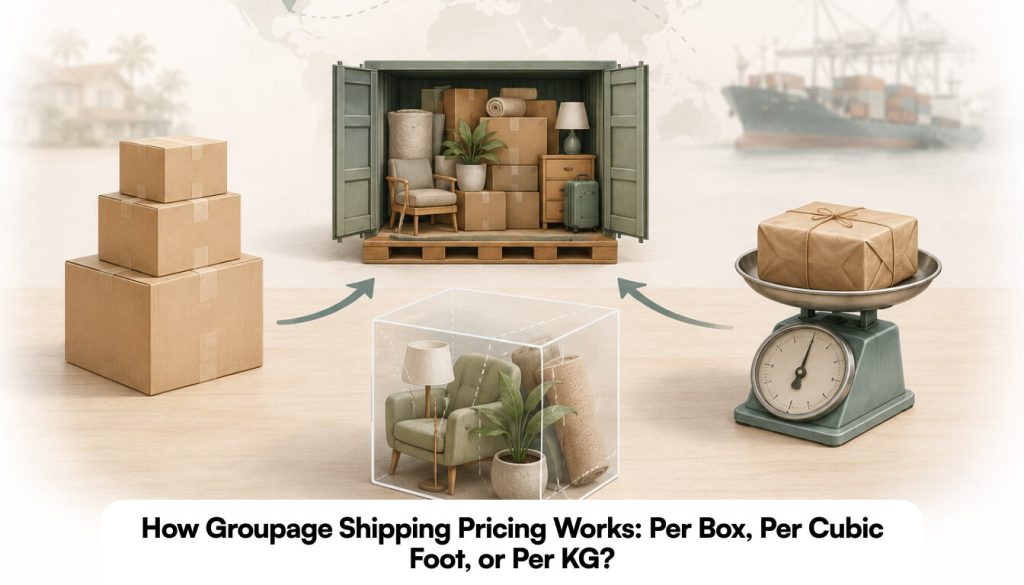
One of the most consistent sources of confusion among people planning an international move is understanding how groupage shipping is actually priced. Is it per box? Per kilogram? Per cubic foot? The answer is: it depends on who you’re quoting, and getting this wrong can make cost comparison nearly impossible.
This article explains the major pricing models used in groupage shipping, what Nobel Relocations uses, and why the measurement methodology is as important as the rate itself.
The Three Main Pricing Models
1. Per Cubic Foot / Cubic Meter (Volume-Based)
This is the standard pricing model used by professional international movers, including Nobel Relocations. Your shipment is measured — either through a pre-move survey or by physical measurement after packing — and you are charged based on the actual volume of space your goods occupy in the shared container. The rate is typically expressed as a price per cubic foot (U.S.) or per cubic meter (internationally).
Volume-based pricing is the most transparent model for household goods because it directly correlates to the resource you’re actually consuming: space in the container. It also incentivizes the mover to accurately measure your goods, because under-estimation creates problems at the CFS when goods don’t fit as expected.
2. Per Kilogram (Weight-Based)
Weight-based pricing is more common in commercial air freight than in ocean groupage, but some LCL freight operators use it for international shipments. For household goods, weight-based pricing is often unfavorable because household goods are typically ‘light’ relative to their volume — furniture, for example, occupies significant space but doesn’t weigh as much as commercial cargo of equivalent volume. If your goods are light relative to their size, you may pay less under volume-based pricing.
Some operators use a ‘chargeable weight’ calculation that takes whichever is greater — the actual weight or the volumetric weight (volume converted to a weight equivalent using a standard conversion factor). This approach is common in air freight and can significantly increase costs for bulky, lightweight shipments.
3. Per Box (Flat Rate)
Per-box pricing is used primarily by budget international parcel services rather than professional movers. It is the most consumer-friendly format to understand but the least accurate for household goods shipments, because ‘a box’ can vary enormously in size and content. Per-box services typically have strict size and weight limits, and any box exceeding those limits incurs surcharges that quickly erode the apparent simplicity of the pricing model.
Per-box services are generally not appropriate for moving household goods that include furniture, appliances, or irregularly sized items.
The Nobel Approach: Volume-Based with Pre-Move Survey
Nobel Relocations prices groupage shipping on a volume basis, calculated from a pre-move survey conducted before your goods are packed. This survey — performed systematically by a Nobel representative — establishes the estimated cubic footage of your shipment, which becomes the basis of your quote.
Nobel’s survey methodology aims for volume accuracy within a 5% margin. This matters because ‘over-volume’ charges — assessed when goods measure more at the CFS than the original survey indicated — are one of the most common sources of unexpected charges in the moving industry. An accurate survey prevents this.
What the Rate Includes — and What It Doesn’t
When comparing groupage quotes, the cubic foot or cubic meter rate is only part of the story. Always confirm what the quoted rate includes:
- Is origin packing included, or quoted separately?
- Are Lift Van provision and CFS handling included?
- Is the ocean freight rate all-in, or subject to fuel surcharges (BAF), port congestion surcharges, or peak season premiums?
- Is destination customs clearance included, or charged separately by a destination agent?
- Are delivery and unpacking at destination included?
A low per-cubic-foot rate from a broker that adds surcharges at every stage can easily exceed the total cost of a higher base rate from a full-service, credentialed mover like Nobel.
2026 Surcharge Environment
In 2026, the ocean freight market continues to carry surcharges that were introduced in the post-pandemic rate volatility period. These include Bunker Adjustment Factors (BAF) reflecting fuel costs, Peak Season Surcharges (PSS) on high-demand corridors, and port-specific congestion fees on routes including U.S. East Coast to Mediterranean and North Sea ports. Nobel’s pricing discloses applicable surcharges upfront, so the total cost delivered is transparent before you commit.
Ready to Move Smarter in 2026?Nobel Relocations is a FIDI-FAIM 3.4 certified, C-TPAT Trusted Trader, and FMC-licensed OTI with decades of groupage experience across every major international corridor. Contact Our Experts | www.nobelrelocations.com |