
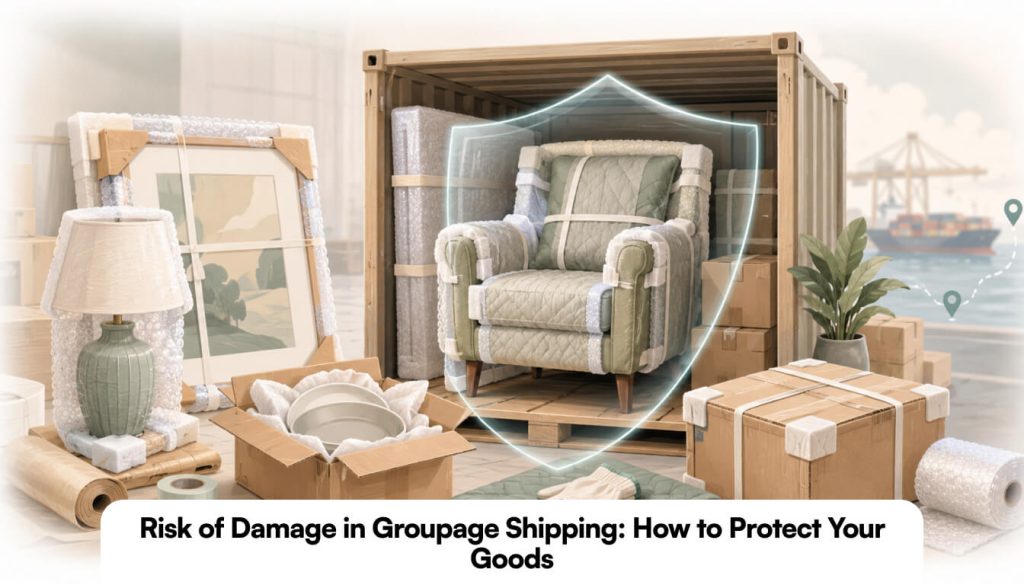
The concern is legitimate and widely shared: when your household goods travel in a shared container with other people’s belongings, doesn’t the risk of damage increase? The honest answer is: it depends entirely on how the consolidation is managed. In a poorly managed LCL consolidation, the answer is yes. In a FIDI-certified groupage operation using Lift Vans, the risk profile is actually comparable to a well-managed full container move.
This article explains the actual sources of damage in groupage shipping, how Nobel’s operating model addresses each one, and what you can do as a shipper to further protect your goods.
The Real Sources of Damage in Ocean Shipping
1. Moisture and Condensation
Ocean containers are subject to dramatic temperature and humidity fluctuations during a trans-oceanic voyage. When warm, humid air inside a container cools, condensation forms on the container walls and ceiling — sometimes called ‘container rain.’ This moisture can damage wood furniture, cause electronics to corrode, and allow mold to develop on textiles and organic materials.
Nobel’s Lift Van construction and moisture-resistant exterior wrapping create a physical barrier between your goods and the container environment. While Lift Vans cannot completely eliminate moisture risk over a very long ocean voyage, they significantly reduce it compared to loose-loaded goods in direct contact with the container walls.
2. Shifting During Transit
Rough seas cause container cargo to shift. In a poorly consolidated container, goods can move, fall, and collide. Professional CFS operators — including Nobel’s team — use blocking and bracing materials to prevent Lift Van movement inside the container. Within each Lift Van, Nobel’s packing crew uses appropriate materials to fill void space and prevent internal shifting.
3. Rough Handling
Port cranes, CFS forklifts, and delivery trucks all handle your shipment at various points in the move. Heavy handling — particularly at busy ports — is a real risk factor. Lift Vans are engineered to withstand forklift handling; individual boxes are not. Nobel’s packing methodology accounts for this: heavy items are packed at the bottom, fragile items are given additional cushioning, and the Lift Van interior is organized so that handling impact at the outer structure doesn’t translate to damage of the contents.
4. Multiple Handoffs (The LCL Problem)
In a commercial LCL operation, your goods may be handled by the origin forwarder, the origin CFS operator, the carrier’s terminal, the destination CFS operator, and the destination delivery agent — none of whom have a direct accountability relationship with you. Each handoff is a point of potential damage or loss.
Nobel’s direct chain of custody eliminates most of these handoffs. Nobel’s team handles your Lift Van at origin, the Nobel-managed CFS stuffs it into the container, and Nobel’s destination network manages it at the other end. The number of parties touching your goods is minimized, and each one operates under Nobel’s FIDI quality standards.
How to Further Protect Your Goods
Professional Packing Is Non-Negotiable
Marine cargo insurance with ‘All Risk’ coverage — the most comprehensive policy available — requires that goods be professionally packed by a licensed packing crew. Self-packed goods are typically covered only for ‘Total Loss’ under a lower-tier policy. The premium difference between All Risk and Total Loss coverage is usually modest; the coverage difference is enormous.
Nobel’s packing crews are trained to FIDI standards and use materials appropriate for ocean transport — not moving blankets and standard box tape, but double-walled corrugated cartons, professional foam cushioning, and specialized wrapping for furniture and artwork.
Marine Cargo Insurance: What to Buy
- All Risk coverage: Covers damage from any external cause during transit — the appropriate policy for household goods
- Declared value: Set the declared value at full replacement cost, not depreciated value. If an antique table is damaged, replacement cost is what it costs to replace it, not what you paid for it 15 years ago.
- Coverage start and end: Ensure the policy covers the full door-to-door journey, including CFS staging time, not just ocean transit
- War risk and strikes: Standard marine cargo policies typically exclude these; for certain corridors, an endorsement may be appropriate
Inventory Documentation
A comprehensive, item-level inventory with photographs taken before packing is your most important protection in the event of a damage claim. Nobel’s packing crew completes a detailed inventory as part of the packing process, but your own photographic record provides additional documentation of condition before the goods entered the Nobel system.
What Happens When Damage Occurs
Despite best practices, damage occasionally occurs in any international shipment. Nobel’s FIDI membership provides access to a structured claims process with defined standards for assessment and resolution. Nobel’s marine cargo insurance partner handles claims directly, with Nobel’s team providing the documentation — inventory, condition reports, Lift Van records — needed to support the claim.
The critical point: document everything at delivery. If you notice damage when your Lift Van is unpacked at destination, note it on the delivery receipt before the Nobel crew leaves. Damage noted at delivery is infinitely easier to claim than damage discovered later.
Ready to Move Smarter in 2026?Nobel Relocations is a FIDI-FAIM 3.4 certified, C-TPAT Trusted Trader, and FMC-licensed OTI with decades of groupage experience across every major international corridor. Contact Our Experts | www.nobelrelocations.com |