
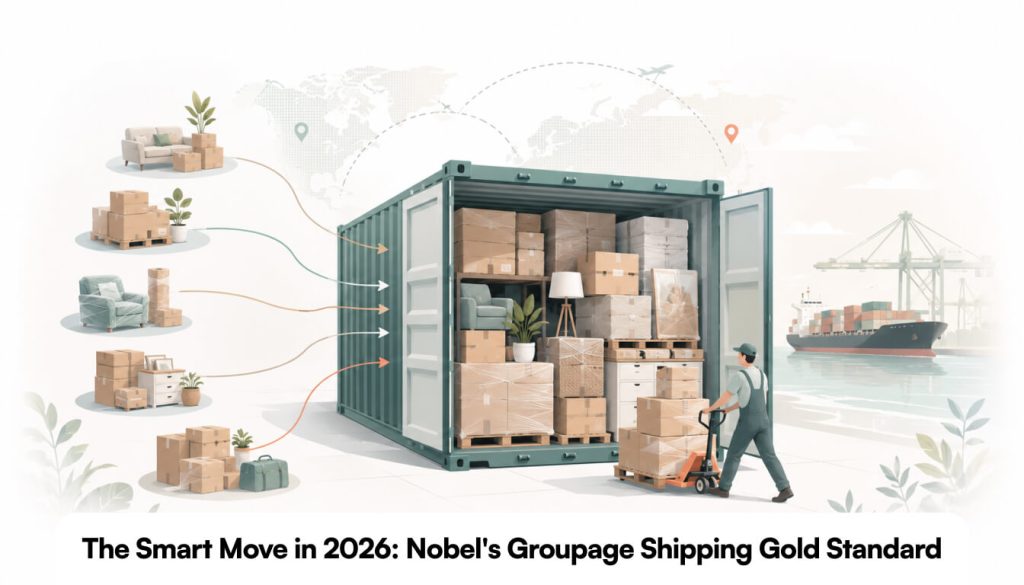
Introduction: The Problem With Moving an Entire Life Overseas
In 2026, the arithmetic of international relocation has never been more challenging. Ocean freight rates remain volatile, customs authorities are enforcing stricter documentation requirements than at any point in the past decade, and the average household moving internationally owns far less than a full 20-foot container (TEU) of goods. Yet the choice they face is deceptively simple: pay for space you don’t need, or trust a consolidation partner who will fill that container around you.
Nobel Relocations was built on the premise that there is a third option — one that requires neither financial waste nor blind trust. It is called True Groupage, and it is the operating foundation of everything Nobel does.
This guide explains exactly what True Groupage is, how it differs from generic Less than Container Load (LCL) freight, why Nobel’s credentials change the risk equation for international families, and what you need to know about moving to the specific countries where Nobel specializes.
Section 1: The Evolution of Groupage in 2026
What Is ‘True Groupage’ — and Why Does the Distinction Matter?
The shipping industry uses the terms ‘groupage’ and ‘LCL’ interchangeably, but they describe meaningfully different models. In standard LCL freight, a freight broker books space in a container owned and managed by an ocean carrier or a third-party consolidator. Your goods share that container with other commercial shipments — electronics, manufactured goods, agricultural products — loaded and unloaded by handlers who have no relationship with you and no accountability for the condition of your personal effects.
True Groupage, as practiced by FIDI-certified movers like Nobel, is different in a critical structural way: the mover controls the entire consolidation loop. Nobel books the container, manages the Container Freight Station (CFS) operation, supervises the stuffing of every Lift Van, coordinates the documentation, and handles the customs clearance at destination. There is no break in the chain of custody.
| Key Distinction |
| LCL (Generic): Your goods travel in a container managed by a third-party carrier, consolidated with commercial freight. |
| True Groupage (Nobel): Nobel controls the full loop — from CFS stuffing to destination customs — with no break in chain of custody. |
| The difference is accountability. In True Groupage, one FIDI-certified party is responsible from door to door. |
The March 2026 CBP Update: Why ‘Consolidation Holds’ Are Now a Real Risk
In March 2026, U.S. Customs and Border Protection (CBP) implemented updated Importer of Record (IOR) verification requirements for consolidated household goods shipments. Under the updated framework, CBP officers have expanded authority to hold consolidated shipments where the IOR documentation is incomplete or where the consolidating party cannot demonstrate compliance with C-TPAT (Customs-Trade Partnership Against Terrorism) Trusted Trader standards.
For families using uncertified LCL brokers, this means their household goods — packed, loaded, and at sea — can be held at the port of departure or destination for days or weeks while documentation issues are resolved. Demurrage fees accumulate. Arrival dates become unpredictable.
Nobel’s C-TPAT Trusted Trader status and in-house compliance team eliminate this exposure. CBP’s expedited processing protocols for certified Trusted Traders mean Nobel’s consolidations clear customs faster, with less risk of holds, and with fully documented IOR paperwork prepared before the container leaves the CFS.
Section 2: The Lift Van Advantage — Nobel’s Technical Security Standard
What Is a Lift Van?
A Lift Van is a custom-built wooden crate, standardized within the international moving industry to approximately 170 cubic feet (roughly 35″ H x 83″ W x 45″ D in Type II configuration). Lift Vans were developed specifically for household goods consolidation because they solve a problem that commercial LCL freight ignores: the vulnerability of personal effects to the weight, moisture, and movement dynamics of a shared ocean container.
When Nobel’s CFS team loads your household goods into a shared container, your belongings are first packed into one or more Lift Vans. The Lift Van is sealed and secured before it ever enters the container. Inside the container, multiple sealed Lift Vans from different Nobel clients travel together — separated, stable, and individually identifiable.
| Why Lift Vans Matter vs. Standard LCL |
| MOISTURE BARRIER: The wooden Lift Van construction, sealed with moisture-resistant wrapping, protects against condensation that is endemic to ocean containers. |
| STABILITY: Lift Vans are engineered to interlock and stack, preventing the shifting that damages loose-loaded goods in rough seas. |
| CHAIN OF CUSTODY: Each Lift Van has a unique identifier. Your goods enter your Lift Van at origin and exit it at destination. They are never commingled with another client’s shipment. |
| ACCOUNTABILITY: Nobel knows exactly what is in each Lift Van and where it is in the consolidation at all times. |
2026 Sustainability: FSC-Certified Timber and CBAM Compliance
Nobel’s 2026 Lift Van specification incorporates FSC-certified timber, sourced from sustainably managed forests. This is not purely a marketing decision. The EU’s Carbon Border Adjustment Mechanism (CBAM), now in its operational phase, requires international shippers moving goods into the European Union to account for the carbon footprint of the materials used in their shipping process. FSC-certified timber and Nobel’s reusable eco-wrapping program reduce the reportable carbon load of your European shipment and position Nobel clients favorably under 2026 EU customs reporting requirements.
Section 3: Nobel’s 2026 Corridors — Country-Specific Expertise
USA to Israel: Teudat Oleh Benefits and Port of Haifa Operations
Nobel’s USA-to-Israel corridor operates on 30-38 day transit times from the New York CFS to the Port of Haifa. For qualifying Olim (new immigrants to Israel), Nobel’s team prepares the Teudat Oleh documentation that exempts household goods from customs duties under Israeli customs law — a benefit that can represent thousands of dollars in savings and requires specific certification from Israel’s Population and Immigration Authority (ICA).
Nobel’s familiarity with Haifa port operations, Israeli customs procedures, and the nuances of the Teudat Oleh benefit process is a core differentiator. For non-Olim moving to Israel, Nobel manages the standard household goods import process, including Hebrew-language customs documentation and coordination with Israeli customs brokers.
USA to Brazil: Navigating Siscomex and 2026 Tax Reform
Brazil’s customs system — the Siscomex electronic clearance platform — requires precise documentation in Portuguese, coordinated through a licensed Brazilian customs broker (despachante aduaneiro). Nobel’s 2026 Brazil corridor accounts for the ongoing implementation of Brazil’s sweeping tax reform legislation, which has introduced changes to how bagagem desacompanhada (unaccompanied baggage) — the Brazilian classification for internationally shipped household goods — is valued and taxed for returning Brazilian citizens and new residents.
Nobel’s in-house compliance team prepares all Receita Federal (Brazilian Federal Revenue Service) documentation, including Transfer of Residence (Transferência de Residência) qualification where applicable, potentially reducing or eliminating import duties on household goods for qualifying individuals.
USA to Europe: Rotterdam and Antwerp as 2026 EU Gateways
Nobel operates weekly consolidations from its New York CFS to Rotterdam (Netherlands) and Antwerp (Belgium), the two primary gateway ports for European household goods distribution. For EU-destined shipments, Nobel’s documentation team prepares Transfer of Residence (ToR) relief claims under EU Regulation 1186/2009, which allows qualifying individuals relocating to an EU member state to import household goods duty-free.
The 2026 implementation of the EU Customs Single Window (EU CSW) has digitized much of the ToR documentation process. Nobel’s paperless customs workflow — part of the Nobel Move Portal — submits documents electronically, reducing processing time and eliminating the risk of physical paperwork errors or delays.
Section 4: The Credential Architecture — Why FIDI-FAIM 3.4 Matters
FIDI Global Alliance’s FAIM (FIDI Accredited International Mover) certification, currently at version 3.4, is the most rigorous quality standard in the international moving industry. FAIM 3.4 certification requires independent auditing of a company’s operations, financial stability, quality management systems, and compliance protocols — with re-auditing required every three years.
For groupage shipping, FAIM 3.4 is specifically relevant because the standard covers consolidation procedures, Lift Van handling specifications, and chain-of-custody documentation requirements. When you ship groupage with a FIDI-FAIM 3.4 certified mover, you are not relying on a marketing claim. You are relying on an independently verified operating standard.
Nobel’s FMC OTI (Ocean Transportation Intermediary) licensure, issued by the Federal Maritime Commission, establishes Nobel’s legal authority to operate as an ocean freight intermediary in the United States. The FMC license is a legal requirement for any company booking ocean freight on behalf of U.S.-based shippers — and the FMC’s public registry allows anyone to verify Nobel’s licensure status at any time.
Technical Glossary
| Term | Definition |
| Lift Van | A custom-built wooden crate (~170 cu ft) used to segregate household goods within a shared ocean container. The standard for FIDI-certified groupage operations. |
| Groupage / True Groupage | A consolidation model in which a single FIDI-certified mover controls the entire consolidation loop, from CFS loading to destination customs. |
| LCL (Less than Container Load) | A commercial freight model in which goods from multiple shippers share container space managed by a third-party carrier. Not the same as True Groupage. |
| CFS (Container Freight Station) | The facility where Nobel’s team loads and seals Lift Vans and stuffs the shared ocean container. |
| TEU (Twenty-foot Equivalent Unit) | The standard measure of container volume. A standard 20-foot ocean container = 1 TEU. |
| IOR (Importer of Record) | The party legally responsible for a shipment’s customs entry at the destination country. Nobel manages IOR documentation as part of its service. |
| C-TPAT | Customs-Trade Partnership Against Terrorism. A U.S. CBP program granting Trusted Trader status to certified supply chain partners, enabling expedited customs processing. |
| FIDI-FAIM 3.4 | The current version of the FIDI Global Alliance’s Accredited International Mover certification standard — the highest quality benchmark in the international moving industry. |
| FMC OTI | Federal Maritime Commission Ocean Transportation Intermediary. The U.S. regulatory license required to book ocean freight on behalf of shippers. |
| AES Filing | Automated Export System filing — the electronic U.S. export declaration required for international household goods shipments. |
| Teudat Oleh | Israeli immigration document issued to new Olim, enabling duty-free import of household goods under Israeli customs law. |
| Siscomex | Brazil’s electronic customs clearance system, through which all import and export transactions are processed. |
| CBAM | EU Carbon Border Adjustment Mechanism — a 2026-active EU policy requiring importers to account for the carbon cost of production processes. |
| FSC-Certified Timber | Timber sourced from forests certified by the Forest Stewardship Council as sustainably managed. |
External Authority Links (for hyperlink insertion in WordPress):
- FIDI Global Alliance (FAIM 3.4): https://www.fidi.org
- Federal Maritime Commission (FMC OTI Registry): https://www.fmc.gov
- U.S. CBP C-TPAT Program: https://www.cbp.gov/border-security/ports-entry/cargo-security/ctpat
- IMO 2026 Container Safety Rules: https://www.imo.org
Ready to Move Smarter in 2026?Nobel Relocations is a FIDI-FAIM 3.4 certified, C-TPAT Trusted Trader, and FMC-licensed OTI with decades of groupage experience across every major international corridor. Contact Our Experts | www.nobelrelocations.com |