
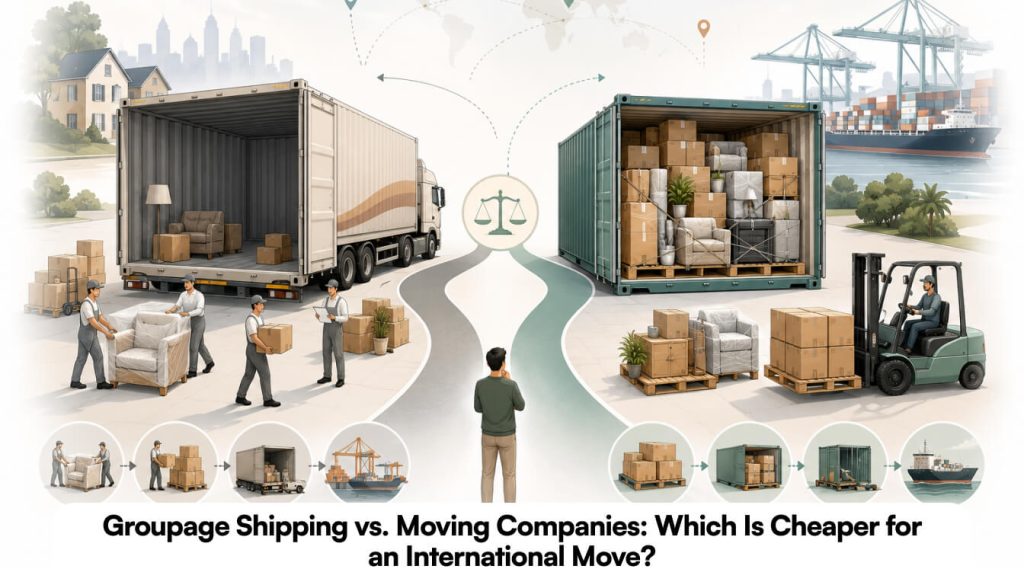
The question arrives in every international moving inquiry: which is actually cheaper — booking a full container with a moving company, or consolidating your shipment through a groupage service? The answer in 2026 is more nuanced than a simple dollar comparison, and the total cost of each option depends on variables that most people don’t factor into their initial calculation.
This article gives you the honest, complete comparison — including the hidden cost variables that turn a seemingly cheaper option into a more expensive one.
The Basic Cost Structure: What You’re Actually Paying For
Full Container (FCL) Moving — When It Makes Sense
A full 20-foot container (1 TEU) provides approximately 1,000-1,200 cubic feet of usable space. In 2026, a door-to-door FCL move from New York to major European ports, for example, typically ranges from $8,000 to $18,000+ depending on origin, destination, and service level. This is the right choice when:
- Your household volume exceeds approximately 700-800 cubic feet (the break-even point where groupage stops being cost-effective)
- You need the container to load and unload directly at your residence without CFS handling
- Transit time is critical and you cannot share a consolidation schedule
Groupage (Shared Container) — When It Makes Sense
Groupage pricing is calculated based on the volume your goods actually occupy — typically quoted per cubic foot or per cubic meter. For a household with 200-500 cubic feet of goods, groupage with a FIDI-certified mover like Nobel is almost always significantly cheaper than booking a full container you’re only partially filling. The break-even calculation is straightforward: if your volume is less than 60-70% of a full container, groupage is likely the better financial decision.
| Shipment Volume | Recommended Option |
| Under 200 cu ft | Groupage |
| 200-500 cu ft | Groupage |
| 500-700 cu ft | Either — compare quotes |
| 700+ cu ft | Full Container (FCL) |
The Variables That Change the Cost Equation
1. Origin and Destination Fees
Both FCL and groupage moves carry origin and destination charges beyond the basic ocean freight rate. These include: packing labor and materials at origin; Lift Van fabrication or container loading fees; port handling and documentation charges; destination customs clearance; and delivery and unpacking labor at destination. For groupage moves, these are typically calculated proportionally to your volume. For FCL moves, many of these are fixed regardless of how full the container is.
2. Insurance Valuation
Replacement value insurance for international moves is priced as a percentage of declared value, not as a percentage of container space. For a typical household goods shipment, insurance costs are similar whether you ship FCL or groupage — but the risk profile is different. Nobel’s Lift Van consolidation model provides a more secure physical environment than loose LCL, which can reduce the likelihood of claims.
3. Transit Time and Storage
Groupage consolidations run on a fixed schedule — Nobel’s New York CFS consolidates to major corridors on a regular weekly or bi-weekly basis. If your move date doesn’t align with the consolidation schedule, your goods may be stored at the CFS for a short period before the next available consolidation. Nobel’s pricing includes standard CFS storage within the consolidation cycle; extended storage beyond a standard window is charged separately.
4. The ‘Minimum Volume’ Question
Most groupage providers charge a minimum volume — typically around 100 cubic feet — regardless of actual shipment size. This means that for very small shipments (a handful of boxes), groupage may not offer the cost advantage you expect. For these cases, Nobel’s team will advise on the most appropriate service for your specific volume.
What Nobel’s FIDI-FAIM Certification Means for Your Cost
There is a category of ‘cheap’ international shipping that is neither groupage nor FCL — it is unvetted LCL freight brokered by companies without FIDI certification, FMC licensure, or C-TPAT status. These services may quote lower prices, but the cost calculation changes dramatically when you account for: CBP consolidation holds that accumulate demurrage charges; incomplete customs documentation that results in additional compliance fees; damage to goods loose-loaded without Lift Van segregation; and no accountability framework when goods arrive damaged or delayed.
Nobel’s pricing reflects the full cost of a properly managed, credentialed move. The comparison isn’t Nobel versus a cheaper mover — it’s Nobel’s total delivered cost versus the total cost of an uncertified service, including the costs you don’t know about until they arrive.
Ready to Move Smarter in 2026?Nobel Relocations is a FIDI-FAIM 3.4 certified, C-TPAT Trusted Trader, and FMC-licensed OTI with decades of groupage experience across every major international corridor. Contact Our Experts | www.nobelrelocations.com |