
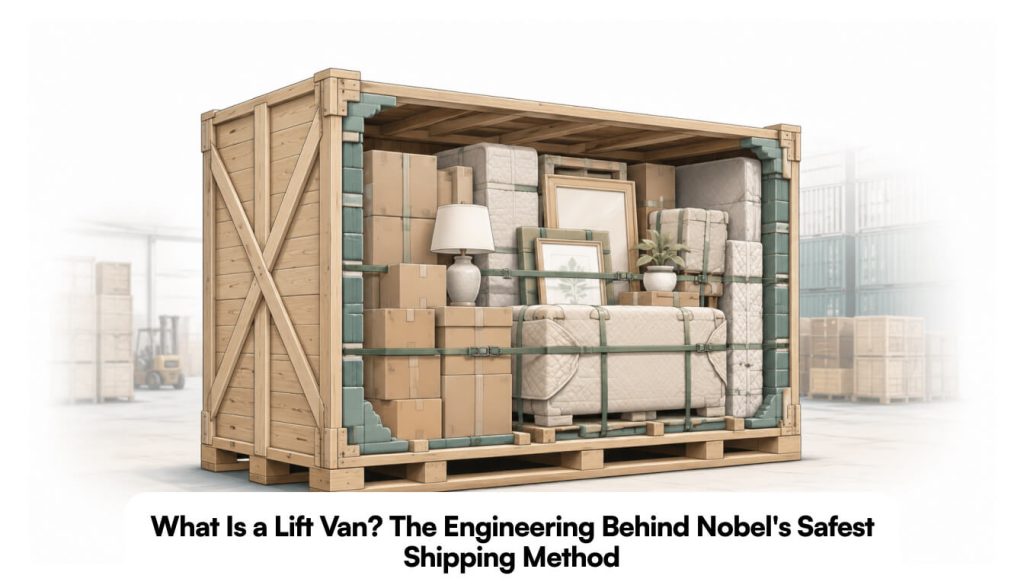
If you’ve ever watched a professional international moving team at work, you’ve likely seen the wooden crates — taller than a person, sealed with metal strapping and plastic wrap — that look like they belong in an industrial warehouse rather than a moving truck. Those are Lift Vans, and they are the single most important piece of equipment in professional groupage shipping.
This article explains what a Lift Van is, why it was invented, how it functions within a shared container shipping operation, and why Nobel Relocations’ use of Type II Lift Vans and FSC-certified timber represents the current standard of best practice in the international moving industry.
The Origin of the Lift Van
Lift Vans were developed specifically for the international household goods moving industry in the mid-20th century, when the growth of ocean container shipping created a new challenge: how to move personal effects — which are fragile, heterogeneous, and irreplaceable — in the same containers designed for standardized commercial cargo.
Commercial cargo is typically identical in format: pallets of the same product, stacked to the same height, with predictable weight distribution. Household goods are the opposite: a mixture of furniture, electronics, artwork, kitchenware, and clothing, each with different dimensions, fragility levels, and packaging requirements. Placing these items loose in a commercial container alongside other shippers’ goods creates an unacceptable risk of damage from shifting, moisture, and weight load.
The Lift Van solved this problem by creating a modular, sealed unit within the container — a wooden crate engineered to hold one household shipment, protect it from the internal environment of the container, and interlock with other Lift Vans to create a stable, fully packed consolidation.
Type II Lift Van Specifications
Nobel Relocations uses Type II Lift Vans, the professional standard in international household goods shipping. The approximate specifications are:
| Interior Volume | Approximately 170 cubic feet |
| Typical Dimensions | 35″ H x 83″ W x 45″ D (interior) |
| Construction | Tongue-and-groove timber construction with reinforced corners and metal banding |
| Weight Capacity | Engineered for typical household goods loads, including heavy items such as furniture and book collections |
| Sealing | Fully sealed on all six faces; moisture-resistant wrapping applied before container loading |
| Identification | Unique Lift Van number linked to Nobel’s shipment tracking system |
| Timber Specification (2026) | FSC-certified timber from sustainably managed forests |
How a Lift Van Functions in Nobel’s Groupage Operation
Step 1: Origin Packing
Nobel’s crew packs your household goods at origin using professional packing materials. Fragile items are bubble-wrapped, furniture is padded and shrink-wrapped, and all items are systematically organized before being placed into the Lift Van. The packing crew completes a detailed inventory that corresponds to the Lift Van’s unique identifier.
Step 2: Lift Van Loading and Sealing
Once packed, the Lift Van is sealed — all six faces closed, corners secured with metal banding, and the exterior wrapped in moisture-resistant film. At this point, your goods are contained within a sealed unit that will not be opened until destination.
Step 3: CFS Staging and Container Stuffing
Your sealed Lift Van is transported to Nobel’s Container Freight Station (CFS), where Nobel’s team manages the consolidation. Multiple sealed Lift Vans — each belonging to a different Nobel client — are positioned and secured inside the ocean container. Nobel’s stuffing team ensures proper weight distribution and uses blocking and bracing materials to prevent any movement during transit.
Step 4: Ocean Transit
The sealed container is booked onto the ocean vessel on one of Nobel’s regular consolidation schedules. Throughout ocean transit, your goods remain inside their sealed Lift Van, protected from moisture, temperature fluctuations, and the movement dynamics of the sea voyage.
Step 5: Destination Customs and Delivery
At the destination port, Nobel’s logistics and customs team manages the clearance process. Once cleared, the container is unstuffed at the destination CFS, your Lift Van is extracted intact, transported to your new home, and unpacked by Nobel’s destination crew.
Lift Van vs. Loose LCL: The Damage Risk Comparison
In standard commercial LCL freight, goods are often loaded ‘loose’ in a container — meaning individual boxes, cartons, or pallets from multiple shippers are placed directly in the container without individual segregation. When goods are loose-loaded with commercial cargo, the risk profile changes significantly:
- Weight dynamics: Heavy commercial pallets can shift and compress lighter household goods
- Moisture exposure: Container condensation (commonly called ‘container rain’) drips directly onto exposed boxes
- Handling at CFS: Loose goods may be handled by multiple parties with no direct relationship to the shipper
- Accountability gaps: When damage occurs, identifying when and how it happened is difficult when goods are loose among multiple shippers’ cargo
The Lift Van eliminates all of these exposures. Your goods are inside a sealed wooden unit. Commercial cargo cannot reach them. Moisture cannot penetrate a properly sealed Lift Van. Nobel’s team handles the Lift Van directly from origin CFS to destination CFS with no third-party involvement.
2026 Sustainability: FSC-Certified Timber and EU CBAM
Nobel’s 2026 Lift Van specification requires FSC-certified timber — wood sourced from forests independently certified by the Forest Stewardship Council as sustainably managed. This specification responds to two converging pressures:
- EU Carbon Border Adjustment Mechanism (CBAM): Now in its operational reporting phase, CBAM requires importers moving goods into the EU to account for the carbon cost of materials in their supply chain. FSC-certified timber reduces the carbon reporting load for European-destined Nobel shipments.
- Client values: Nobel’s client base increasingly expects environmental accountability from their service providers. FSC certification provides a credible, independently verified standard rather than a self-declared claim.
Nobel has also implemented a reusable eco-wrapping program that reduces single-use plastic consumption in the Lift Van sealing process, replacing conventional shrink wrap with a reusable, moisture-resistant alternative on qualifying shipments.
| Ready to Move Smarter in 2026?
Nobel Relocations is a FIDI-FAIM 3.4 certified, C-TPAT Trusted Trader, and FMC-licensed OTI with decades of groupage experience across every major international corridor. Contact Our Experts | www.nobelrelocations.com |