
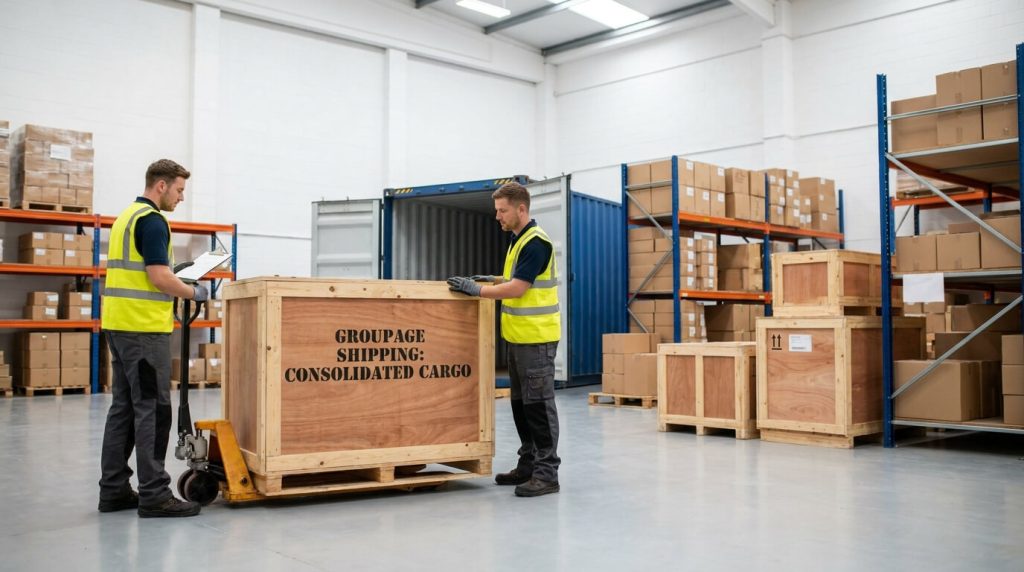
Groupage shipping is one of the most cost-effective and logistically sound methods for moving household goods internationally and one of the most misunderstood. At Nobel Relocations, we field questions about groupage every single day from people who have heard the term but aren’t entirely sure what it means, how it works, or whether it’s right for them.
This guide answers every meaningful question we hear. No jargon left unexplained. No important detail glossed over. Just straight answers from a team that has been doing this at the highest certified level for years.
The Basics
Q: What is groupage shipping?
Groupage shipping is the practice of consolidating multiple customers’ household goods into a single shared ocean container. Rather than paying for an entire container when you only need a portion of the space, you pay exclusively for the cubic footage your belongings actually occupy. Other customers’ goods fill the remaining space, and the total container freight cost is shared proportionally among all parties.
The result: you access the same ocean freight infrastructure used for full-container moves the same vessels, the same ports, the same transit lanes at a fraction of the cost.
Q: Is groupage shipping the same as LCL shipping?
They are related but not identical, and the difference matters.
LCL Less-than-Container-Load is the broad industry term for any shipment that does not fill an entire container. In commercial freight, LCL typically means your goods share space with other businesses’ cargo, handled as commodity freight with minimal specialist oversight.
True Groupage the model Nobel Relocations operates is a specific form of LCL where the consolidating company controls the entire process from origin to destination. We pack the goods, we manage the consolidation, we handle customs, and we oversee delivery. There are no handoffs to unknown third parties, and the goods moving alongside yours are other households’ personal effects, not commercial cargo.
When you hear “LCL” from a freight broker, ask whether they operate True Groupage or commodity consolidation. The answer will tell you a great deal about what your shipment experience will look like.
Q: How long has groupage shipping existed?
Groupage consolidation has been a standard feature of the international moving industry for decades. The core concept sharing container space to distribute freight costs predates containerization itself, with early forms of consolidated shipping appearing in the mid-twentieth century as international moving became more common for corporate transferees and emigrants.
What has changed significantly in recent years is the regulatory environment surrounding it. Customs agencies worldwide have tightened importer of record verification, container safety reporting requirements have expanded under IMO 2026 rules, and the credentials required to operate a compliant groupage service have become more demanding. The concept is mature. The compliance requirements are very much evolving.
Q: What is a TEU, and why does it keep appearing in shipping conversations?
TEU stands for Twenty-foot Equivalent Unit. It is the standard measure of container capacity in ocean freight a reference to the dimensions of a standard 20-foot shipping container. When carriers talk about vessel capacity, port throughput, or freight rates, they typically express everything in TEUs.
For groupage customers, the practical relevance is this: when you ship groupage, your cubic footage is being loaded into a container measured and priced in TEUs. Understanding TEU pricing helps explain why groupage rates fluctuate with global freight markets your share of the container is still subject to the same supply and demand dynamics that affect full-container shipping.
Q: What is a CFS?
CFS stands for Container Freight Station. It is the facility where Nobel’s teams physically load or “stuff,” in industry terminology customer goods into shared containers. The CFS is where Lift Vans are positioned and secured within the container, where seal numbers are documented, and where the final weight and volume measurements are confirmed before the container departs for the port.
The quality of a CFS operation is a direct reflection of the mover’s standards. Nobel operates its consolidations through FIDI-certified CFS facilities, meaning the people handling your goods at this critical stage are trained specifically for household goods not general cargo.
How It Works
Q: Walk me through the groupage shipping process from start to finish.
The process follows eight stages:
- Volume Assessment The first step is establishing how much space your belongings will occupy. Nobel’s team works through a detailed inventory of your household goods to produce an accurate cubic footage estimate. Accuracy at this stage matters underestimates create problems at the CFS, and overestimates mean you pay for space you don’t use.
- Booking and Scheduling Once your volume is confirmed, your shipment is assigned to a sailing. Nobel operates on fixed weekly consolidation schedules, which means your goods don’t sit in a warehouse indefinitely waiting for a container to fill.
- Packing at Origin Nobel’s packing crews arrive at your residence and prepare your goods for international transit. This is not standard domestic moving. International packing uses specialist materials and techniques designed to withstand the vibrations, temperature changes, and humidity variations of an ocean voyage.
- Lift Van Loading Your packed goods are loaded into your dedicated Type II Lift Van at the origin facility or your residence. The Lift Van is braced, blocked, and sealed. The seal number is recorded and begins its documented chain of custody.
- Container Freight Station Consolidation Your sealed Lift Van moves to the CFS, where Nobel’s teams load it into the shared container alongside other customers’ Lift Vans. The container is then sealed for port departure.
- Ocean Transit The container moves through the port, clears export documentation, and sails. Nobel’s compliance team has prepared and submitted all export documentation including AES Electronic Export Information filing where required in advance of the vessel’s departure.
- Destination Customs Clearance Nobel’s destination team, or our FIDI-certified local partner, manages customs clearance at the port of arrival. This is where destination-specific regulatory expertise the knowledge that makes a real difference between a smooth delivery and a costly delay comes into play.
- Final Delivery Your Lift Van is unsealed at the destination CFS with the original seal number verified and your goods are delivered to your new address, unpacked, and placed.
Q: How is my cubic footage calculated?
Cubic footage is calculated by multiplying the length, width, and height of each item or packed box and summing the totals. Nobel’s volume surveys are conducted by trained estimators who have catalogued thousands of household inventories and know how items pack together in a Lift Van context.
The precision of this estimate matters for two reasons. First, your cost is based on it an accurate estimate means no surprises on your final invoice. Second, your Lift Van is sized to your shipment an accurate estimate means your goods fit securely without wasted space or, worse, items that don’t make it into the planned Lift Van.
Q: What is a Lift Van, exactly?
A Lift Van is a custom-built wooden crate used to house one customer’s household goods within a shared ocean container. Nobel uses Type II Lift Vans approximately 170 cubic feet in capacity constructed from FSC-certified, ISPM 15 heat-treated timber.
The name comes from the crate’s original design purpose: it was built to be lifted by a crane or forklift and loaded directly into a vessel’s hold. Modern Lift Vans are loaded into standard ISO containers at the CFS, but the fundamental design principle remains a sealed, sturdy, self-contained unit that protects its contents from the physical and environmental stresses of ocean freight.
Within the shared container, your Lift Van is your private space. Your goods do not touch other customers’ goods. Your seal is your seal. Your Lift Van travels as an intact unit from origin CFS to destination CFS.
Q: What does ISPM 15 mean, and why does it matter for my shipment?
ISPM 15 refers to International Standards for Phytosanitary Measures No. 15 the international regulation governing wooden packaging materials used in international trade. It requires that wood used in international shipping including the timber used to build Lift Vans be treated to eliminate the risk of transporting wood-boring insects or plant diseases across borders.
Nobel’s Lift Vans are built from ISPM 15 certified heat-treated timber. This is not optional for international shipments non-compliant wooden packaging can be seized and destroyed at destination customs. Using certified timber is a basic requirement of operating a professional international groupage service, and it is one that unlicensed or under-resourced operators sometimes cut corners on.
Q: What happens to my goods if not enough customers book a particular sailing?
Nobel’s fixed weekly consolidation schedule is designed specifically to prevent this scenario from becoming your problem. Containers depart on schedule regardless of whether they are completely full. If a particular container is lighter than projected, Nobel absorbs the additional per-unit cost of the unused space it is not passed on to customers who booked and planned around a confirmed sailing date.
This is one of the meaningful differences between a professional groupage operator and a commodity LCL broker. Brokers may hold shipments until a container reaches commercial profitability. Nobel’s customers have a confirmed sailing, and that sailing departs.
Cost and Value
Q: How much does groupage shipping typically cost?
Groupage shipping is priced primarily by cubic footage, with the total cost influenced by several variables: the origin and destination, current ocean freight rates on the relevant trade lane, fuel surcharges, port fees, customs documentation costs, and any destination-specific duties or taxes for which the customer is liable.
As a general framework: groupage customers moving 200 to 500 cubic feet of household goods internationally typically save 40 to 60 percent compared to exclusive-use container pricing for the same volume. The savings are most pronounced for smaller moves a single professional’s apartment, a couple without children, a partial household relocation.
Nobel provides itemized quotes that break down origin services, ocean freight, destination services, and any corridor-specific fees separately. There should never be a situation where a groupage customer is surprised by a charge they were not told about at the quoting stage.
Q: What is included in a Nobel groupage quote?
A comprehensive Nobel groupage quote covers: volume survey and cubic footage estimate, origin packing and materials, Lift Van construction and loading, Container Freight Station handling at origin, ocean freight for your cubic footage allocation, export documentation including AES filing where required, destination customs clearance, destination CFS handling and Lift Van unsealing, and final delivery and unpacking at your new address.
What the quote will separately identify because they vary by destination and individual circumstance are destination duties and taxes, specialized regulatory documentation fees (such as Transfer of Residence applications or Teudat Oleh coordination), and storage fees if the customer requires holding at origin or destination beyond standard dwell times.
Q: Is groupage shipping cheaper than a full container?
For moves under roughly 500 to 600 cubic feet, yes typically significantly cheaper. A full 20-foot container provides approximately 1,000 to 1,200 cubic feet of usable space. If your shipment occupies 300 cubic feet, a full container means you are paying for 700 to 900 cubic feet of air. Groupage eliminates that waste entirely.
The crossover point where a full container becomes more economical than groupage generally falls somewhere between 600 and 800 cubic feet, depending on the trade lane and current market rates. Nobel’s estimators will tell you honestly where your shipment volume falls relative to that threshold, and will recommend the economically appropriate option regardless of which is more profitable for us.
Q: Are there hidden costs I should know about?
The costs that most often surprise groupage customers who have worked with less transparent operators fall into three categories:
Destination duties and taxes. These are government-imposed charges that no mover controls. What a good mover does is advise you clearly on what to expect, help you understand which exemptions you may qualify for, and handle the documentation to access those exemptions correctly.
Over-volume charges. If the volume of your goods exceeds the estimate at packing time, you will be charged for the additional cubic footage. Nobel’s accurate upfront volume surveys are designed specifically to prevent this from being a surprise.
Storage fees. If your destination is not ready to receive goods on arrival, port storage accrues. Nobel will advise on estimated vessel arrival times and coordinate delivery timing to minimize unnecessary storage exposure.
None of these represent hidden charges in the sense of being manufactured by Nobel. They are real costs of the shipping process. The difference between a trustworthy mover and an untrustworthy one is whether they explain these possibilities to you upfront.
Safety and Security
Q: How are my goods protected inside the shared container?
Through the Lift Van system described above, combined with professional packing techniques and systematic chain of custody documentation.
Your goods are packed using international-grade materials double-walled cartons, foam wrapping, specialized dish packs, furniture blankets by crews trained for ocean transit specifically. They are loaded into your Lift Van and braced internally to prevent shifting. The Lift Van is sealed. The seal number is recorded. The container is sealed. That seal number is also recorded.
From that point until your Lift Van is unsealed at the destination CFS, your goods have not been accessible to anyone outside of Nobel’s documented processes. If a seal shows evidence of tampering, Nobel’s team identifies it before you ever see your goods.
Q: What if something is damaged during transit?
Nobel’s FIDI-FAIM 3.4 certification includes specific requirements around claims management how damage claims are received, documented, assessed, and resolved. FAIM-certified movers are required to maintain a responsive claims process and are audited on their claims resolution performance.
All Nobel international shipments are covered by marine cargo insurance. Nobel’s team will advise on appropriate coverage levels at the quoting stage based on the declared value of your goods. The combination of professional packing, Lift Van protection, and marine insurance provides a comprehensive safety net for the journey.
Q: Can someone access my goods while they are in the container?
No. Once your Lift Van is sealed at the CFS, it is not opened until it arrives at the destination CFS and your seal number is verified. The container itself is also sealed from the origin port to the destination port. Two separate seal systems your Lift Van and the container would need to be breached and resealed without evidence for any unauthorized access to occur.
This two-layer security model is one of the practical advantages of professional groupage over standard LCL freight, where goods may be loaded loose and are therefore accessible every time the container is opened for any reason during transit.
Q: What is chain of custody, and how does Nobel maintain it?
Chain of custody refers to the continuous, documented record of who has had physical access to your goods at every stage of the shipping process. Nobel maintains chain of custody through seal number documentation at the Lift Van level, container seal documentation at the ocean freight level, CFS handling records at both origin and destination, and customs entry documentation that names Nobel as the responsible party throughout.
In practical terms, chain of custody means that if something goes wrong a damaged item, a missing piece, a customs query Nobel can trace exactly what happened, where, and when. For customers, it provides accountability that commodity LCL freight simply cannot match.
Credentials and Compliance
Q: What is FIDI-FAIM, and why does it matter for groupage shipping?
FIDI is the FIDI Global Alliance, the international trade association for professional international moving companies. FAIM FIDI Accredited International Mover is FIDI’s quality certification program, currently at version 3.4.
FAIM 3.4 certification requires independent biannual audits covering packing standards, staff training, equipment, claims handling, financial stability, and partner network quality. It is the most rigorous quality credential in the international moving industry, and it is not self-reported it is audited by independent assessors against a defined standard.
For groupage customers, FAIM certification means that the company consolidating your goods alongside strangers’ goods has been independently verified to meet a defined professional standard. It is the credential that distinguishes a professional household goods mover from a freight forwarder operating in the household goods space.
Nobel Relocations is FIDI-FAIM 3.4 certified. This can be independently verified at www.fidi.org.
Q: What is an FMC OTI license?
FMC refers to the U.S. Federal Maritime Commission. OTI stands for Ocean Transportation Intermediary. An FMC OTI license is the legal authorization issued by the U.S. government for a company to negotiate ocean freight rates and issue bills of lading on behalf of customers in the United States.
Operating as an ocean freight intermediary without an FMC OTI license is illegal under U.S. maritime law. More practically: if your mover does not hold an FMC OTI license, they are either routing your shipment through a licensed third party without your knowledge or operating unlicensed.
Nobel Relocations holds an FMC OTI license. This can be verified at www.fmc.gov.
Q: What is C-TPAT, and how does it affect my shipment?
C-TPAT stands for Customs-Trade Partnership Against Terrorism. It is a U.S. Customs and Border Protection program that designates pre-vetted, security-compliant companies as Trusted Traders low-risk partners whose shipments qualify for expedited processing at U.S. ports.
For groupage customers, C-TPAT status has become particularly significant following the March 2026 CBP update to Importer of Record (IOR) verification protocols. Consolidated shipments moving through non-C-TPAT operators are now subject to heightened scrutiny and potential Consolidation Holds at U.S. ports of export. Nobel’s C-TPAT Trusted Trader designation means our consolidated shipments move through export processing efficiently and predictably.
Nobel Relocations is C-TPAT certified through the CBP Trusted Trader program.
Q: What is the IMO 2026 container safety requirement?
The International Maritime Organization the United Nations body that regulates international shipping introduced updated mandatory container safety reporting requirements effective 2026. These include accurate Verified Gross Mass (VGM) declarations for every loaded container and updated SOLAS (Safety of Life at Sea) container integrity standards.
VGM compliance means that the weight of every loaded container must be officially verified and declared before it can be loaded onto a vessel. Nobel’s operations incorporate VGM measurement and declaration as a standard step in the consolidation process. Customers do not need to manage this it is handled within Nobel’s documented CFS procedures.
Q: What is AES filing?
AES stands for Automated Export System the U.S. Census Bureau’s electronic system for filing Electronic Export Information (EEI) for shipments leaving the United States. AES filing is legally required for international shipments above certain value thresholds and for all shipments to certain destinations.
Nobel’s compliance team handles AES filing as a standard component of every export shipment. Customers do not need to file independently. The filing is submitted prior to vessel departure, and the resulting Internal Transaction Number (ITN) is incorporated into the export documentation package.
Practical Considerations
Q: How long does groupage shipping take?
Transit times vary by destination trade lane and are published as part of Nobel’s corridor-specific service information. The general framework: groupage transit times are comparable to full-container transit times on the same vessel, because the container carrying your Lift Van is on the same ship regardless of how many other households are sharing it.
What can add time to a groupage shipment relative to a full-container shipment is the consolidation process itself the time between Nobel collecting your goods and the container’s vessel departure date. Nobel’s fixed weekly consolidation schedule minimizes this window, but customers should plan for a consolidation lead time of several days beyond the collection date in their overall move timeline.
Q: How early should I book my groupage shipment?
Four to six weeks before your target packing date is a reasonable planning horizon for most groupage shipments. This allows time for a thorough volume survey, quote finalization, booking confirmation, and scheduling coordination.
For moves involving regulatory documentation Transfer of Residence applications, duty exemption filings, or specialist destination requirements earlier engagement is advisable. Some of these processes have government processing timelines that cannot be compressed regardless of how efficiently Nobel manages our side of the equation.
Q: What items cannot be shipped in a groupage container?
The prohibited and restricted items list for international groupage shipments encompasses several categories. Outright prohibitions include: hazardous materials (paints, certain cleaning agents, aerosols, pool chemicals), flammable liquids, ammunition and firearms without specialist licensing, and perishable food items.
Restricted items those that can be shipped only with specific documentation or exemptions vary by destination and include items such as alcohol, prescription medications, certain electronics, and high-value items like jewelry and currency. Nobel’s pre-move documentation process identifies any restricted items in your inventory and advises on the correct handling procedure for each.
Q: Can I pack my own boxes?
Customer-packed boxes known in the industry as PBO, or Packed By Owner can be included in a groupage shipment, but with important caveats. Most marine cargo insurance policies apply more limited coverage to PBO items, as the insurer has no visibility into how the items were packed. Nobel’s packing crews are trained to pack to a standard that supports full insurance coverage customer packing is inherently variable.
If you choose to pack some items yourself, Nobel’s team will advise on which items are most appropriate for PBO handling and which should be professionally packed to protect both the items and your insurance position.
Q: What happens if my goods arrive before my new home is ready?
Nobel can arrange destination storage through our FIDI-certified local partner network. Your Lift Van is held at the destination CFS or a bonded warehouse until you are ready to receive delivery. Storage fees apply and are based on the duration and the destination’s local storage rates.
The practical advice: plan your move timeline so that vessel arrival aligns as closely as possible with your readiness to receive. Nobel’s operations team will provide estimated vessel arrival windows and work with you to coordinate delivery timing that minimizes unnecessary storage exposure.
Q: How do I know what I can and can’t claim duty-free at the destination?
Duty-free import allowances for personal effects vary significantly by destination country and depend on factors including your immigration status, your length of residence abroad, the timing of your return or relocation relative to your arrival date, and the specific categories of goods in your shipment.
Nobel’s corridor-specific regulatory expertise means we know the duty exemption frameworks Transfer of Residence relief, returning resident exemptions, new immigrant benefits that apply to each destination we serve. This knowledge is built into our pre-move consultation process, not offered as a paid add-on. Getting this right at the documentation stage is far less expensive in time and money than attempting to correct it after a customs hold.
Working With Nobel
Q: What makes Nobel Relocations different from other groupage providers?
Three things, none of which are marketing claims:
Verified credentials. Nobel’s FIDI-FAIM 3.4 certification, FMC OTI license, and C-TPAT Trusted Trader status are publicly verifiable. Anyone can check them. Many groupage providers cannot make the same claim.
In-house compliance. Nobel’s regulatory expertise customs documentation, duty exemption applications, destination-specific filing requirements is managed internally by our own compliance team, not outsourced to third-party brokers who may not share our standards or our accountability to you.
True Groupage model. Nobel controls the entire consolidation loop. Your goods do not pass through unverified hands at any stage. The chain of custody runs from Nobel’s packing crew at your origin address to Nobel’s delivery crew at your destination address, with documented accountability at every point in between.
Q: How do I get started?
Contact Nobel’s team directly at www.nobelrelocations.com/contact. The first conversation is a consultation we will discuss your move timeline, destination, approximate volume, and any destination-specific considerations that apply to your situation. From there, we arrange a volume survey, produce an itemized quote, and walk you through the regulatory requirements specific to your corridor.
There is no commitment at the consultation stage. There is, however, a significant amount of useful information you will leave with regardless of which direction you decide to go.
Q: What should I bring to my first conversation with Nobel?
A general sense of what you are moving which rooms, which large items, any items of particular value or fragility. A target timeline for packing and a target date for being in your new home. Your destination address or at minimum the destination city. And any questions from this guide that we haven’t answered to your satisfaction.
Everything else the regulatory detail, the customs documentation, the sailing schedules, the volume estimation is Nobel’s job. That is what FIDI-FAIM 3.4 certification, decades of corridor-specific experience, and a team of in-house compliance specialists exist to handle.
Nobel Relocations is FIDI-FAIM 3.4 certified, FMC OTI licensed, and a C-TPAT Trusted Trader. Industry references: FIDI Global Alliance www.fidi.org | U.S. Federal Maritime Commission www.fmc.gov | CBP C-TPAT Program www.cbp.gov/ctpat | International Maritime Organization www.imo.org | International Association of Movers www.iamovers.org