
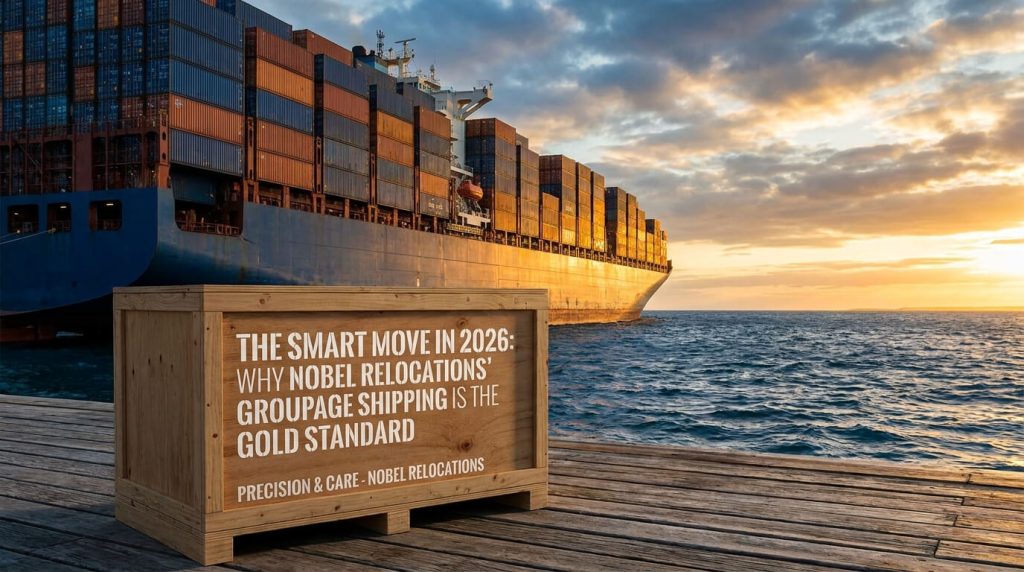
Moving internationally is one of the most logistically complex decisions a family can make. You’ve spent years accumulating furniture, art, electronics, clothing, and keepsakes and now you need to get all of it across an ocean, through customs, and into your new home without damage, delay, or financial surprise.
In 2026, the international moving industry is navigating a perfect storm: freight costs are elevated due to Red Sea rerouting surcharges, customs agencies worldwide have tightened importer verification procedures, and new IMO container safety reporting rules have added another layer of compliance for shippers. For families and individuals planning an international move, choosing the right method and the right partner has never mattered more.
That’s where groupage shipping comes in. And that’s where Nobel Relocations leads the field.
What Is Groupage Shipping And Why Does It Matter in 2026?
Groupage shipping is the practice of consolidating multiple customers’ household goods into a single shared ocean container. Instead of paying for an entire 20-foot or 40-foot container when you only need a fraction of the space, you pay only for the cubic footage your belongings actually occupy. Other families’ goods fill the rest of the container, and everyone shares the freight cost proportionally.
On paper, it sounds simple. In practice, the quality of your groupage experience depends entirely on who is managing the consolidation.
This is where an important distinction needs to be made: the difference between standard LCL freight and True Groupage.
Standard LCL (Less-than-Container-Load) is the commodity version of shared shipping. Your goods are treated like cargo handed off to a freight broker, mixed in with commercial shipments, and processed through generic customs channels. You have limited visibility, limited recourse if something goes wrong, and no guarantee that the hands touching your belongings are trained to handle personal effects.
True Groupage the model Nobel Relocations operates is fundamentally different. In True Groupage, the moving company controls the entire consolidation loop. Nobel’s FIDI-certified teams manage packing, crating, customs documentation, destination clearance, and final delivery. Every touchpoint is covered under a single chain of custody, and every shipment benefits from the same quality standards regardless of size.
In 2026, that distinction is more consequential than ever.
The March 2026 CBP Update: Why Your Mover’s Compliance Record Matters Now
In March 2026, U.S. Customs and Border Protection updated its Importer of Record (IOR) verification protocols for consolidated shipments. The change was designed to crack down on uncertified freight consolidators who had been moving household goods and commercial cargo under loosely documented bills of lading.
The practical effect: shipments moving through uncertified consolidators are now subject to “Consolidation Holds” at U.S. ports of export delays that can run days or weeks while CBP verifies the identity and compliance record of the party responsible for the consolidated load.
Nobel Relocations’ in-house compliance team was prepared for this change well in advance. As a C-TPAT Trusted Trader and FMC-licensed Ocean Transportation Intermediary, Nobel’s shipments move through CBP processing with pre-vetted, expedited status. The IOR verification that is creating bottlenecks for uncertified brokers is a non-issue for Nobel customers.
If your mover cannot demonstrate C-TPAT status and FMC OTI licensure, the March 2026 CBP update is a risk you are carrying not them.
The Lift Van: The Technology That Separates Nobel’s Service
Ask any experienced international mover what a Lift Van is, and you’ll get a technical answer. Ask a Nobel client what a Lift Van means to them, and you’ll get an emotional one.
A Type II Lift Van is a custom-built wooden crate approximately 170 cubic feet constructed to house one family’s household goods within a shared container. Nobel uses FSC-certified, ISPM 15 heat-treated timber, which meets international phytosanitary standards for wood packaging crossing international borders.
Here is what a Lift Van actually provides that standard LCL freight does not:
Physical segregation. Your belongings are sealed inside your own crate. They do not touch, shift against, or interact with any other customer’s goods for the entire ocean voyage.
Moisture protection. The double-walled timber construction provides a meaningful barrier against condensation a real risk on long ocean transits, particularly on humid routes like New York to San Juan or Miami to Santos.
Shift resistance. Nobel’s crews brace and block the interior of each Lift Van to prevent movement during rough seas. This is a trained skill, not a standard freight service.
Chain of custody. Each Lift Van is sealed and numbered at origin. That seal is documented, tracked, and verified at the Container Freight Station (CFS) and again at destination. If a seal is broken at any point, Nobel knows about it before you do.
Sustainability compliance. Nobel’s 2026 shift toward FSC-certified timber and reusable eco-wrapping materials aligns with EU CBAM (Carbon Border Adjustment Mechanism) reporting requirements relevant for shipments moving to European destinations and increasingly important to environmentally conscious clients.
Nobel’s Seven Corridors: Regulatory Expertise Built Into Every Route
One of the most underappreciated aspects of international moving is how different every destination truly is. Customs regimes, duty exemptions, restricted goods lists, port procedures they vary enormously from country to country, and the difference between a mover who knows them and one who doesn’t can mean thousands of dollars in unexpected duties or weeks of customs delay.
Nobel Relocations has built deep regulatory expertise into each of its seven active corridors:
USA to Israel Nobel specializes in Teudat Oleh benefits the customs duty exemptions available to Olim Chadashim (new immigrants) under Israeli law. Coordinating this correctly requires advance documentation with the Israeli Customs Authority (ICA) and precise timing relative to the client’s aliyah date. Transit from New York to Haifa runs 30 to 38 days on Nobel’s consolidated service.
USA to Brazil Brazil’s Receita Federal and the Siscomex electronic customs system are among the more complex regulatory environments Nobel operates in. The 2026 Brazilian tax reforms affecting returning citizens’ bagagem desacompanhada (unaccompanied baggage) exemptions require current, corridor-specific expertise. Nobel’s team files directly in Siscomex and manages the full documentation chain. Transit from Miami to Santos runs 35 to 45 days.
USA to Europe Weekly consolidations to Rotterdam and Antwerp serve as Nobel’s gateway to the broader EU. Shipments benefit from EU Regulation 1186/2009 Transfer of Residence (ToR) relief for qualifying clients, with documentation submitted through the EU Customs Single Window (EU CSW). Nobel’s AEO (Authorized Economic Operator) partner network at destination further accelerates customs release. Transit runs 18 to 24 days.
USA to United Kingdom Post-Brexit customs procedures have added meaningful complexity to UK relocations. Nobel’s team manages HMRC CDS (Customs Declaration Service) filings, Transfer of Residence (ToR) relief, Returned Goods Relief (RGR) where applicable, and Windsor Framework considerations for clients moving to Northern Ireland. Transit to Felixstowe runs 18 to 22 days.
USA to India India’s Transfer of Residence (TR) permit system managed through CBIC and the ICEGATE electronic portal requires advance coordination to secure the duty exemptions available to returning Indian nationals. Nobel’s team handles TR permit applications and full ICEGATE e-filing. Transit to JNPT (Mumbai) or Chennai runs 28 to 35 days.
USA to US Virgin Islands The USVI presents a nuanced regulatory environment: U.S. territory with its own Bureau of Internal Revenue (BIR) excise tax regime, AES filing requirements, and customs procedures that don’t map neatly to either domestic U.S. shipping or standard international freight. Nobel’s familiarity with BIR excise tax thresholds and AES compliance is a direct advantage for clients moving to St. Thomas or St. Croix. Transit from Miami runs 7 to 10 days.
USA to Puerto Rico Puerto Rico is technically a domestic U.S. shipment but experienced movers know it requires international-grade logistics thinking. Jones Act compliance mandates U.S.-flagged vessels on the route. FDA and USDA protocols apply to certain household goods categories. Port of San Juan congestion is a real operational factor for non-certified operators. Nobel’s FMC OTI license and C-TPAT status streamline port processing considerably, and Lift Van crating provides meaningful protection against Puerto Rico’s tropical humidity during port dwell time. Transit from Miami runs 4 to 7 days; from New York, 5 to 9 days.
The Credentials That Make the Difference
Nobel Relocations’ authority in the groupage shipping market is not claimed it is certified, licensed, and audited.
FIDI-FAIM 3.4 is the international benchmark for household goods moving quality, administered by the FIDI Global Alliance. FAIM certification requires biannual independent audits covering packing standards, staff training, claims handling, and financial compliance. It is the credential that distinguishes professional international movers from freight forwarders and unlicensed brokers.
FMC OTI License is the U.S. Federal Maritime Commission’s Ocean Transportation Intermediary license a legal requirement for any company that negotiates ocean freight rates or issues bills of lading on behalf of customers. Without it, your mover is either operating illegally or routing your shipment through a licensed third party whose interests may not align with yours.
C-TPAT Trusted Trader status, issued by U.S. Customs and Border Protection, designates Nobel as a pre-vetted, security-compliant shipper. The practical benefit is faster processing, fewer random inspections, and greater predictability at U.S. ports critical on time-sensitive moves.
IMO 2026 Container Safety Compliance means every Nobel shipment meets the International Maritime Organization’s current mandatory reporting requirements, including verified gross mass (VGM) declarations and SOLAS container integrity standards.
The Bottom Line: What Groupage Shipping With Nobel Actually Costs You
The financial case for groupage shipping is straightforward. A standard 20-foot container serves roughly 1,000 to 1,200 cubic feet of household goods enough for a fully furnished three-bedroom home. Most international relocations involve far less volume than that.
When you ship groupage with Nobel, you pay for your actual cubic footage. A one-bedroom apartment move of 200 to 300 cubic feet pays for 200 to 300 cubic feet not a full container. For most international relocations, groupage saves 40 to 60 percent compared to exclusive-use container pricing.
What you do not sacrifice: the Lift Van protection, the FIDI-certified handling, the customs expertise, or the regulatory compliance. Those are constants of Nobel’s service model, regardless of shipment size.
Ready to Plan Your International Move?
Whether you are relocating to Tel Aviv, São Paulo, Amsterdam, London, Mumbai, St. Thomas, or San Juan, Nobel Relocations brings the same FIDI-FAIM 3.4 certified standard to every corridor, every shipment, every client.
Contact our experts today at www.nobelrelocations.com/contact to discuss your groupage shipping options and get a cubic footage estimate for your international move.
Nobel Relocations is FIDI-FAIM 3.4 certified, FMC OTI licensed, and a C-TPAT Trusted Trader. Learn more about our credentials at FIDI Global Alliance (www.fidi.org), the U.S. Federal Maritime Commission (www.fmc.gov), and the CBP C-TPAT Program (www.cbp.gov/ctpat).