
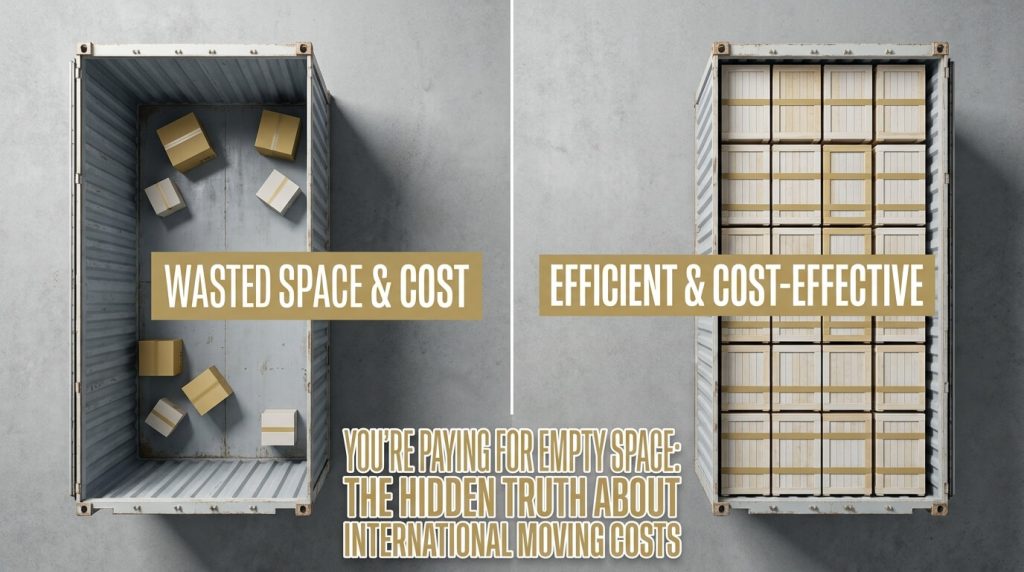
Nobody warns you about the empty space.
You spend weeks getting quotes for your international move. You compare prices, read reviews, ask friends who have done it before. Then the estimate arrives and somewhere buried in the details is the assumption that will quietly cost you thousands of dollars: you are being quoted for an entire ocean container, whether you need all of it or not.
A standard 20-foot ocean container holds roughly 1,000 to 1,200 cubic feet of household goods. The average international relocation a couple moving from New York to London, a family relocating from Miami to Tel Aviv, a professional transferring from Los Angeles to Amsterdam involves somewhere between 200 and 500 cubic feet. The math is uncomfortable: most people moving internationally are paying for 60 to 80 percent empty space.
There is a better way. It has existed for decades. It is just not the option that gets pushed first.
It is called groupage shipping, and understanding how it actually works could change every decision you make about your international move.
The Container Problem Nobody Talks About
Ocean shipping is priced around containers. A Twenty-foot Equivalent Unit a TEU, in industry shorthand is the standard measure. Carriers price sailings in TEUs. Ports process ships in TEUs. The entire global logistics infrastructure is organized around the assumption that containers are the unit of commerce.
For commercial freight, this makes perfect sense. A factory shipping 40,000 units of electronics to a distributor fills containers efficiently. A retailer importing furniture from Vietnam fills containers deliberately. Commercial shippers plan their production and purchasing cycles around container capacity.
Households do not work this way. A family moving from Chicago to São Paulo does not generate a container’s worth of goods on a schedule aligned with vessel departures. They have what they have a dining table, a sofa, boxes of books, the children’s bicycles, the artwork that took years to collect and they need it moved once, to one place, without paying for the space it doesn’t occupy.
The industry’s traditional answer was: pay for the whole container anyway. Or leave things behind. Or sell everything and start over at the destination.
Groupage shipping offers a fourth option: share the container with other families making similar moves, pay only for your portion, and let a qualified consolidator manage the logistics that make it work safely.
What Actually Happens Inside a Shared Container
Here is where groupage shipping either earns your confidence or loses it because the concept of sharing a container with strangers raises an obvious question: what is actually stopping my grandmother’s china from ending up pressed against a stranger’s filing cabinet for four weeks at sea?
The answer, when groupage is done properly, is a Lift Van.
A Type II Lift Van is a custom-built wooden crate roughly 170 cubic feet constructed specifically to house one household’s belongings within a shared container. Think of it as a room within a room. Your goods are packed into the Lift Van by trained crews, braced and blocked to prevent interior shifting, and then sealed. The sealed Lift Van goes into the container alongside other sealed Lift Vans belonging to other families. Your belongings never share physical space with anyone else’s.
Nobel Relocations builds its groupage service around Lift Van technology for exactly this reason. The Lift Van is not an upgrade or an optional add-on. It is the foundational unit of Nobel’s consolidation model the mechanism that makes shared container shipping genuinely safe for household goods, not just theoretically safe.
The timber Nobel uses is FSC-certified and ISPM 15 heat-treated, meeting international phytosanitary requirements for wooden packaging crossing borders. The double-walled construction provides a moisture barrier that the container’s steel walls alone do not guarantee particularly relevant on tropical routes like Miami to San Juan or New York to India, where temperature differentials during ocean transit can generate meaningful condensation inside a container.
When your Lift Van is sealed at the Container Freight Station (CFS) before loading, that seal number is documented and tracked. It is verified again at the destination CFS before delivery. A broken seal triggers an immediate alert. This is chain of custody the same principle that governs pharmaceutical shipping and fine art transport applied to your household move.
The Difference Between a Freight Broker and a Mover
One of the most important distinctions in international shipping is one that most customers never learn to make: the difference between a freight broker and an actual international mover.
A freight broker arranges transportation. They negotiate rates with carriers, book space on vessels, and issue paperwork. They are, in many cases, licensed and legitimate. What they are not is a household goods specialist. When a freight broker handles your international move as an LCL (Less-than-Container-Load) shipment, your sofas and artwork are being processed through the same systems designed for pallets of industrial components. The people handling your goods at the Container Freight Station may have no training in residential packing. The customs documentation may be prepared by someone who has never heard of Teudat Oleh or bagagem desacompanhada or Transfer of Residence relief.
An international mover particularly one certified to FIDI-FAIM 3.4 standards operates an entirely different model. The consolidation is managed in-house. The packing crews are trained on household goods specifically. The customs team knows the destination country’s regulations because they file documentation in that country’s customs systems regularly. The chain of custody runs from your front door to your destination address without handoffs to parties who don’t share the same standards.
This distinction has become more consequential in 2026 following the March update to U.S. Customs and Border Protection’s Importer of Record (IOR) verification protocols. CBP now applies heightened scrutiny to consolidated shipments moving through uncertified brokers creating the “Consolidation Holds” that are adding days and sometimes weeks to shipments handled by parties who cannot demonstrate compliance credentials. Nobel Relocations’ C-TPAT Trusted Trader status and FMC OTI license put its consolidated shipments in the expedited processing lane, not the inspection queue.
The Seven Moves That Reveal How Groupage Works in Practice
Abstract explanations only go so far. Here is what groupage shipping with Nobel actually looks like across seven real corridors:
The Family Moving to Israel A family of four relocating from New Jersey to Tel Aviv has 350 cubic feet of household goods furniture for a two-bedroom apartment, personal belongings, and children’s items. They qualify for Teudat Oleh benefits as Olim Chadashim, meaning their goods can enter Israel duty-free if the documentation is handled correctly. Nobel’s team prepares the ICA certification paperwork, coordinates the timing with the family’s aliyah date, and loads their Lift Van into a weekly consolidation sailing from New York to Haifa. Transit: 30 to 38 days. Duty paid: none.
The Professional Moving to London A corporate relocation from Boston to London involves 180 cubic feet enough for a one-bedroom’s worth of personal effects and a home office setup. Post-Brexit, Transfer of Residence (ToR) relief and HMRC CDS filing requirements mean the customs documentation is more complex than it was before 2020. Nobel files the CDS documentation, coordinates ToR relief eligibility, and ships via Felixstowe. Transit: 18 to 22 days.
The Returning Brazilian National A Brazilian professional returning from Miami to São Paulo with 280 cubic feet of goods qualifies for bagagem desacompanhada duty exemptions but only if the Receita Federal documentation is filed correctly through Siscomex and the timing relative to the client’s return date is managed precisely. Nobel’s Brazil corridor team handles the Siscomex filing end-to-end. Transit: 35 to 45 days.
The Expat Family Moving to Amsterdam A family relocating from Chicago to Amsterdam has 420 cubic feet of goods and qualifies for EU Regulation 1186/2009 Transfer of Residence relief. Nobel’s weekly Rotterdam consolidation gets their Lift Van onto a vessel within days of packing. Transit: 18 to 24 days, arriving into the EU’s single market with AEO-expedited customs processing at the port.
The IT Professional Moving to Mumbai An Indian national returning from San Francisco to Mumbai with 240 cubic feet of household goods qualifies for Transfer of Residence (TR) permit benefits under CBIC regulations. Nobel’s team submits the TR application through ICEGATE and coordinates timing with the vessel arrival at JNPT. Transit: 28 to 35 days.
The Retiree Moving to St. Thomas A couple retiring from the mainland to the U.S. Virgin Islands has 300 cubic feet enough for a comfortable island setup without overshipping. The USVI’s Bureau of Internal Revenue excise tax regime and AES filing requirements are unfamiliar territory for most domestic movers. Nobel’s team handles both, and the Lift Van’s moisture protection is particularly relevant for a destination where humidity begins the moment the container is unsealed at the dock. Transit from Miami: 7 to 10 days.
The Family Moving to Puerto Rico A family relocating from New York to San Juan has 380 cubic feet of household goods and a tight timeline. Puerto Rico is technically domestic under U.S. territorial law, but Jones Act compliance means the vessel must be U.S.-flagged, FDA and USDA protocols apply to certain household goods categories, and Port of San Juan processing times vary significantly depending on whether your mover has C-TPAT trusted trader status. Nobel does. Transit from New York: 5 to 9 days. Transit from Miami: 4 to 7 days.
What You Are Actually Paying For And What You Are Saving
The groupage savings calculation is straightforward once you understand the underlying economics.
A 20-foot container to Israel from New York costs, in 2026 freight conditions, significantly more than it did three years ago. Red Sea rerouting has added both time and cost to sailings that previously transited the Suez Canal. When you pay for an exclusive-use container, you are absorbing 100 percent of that surcharge regardless of how full the container is.
When you ship groupage with Nobel, that surcharge is distributed across all the households sharing the container, proportional to their cubic footage. A family with 300 cubic feet pays the freight cost of 300 cubic feet not 1,000.
The savings typically run 40 to 60 percent compared to exclusive-use container pricing for moves under 500 cubic feet. For a move in the 150 to 300 cubic feet range a single professional, a couple without children, a partial household the savings can be more dramatic still.
What you do not sacrifice in exchange for those savings: Lift Van protection, FIDI-certified handling, regulatory compliance, or Nobel’s chain of custody. The quality of the service is identical to what a full-container Nobel client receives. The only variable is the space you are paying for.
The Questions Worth Asking Before You Book
Before you commit to any international mover offering groupage or LCL services, these questions will tell you a great deal about what you are actually buying:
Do you use Lift Vans, or do my goods go loose into the shared container? If the answer is anything other than a clear confirmation of Lift Van use, your goods are not segregated.
Are you FIDI-FAIM certified? FIDI certification is publicly verifiable at www.fidi.org. If a mover claims certification, it can be confirmed.
Do you hold an FMC OTI license? Verifiable at www.fmc.gov. Required for any company legally issuing ocean bills of lading in the U.S.
Are you C-TPAT certified? Following the March 2026 CBP IOR update, this question has direct implications for your shipment’s processing time at U.S. ports.
Who manages customs documentation at the destination your team or a third-party broker? The answer tells you whether the regulatory expertise you need is in-house or outsourced.
The Move You Deserve
International relocation is hard enough without paying for space you don’t use, or trusting your belongings to a supply chain that wasn’t built for household goods. Groupage shipping done properly, with Lift Vans, certified crews, and in-house regulatory expertise is not a compromise. It is a smarter use of a mature logistics infrastructure that the industry’s best operators have spent decades perfecting.
Nobel Relocations has built its groupage service around exactly this principle. FIDI-FAIM 3.4 certified. FMC OTI licensed. C-TPAT trusted. Seven corridors. One standard.
Contact our experts at www.nobelrelocations.com/contact to discuss your move and get a cubic footage estimate. Stop paying for empty space.
Nobel Relocations credentials and industry references: FIDI Global Alliance www.fidi.org | U.S. Federal Maritime Commission www.fmc.gov | CBP C-TPAT Program www.cbp.gov/ctpat | International Maritime Organization www.imo.org