
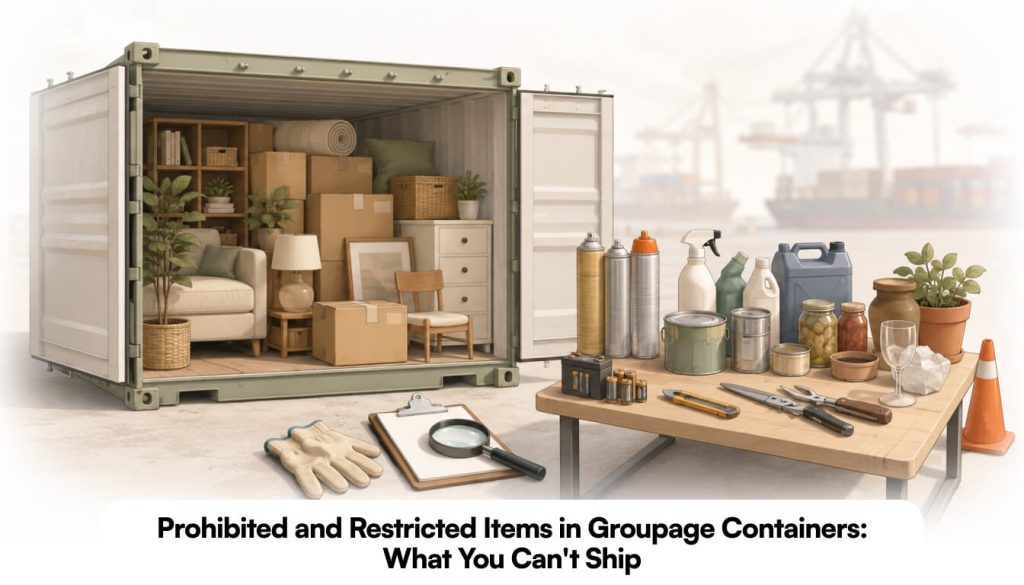
Every international groupage shipment must comply with the prohibited and restricted goods regulations of both the origin country (in Nobel’s case, the United States) and the destination country. Violations — even unintentional ones — can result in shipment holds, confiscation of goods, significant fines, and in extreme cases, criminal liability for the shipper.
This article covers the major categories of prohibited and restricted items for international household goods consolidations, with specific notes for Nobel’s key corridors.
Universally Prohibited Items (All Corridors)
The following categories are prohibited across virtually all international household goods shipments and will not be accepted by Nobel Relocations under any circumstances:
Hazardous Materials (HAZMAT)
- Flammable liquids: paint, solvents, gasoline, lighter fluid, aerosol cans under pressure
- Compressed gases: propane tanks, oxygen tanks, fire extinguishers
- Explosives: fireworks, ammunition, flares (firearms handled under separate, specific protocols)
- Corrosives: batteries (most types), pool chemicals, drain cleaners
- Radioactive materials
HAZMAT regulations for ocean shipments are governed by IMDG (International Maritime Dangerous Goods) Code under IMO authority. In 2026, IMO has updated several IMDG classifications affecting lithium battery shipping — particularly relevant for electric vehicles, e-bikes, and large battery-powered equipment.
Perishables
- All food items (including canned goods in many jurisdictions — check destination country regulations)
- Plants and plant material — subject to ISPM 15 phytosanitary requirements for wood packaging
- Soil
Illegal and Controlled Items
- Narcotics and controlled substances
- Weapons (firearms require specific export/import licensing; handguns and long arms are NOT included in standard household goods shipments)
- Counterfeit goods
- Goods subject to CITES (Convention on International Trade in Endangered Species) restrictions — ivory, certain furs, exotic wood products
Destination-Specific Restrictions
USA to Israel
- Food items: Israel’s Ministry of Agriculture applies strict phytosanitary controls; most food is prohibited
- Religious items: No restrictions, but accurate inventory descriptions are required
- Electronics: No general restriction, but dual-use technology may require additional export documentation
- Weapons: Prohibited except under specific government authorization
USA to Brazil
- Used mattresses: Prohibited for import
- Alcohol: Limited quantities permitted for personal use; commercial quantities require separate import license
- Firearms: Prohibited except under specific authorization from the Brazilian Federal Police
- High-value electronics: May be subject to ICEGATE/CBIC (Brazilian customs) scrutiny and high import duties if not qualifying under Transfer of Residence
USA to EU Member States
- Certain plant-based items: Subject to EU phytosanitary regulations
- CITES-listed items: Require specific permit — applies to certain musical instruments (e.g., vintage guitars with rosewood components)
- Meat and dairy products: Prohibited for private import from non-EU countries
- Currency: Amounts over EUR 10,000 require customs declaration
USA to UK
- Firearms: Prohibited without specific Home Office authorization
- Certain food items: Post-Windsor Framework customs rules apply for shipments to Northern Ireland
- CITES items: UK maintains its own CITES permit requirements post-Brexit
The ISPM 15 Wood Packaging Standard
International Standards for Phytosanitary Measures No. 15 (ISPM 15) requires that wooden packaging materials used in international trade — including Lift Vans — be treated to eliminate pest risk. Nobel’s Lift Vans comply with ISPM 15 treatment requirements, with appropriate markings. This is a critical compliance requirement: non-compliant wooden packaging can result in shipment rejection or mandatory treatment at destination at the shipper’s expense.
Nobel’s FSC-certified, ISPM 15-compliant Lift Vans address this requirement automatically — it is built into the Nobel service standard, not an optional add-on.
Nobel’s Pre-Move Prohibited Items Consultation
As part of every Nobel booking, a pre-move consultation includes a review of your inventory against destination country prohibited and restricted goods lists. This proactive review prevents the costly surprises that occur when prohibited items are discovered at customs after the goods have already been shipped. Nobel’s team is familiar with the nuanced regulations across all major corridors and can advise on items that fall into gray areas — such as vintage items with potentially CITES-restricted components or specialty food items that may qualify under specific exemptions.
Ready to Move Smarter in 2026?Nobel Relocations is a FIDI-FAIM 3.4 certified, C-TPAT Trusted Trader, and FMC-licensed OTI with decades of groupage experience across every major international corridor. Contact Our Experts | www.nobelrelocations.com |