
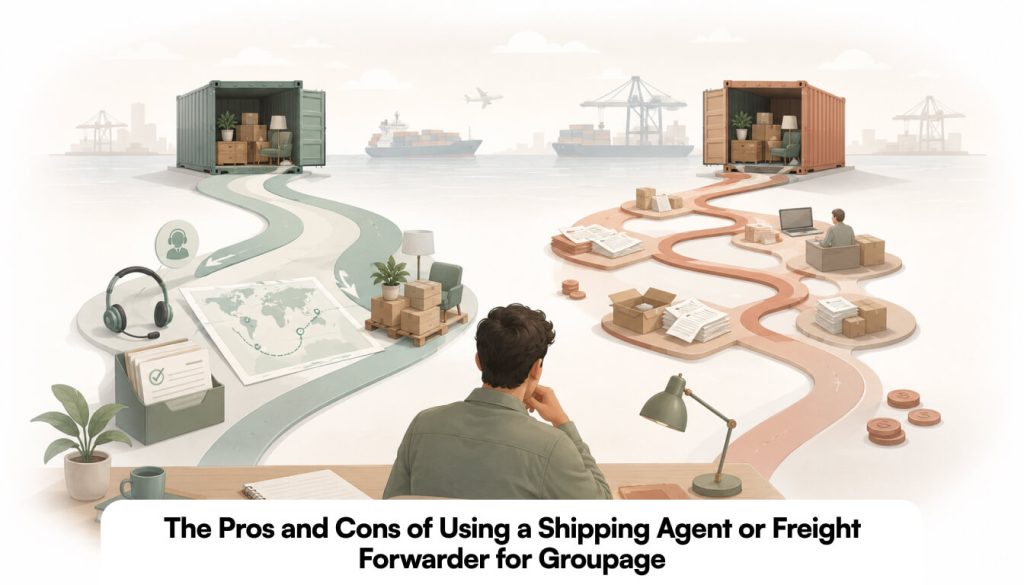
The international moving industry is served by several different types of companies, and the differences between them are not always clear from a website or a quote. A ‘freight forwarder,’ a ‘shipping agent,’ and an ‘international mover’ are related but distinct — and choosing the wrong type for your specific shipment can have real consequences.
This article gives you an honest comparison so you can identify which type of service is right for your situation.
Understanding the Different Service Types
Freight Forwarder
A freight forwarder is a logistics intermediary that arranges ocean, air, or land transportation on behalf of shippers. Freight forwarders typically specialize in commercial cargo — goods being exported or imported for business purposes. They have expertise in international trade documentation, customs procedures, and carrier relationships, but they are not typically equipped for household goods consolidation. Most freight forwarders do not own Lift Vans, do not operate CFS facilities for household goods, and are not FIDI-certified.
Shipping Agent / NVOCC
A Non-Vessel Operating Common Carrier (NVOCC) is a company licensed by the FMC to issue bills of lading and book ocean freight as if it were a carrier, without actually owning vessels. Many groupage operators are NVOCCs. The quality range among NVOCCs is wide — from professional, FIDI-certified movers to budget consolidators with minimal service infrastructure. FMC licensure confirms legal authority to operate; it does not confirm quality, insurance adequacy, or household goods expertise.
FIDI-Certified International Mover
A FIDI-FAIM 3.4 certified international mover is a company that has passed independent auditing of its moving operations, financial stability, and quality management systems. FIDI movers specialize in household goods — they own or operate Lift Vans, manage CFS operations specifically for personal effects, have destination agent networks in their key corridors, and carry the insurance and regulatory credentials (FIDI membership, FMC OTI license, C-TPAT status) appropriate for household goods moving.
Nobel Relocations is a FIDI-FAIM 3.4 certified international mover with FMC OTI licensure and C-TPAT Trusted Trader status — the full credential stack for professional household goods groupage shipping.
Honest Pros and Cons: Each Option
Freight Forwarder: Pros and Cons
- PRO: Often competitive rates for commercial cargo
- PRO: Strong documentation expertise for regulated commodities
- PRO: Good for business-to-business shipments
- CON: Typically not equipped for household goods consolidation
- CON: Not FIDI-certified — no independent quality audit
- CON: May not provide Lift Van handling, packing services, or destination unpacking
- CON: Marine cargo insurance for household goods may require separate arrangement
Generic NVOCC / Shipping Agent: Pros and Cons
- PRO: Sometimes lower base rates than full-service movers
- PRO: FMC-licensed (verifiable legal authority)
- CON: Wide quality variation — FMC license does not verify service quality
- CON: May not be C-TPAT certified — higher CBP hold risk in 2026
- CON: Often lacks destination agent network for customs clearance
- CON: No FIDI-FAIM quality audit — no independent verification of operating standards
FIDI-Certified International Mover (Nobel Relocations): Pros and Cons
- PRO: FIDI-FAIM 3.4 independent quality audit — the highest standard in the industry
- PRO: FMC OTI license and C-TPAT Trusted Trader status — full regulatory compliance
- PRO: Lift Van consolidation — physical security standard specific to household goods
- PRO: In-house compliance for origin and destination customs documentation
- PRO: Destination agent network in all major corridors — one point of contact, end to end
- CON: Higher base price than budget alternatives — reflects actual service cost
- CON: Consolidation schedule-dependent — not appropriate for urgent, date-specific shipments (where FCL is better)
The Accountability Question
The most important difference between service types is not price — it is accountability. When something goes wrong with a freight forwarder or generic NVOCC shipment, the accountability question is genuinely complicated: Was the damage from the carrier? The CFS operator? The destination agent? The individual who packed the Lift Van?
With Nobel, there is one responsible party from origin to destination. Nobel’s FIDI membership and its quality management framework provide a claims and dispute resolution process with clear standards. This single point of accountability has real financial value — particularly for household goods with high sentimental or replacement value.
Ready to Move Smarter in 2026?Nobel Relocations is a FIDI-FAIM 3.4 certified, C-TPAT Trusted Trader, and FMC-licensed OTI with decades of groupage experience across every major international corridor. Contact Our Experts | www.nobelrelocations.com |