
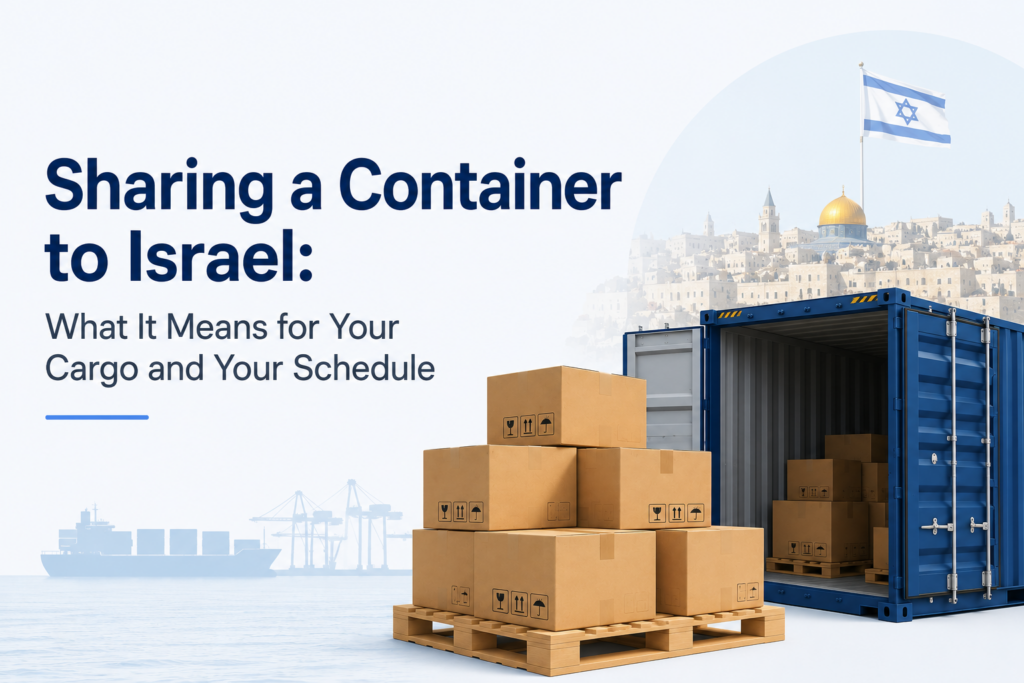
The word people react to is “shared.” Your dining table crosses the Atlantic and the Mediterranean in a steel box with someone else’s dining table, sealed together, on one manifest, to one port. For a shipment that may include everything you own, that description does not immediately sound reassuring.
It is, in practice, a well-established and heavily structured arrangement. But the structure is worth understanding, because it explains both what protects you and what genuinely exposes you.
What Is Actually Shared, and What Is Not
Shared: the container, the vessel, the schedule
You share the physical box, the sailing it travels on, and critically its fate as a unit while it remains sealed. If the container is held, delayed or rolled to a later vessel, that applies to everything inside it.
Not shared: your customs entry
This is the part people most often get wrong. Customs entries in groupage are made per consignment. Your goods are declared against your documentation, your status, and your entitlements as an oleh chadash, a returning resident, or an ordinary importer. Someone else’s declaration is not your declaration and their assessment is not your assessment.
Not shared: liability for your goods
Your consignment is contracted, manifested and insured as your consignment. You are not underwriting anyone else’s belongings by travelling alongside them.
Not shared: physical space
Consignments are separated, blocked and braced within the container. This is loading craft rather than a legal protection, and it is one of the practical reasons that who loads your container matters.
The short version: you share a schedule and a steel box. You do not share a customs file, a liability position, or an insurance policy.
The Real Shared Risk: A Hold Before Destuffing
Because entries are separate, the honest exposure is narrower than people fear but it is not zero, and it is worth naming precisely.
While the container is sealed, it moves as one item. If it is selected for examination, flagged on a manifest discrepancy, or referred for scanning, the container waits and every consignment inside it waits with it, regardless of how immaculate any individual shipper’s paperwork is.
This is the concrete, unglamorous reason that origin-side security standing matters in consolidated shipping, and why it is not a marketing line. C-TPAT Trusted Trader status is a US Customs and Border Protection programme requiring a validated supply chain security profile, and participants are recognised as lower risk with correspondingly reduced examination rates. In a shared container, that benefit is collective. It protects the schedule of every shipper in the box.
On the Israel lane, where port storage at Ashdod is among the most expensive of any destination, a schedule protected at origin has a direct financial value at destination.
Why Groupage Suits the Israel Lane Particularly Well
There is a structural fit here that does not exist on most corridors.
Customs rights for new immigrants are designed to be used across more than one shipment rather than in a single consignment. That makes a phased approach genuinely practical: send what you need to set up a home first, live in the apartment for a few months, then send the rest once you know what you actually want in it.
That strategy is affordable in groupage and awkward in FCL. Two moderate consolidated consignments is a normal, sensible plan. Two half-empty containers is an expensive one, because you pay for the box twice regardless of how little is in it.
It also solves a real problem specific to this lane. Israeli apartments, doorways and stairwells are frequently smaller than American equivalents. Shipping in phases lets you measure the actual space before committing the second consignment to it.
Packing for a Shared Container
Consolidated cargo is handled more times than a dedicated container: loaded at origin, received at the CFS, loaded into the container, destuffed at Ashdod, sorted, and loaded again for delivery. Each of those is a handling point, and packing should be specified for that reality.
- Export-standard packing rather than domestic-move packing the difference is real and it matters here.
- Clear, durable marking on every piece. Reconciliation at destuffing is fast when marking is unambiguous.
- Numbered inventory matching the marking exactly.
- Crating for anything fragile, awkward or high-value. In a shared container it is not just your own goods moving around it.
- Nothing prohibited, ever. Hazardous items in a shared container are a problem for everyone in it, and are the fastest route to a container-level intervention.
How Nobel Runs Groupage to Israel
Nobel Relocations holds FIDI-FAIM 3.4 accreditation the international moving industry’s independently audited quality standard along with FMC Ocean Transportation Intermediary licensing and C-TPAT Trusted Trader status with US Customs and Border Protection. All three are independently verifiable.
The Ashdod lane runs on a scheduled consolidation calendar with a pre-approved Israeli destination agent experienced in oleh and returning resident clearances. C-TPAT status at origin protects the whole container’s schedule which, given Israeli port storage costs, is where a good deal of the value on this lane sits.
Quick Answers
Could my goods be mixed up with someone else’s?
Every piece is marked and manifested, and reconciliation against the manifest happens at destuffing. Clear marking and an accurate inventory at origin are what make that reliable.
Am I liable if another shipper has prohibited goods in the container?
Your consignment is your consignment for liability and customs purposes. The realistic exposure is to the schedule, not the assessment which is why what goes into the container at origin matters to everyone in it.
Can I choose who I share with?
No, and that is the point. Groupage is a structured commercial service, not an informal arrangement between individuals which is precisely what gives it a proper manifest, proper liability separation and proper insurance.
Is a shared container less secure?
Containers are sealed and move through bonded facilities. The meaningful security question is who consolidates and who handles at destination, not whether the box is shared.
Read the Full Guide
This post covers one mechanic of consolidated shipping in depth. For the complete corridor picture ports, customs framework, transit times, prohibited items and the full eight-step process read the Ultimate Guide: Groupage Shipping from the USA to Israel.
Get the Numbers for Your Own Shipment
If you are considering a phased approach an initial consignment now and a second one later that is worth structuring at the outset rather than improvising after the first shipment lands.
Contact Our Experts to review your Israel groupage shipment with Nobel Relocations and receive a written, itemised quotation.
This article is provided for general informational purposes. Rates, schedules, charge structures and customs requirements change. Confirm current terms with Nobel Relocations before making shipping decisions.