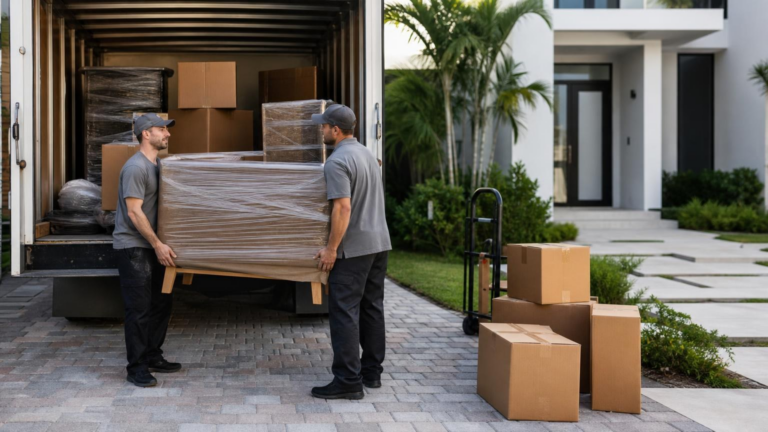

Moving in Miami means doing heavy work in heavy humidity. Your sofa has to get through a Brickell condo’s service elevator, onto a truck that sits in I-95 traffic, and into a Kendall house before the afternoon storm arrives. Hiring the wrong crew adds to all of that: damaged furniture, surprise fees, or a truck that won’t unload until you pay double the quote.
The upside is that unreliable movers usually show the same warning signs, and you can spot most of them before signing anything. This guide covers how to choose a reliable moving company in Miami. It explains how to check licenses with Florida and federal regulators, how to read estimates, and how to tell a real professional from a phone number with a rented truck.
The South Florida moving market draws a lot of new companies, partly because demand stays high most of the year. Some are excellent family-run outfits that have worked these streets for decades. Others are brokers posing as movers, or crews that disappear after the deposit clears. The steps below will help you hire the first kind.
Navigating the Unique Challenges of Moving in Miami
Miami is a harder place to move than most cities, and a reliable company should be able to explain why without being prompted. Weather is the biggest factor. Hurricane season runs from June 1 through November 30, and summer afternoons bring storms that can soak an open truck in ten minutes. A good mover watches the forecast, brings plenty of shrink wrap and moisture barriers, and won’t leave your mattress uncovered on the curb.
Humidity causes slower damage that you may not notice until weeks later. Clothes packed in plastic garbage bags trap moisture and can develop mildew within days, especially if they go into a storage unit without climate control in Doral or Medley. Ask your mover whether they use breathable wardrobe boxes. For electronics, documents, and leather goods, put silica gel packets in the boxes.
Traffic changes how long a move takes and what it costs. The Palmetto Expressway (SR 826), the Dolphin Expressway (SR 836), and I-95 through downtown can turn a 20-minute trip into 90 minutes during rush hour. On Dolphins game days and big concerts at Hard Rock Stadium, the area around Miami Gardens and the Florida Turnpike backs up badly. An experienced local mover will schedule around these problems, often suggesting early-morning starts. If you’re paying by the hour, that planning saves you real money.
Parking is the last obstacle. In South Beach, Wynwood, and Little Havana, a 26-foot truck may need a curbside permit or a reserved loading zone. Companies that know Miami will mention this during the estimate.
Verifying Credentials and Florida State Licensing
Verification is the part people skip most often, and it’s also the most important. Florida regulates intrastate movers under Chapter 507 of the Florida Statutes. Federal rules apply as soon as your belongings cross state lines. A company that works legally will give you its registration numbers without hesitation. If a mover dodges the question, end the conversation.
Checking FDACS and USDOT Registrations
For a move within Florida, such as Coral Gables to Fort Lauderdale or Hialeah to Orlando, the mover has to be registered with the Florida Department of Agriculture and Consumer Services (FDACS). The registration number should appear on the company’s website, ads, estimates, and contract. You can verify it with FDACS’s online business lookup or by calling the state consumer hotline at 1-800-HELP-FLA. While you’re there, check whether the company has complaints on file.
For an interstate move, the company also needs a USDOT number from the Federal Motor Carrier Safety Administration (FMCSA). Look it up in FMCSA’s public database. The listing should show that the company is authorized for household goods and should not show “inactive” or “not authorized.” Interstate movers also have to give you FMCSA’s “Your Rights and Responsibilities When You Move” booklet. Use this quick checklist:
- FDACS registrationactive, with the number printed on paperwork
- USDOT number(interstate only), authorized for household goods
- Physical Miami-area addressyou can find on a map, not only a P.O. box
- Mover vs. broker statusstated clearly in writing
The last point is important. A broker sells your job to a different company, so the crew that arrives may not be the one you researched.
Understanding Insurance and Liability Coverage
Many people don’t realize that the basic coverage included in a moving quote pays very little. Standard released-value protection is usually figured by weight, roughly 60 cents per pound per item for interstate moves. If movers break a 40-pound flat-screen TV, that comes to about $24. Full value protection costs extra, but it requires the mover to repair, replace, or pay the current value of damaged items.
Ask what coverage is included, what upgrades cost, and whether there’s a deductible. Ask for proof of general liability and workers’ compensation insurance as well. If an uninsured worker gets hurt carrying your dresser up the stairs, you don’t want the claim to end up with your homeowner’s policy.
Evaluating Local Reputation and Customer Feedback
Star ratings alone tell you very little. A company with 4.8 stars from 30 reviews posted within a single month needs a closer look. Reading reviews well means finding patterns and noticing how the business responds when things go wrong.
Begin with Google and the Better Business Bureau, then look at Yelp and neighborhood groups on Nextdoor or Facebook. Miami residents tend to be blunt in local groups, and a question like “Anyone used X movers in Aventura?” usually draws honest answers fast. Pay attention to recurring themes. A single complaint about a late crew is normal. Ten complaints describing a final bill far above the estimate point to a business practice.
How the company answers negative reviews is also revealing. A reliable mover replies in specific terms: “We’ve filed the claim for your damaged table and our manager will call you Thursday.” A shady one fights with customers or posts the same copied apology everywhere. Also keep an eye on the company name. Some operators with bad records close down and reopen under a new name, so compare the address and phone number across listings.
Ask about Miami experience directly. Has the crew moved people into the condo towers on Collins Avenue? Do they know the loading dock rules at buildings along Brickell Avenue? A company that has done these jobs many times will answer in detail.
The Importance of On-Site or Virtual Estimates
A mover that quotes a price over the phone without seeing your belongings is guessing, or setting you up for a higher bill later. Accurate pricing depends on volume, weight, access, and special items, and someone has to look at your home to judge those. A walk-through in person is best. A live video survey, where an estimator directs you room by room, works well for straightforward moves.
During the survey, open every closet, the garage, and the storage cage. Point out anything heavy, fragile, or awkward. If your Pinecrest home has a long driveway that a truck can’t fit down, mention it, because a shuttle truck or long carry adds cost. Any surprise you leave for moving day will likely appear on the invoice.
Binding vs. Non-Binding Quotes
A binding estimate sets the price for the inventory listed. If nothing changes, that’s what you pay. A non-binding estimate is the mover’s best guess, and the final bill depends on actual weight or hours worked. Interstate moves also have a “binding not-to-exceed” option, which caps the price but lets it go lower if your shipment weighs less than expected.
For most local Miami moves billed by the hour, request a written estimate that states the hourly rate, crew size, truck fees, travel time, and any minimum hours. Florida law requires movers to provide written estimates, so a verbal number isn’t acceptable.
Identifying Red Flags in Low-Ball Bids
If one quote is 40% below the others, it isn’t a bargain. It’s often the first step of a scam. These are the patterns to watch for:
- Bait-and-switch pricing: a low quote followed by “extra” charges for stairs, tape, or fuel once your things are already loaded
- Hostage situations: the crew won’t unload until you pay an amount far above the estimate, often in cash
- Large upfront deposits: reputable movers usually ask for little or nothing until delivery
- No physical or video survey: a firm price given in two minutes over the phone
- Blank or incomplete contracts: “We’ll fill it in later” means they’ll fill it in to suit themselves
If you’re in a hostage situation, contact local police and FDACS. Florida law treats holding goods over an inflated bill as a serious violation.
Assessing Specialized Services for South Florida Living
Most Miami moves involve at least one complication. It could be a baby grand piano in a Coconut Grove living room, artwork headed to a gallery-style apartment in the Design District, or an entire dental office relocating from Doral to Kendall. Ask whether the company does this kind of work itself or hands it off to someone else.
For specialty items, these are rough market ranges to use as a reference point. Always confirm with written quotes:
| Service | Typical South Florida Range |
| Upright piano (local) | $300 to $600 |
| Grand piano (local) | $500 to $1,200+ |
| Custom wood crate (art, mirrors, marble) | $150 to $600 per crate |
| Pool table disassembly and move | $300 to $800 |
| Climate-controlled storage (per month, 10×10) | $150 to $300 |
Commercial moves need different planning. Office buildings often allow moves only after hours or on weekends, limit dock time to set windows, and require you to book freight elevators. IT equipment needs anti-static packing and careful labeling so servers and workstations can be reconnected quickly. Many businesses move in phases, one department at a time over several weekends, to avoid shutting down. A mover with commercial experience will propose that kind of schedule without being asked.
Handling High-Rise Logistics and HOA Requirements
A large share of Miami lives in condos, and condo moves have their own rules. Most associations require a certificate of insurance (COI) naming the building and management company as additional insureds, often with specific coverage minimums. Your mover should be able to provide one within a day or two. If they don’t know what a COI is, find another company.
Expect to reserve the service elevator, sometimes weeks in advance. Many buildings in Brickell, Edgewater, and Sunny Isles limit moves to weekday windows such as 9 a.m. to 4 p.m. and charge refundable damage deposits. The crew should pad elevator walls and protect lobby floors. Ask management for the building’s move policy early and send it to your mover so the time slot, dock access, and truck height clearance all match.
Reviewing the Moving Contract and Inventory List
The contract, usually called the bill of lading, is your proof if anything goes wrong. Read it before the crew starts carrying boxes, not afterward. Check that the company’s legal name, FDACS registration, and USDOT number (if interstate) all appear, and that the price matches your written estimate.
The inventory list is the second key document. For larger or interstate moves, the crew tags each item and notes its condition: “dresser, scratch on top left,” for example. Walk through the list with them and dispute anything that seems overstated. If your new dining table is marked “heavily scratched” when it’s in perfect condition, you’ll have trouble filing a damage claim later. Take your own photos of valuable items before they’re loaded.
Before you sign, confirm that the contract covers the following:
- Pickup and delivery dates or delivery windows
- The total price or rate structure, including every fee
- Valuation coverage you selected, in writing
- How to file a claim and the deadline for filing
- Payment methods accepted at delivery
Never sign a blank or partly completed document. At delivery, check items against the inventory before you sign off, and write down any damage on the paperwork right there.
Finalizing Your Relocation for a Stress-Free Move
Once you’ve chosen a mover, a simple timeline helps prevent last-minute problems. Here’s a practical schedule for a typical Miami move:
- 8 weeks out: Get three in-home or video estimates and verify FDACS/USDOT registrations
- 6 weeks out: Book your mover, request the COI, and reserve condo elevators at both buildings
- 4 weeks out: Order wardrobe boxes and silica gel, and schedule piano or art crating if needed
- 2 weeks out: Confirm parking permits, start packing rooms you don’t use often, and plan around game days or events at Hard Rock Stadium
- 3 days out: Check the hurricane and storm forecast, and confirm the arrival time and crew size
- Moving day: Walk through the inventory, keep valuables and documents with you, and inspect everything before signing
To sum up the process: confirm the company is licensed, read reviews for patterns, insist on a real survey and a written estimate, and read every line of the contract. Miami’s heat, traffic, and condo rules make the work harder, but a good mover already plans for those things.
If you take one step from this guide, verify the registration number before you pay any deposit. It takes five minutes and filters out most of the operators you need to avoid.