
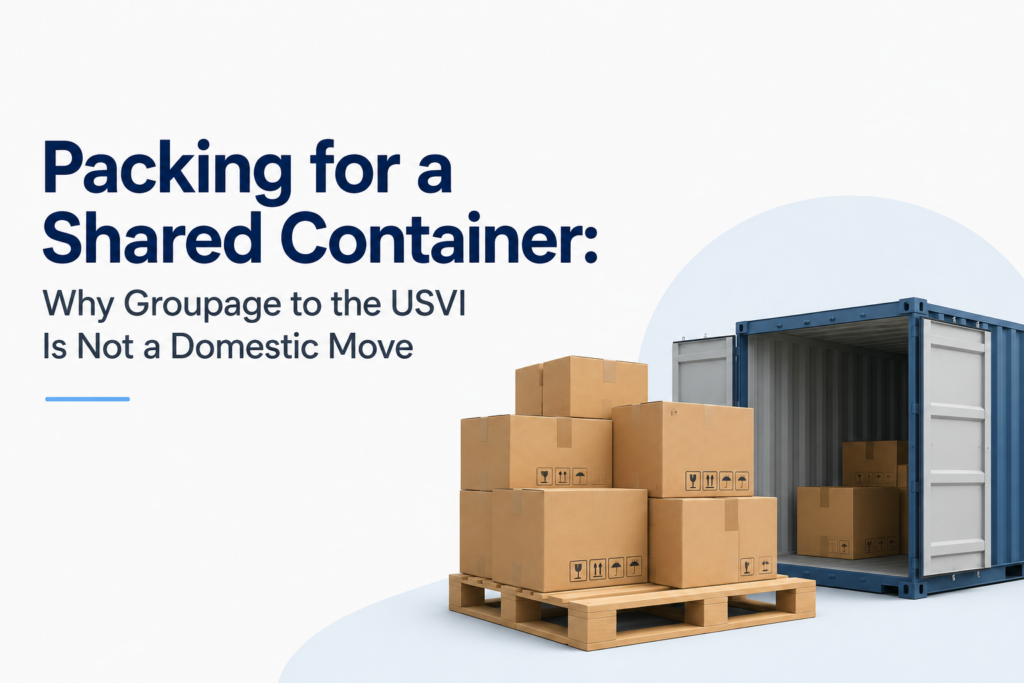
The Virgin Islands lane invites a specific mistake, and it is an understandable one. The sailing from Florida is measured in days rather than weeks. You never leave the United States. The whole thing feels like a long domestic move, and people pack for it accordingly with the same cartons and the same care they would use to move across a state line.
Then the consignment goes through five or six handling points, sits in a marine climate at both ends, possibly transfers to a barge, and arrives having had a considerably harder trip than the distance suggests. Groupage packing is not about distance. It is about handling, and this lane has plenty of it.
Count the Handling Points
A dedicated container is loaded at your address and unloaded at your destination. Two handling events. That is why FCL packing standards can be lighter.
A consolidated consignment to the Virgin Islands goes through something closer to this:
- Loaded at your address onto a collection vehicle.
- Unloaded and received at the container freight station.
- Checked, measured and staged.
- Loaded into the shared container, blocked and braced alongside other consignments.
- Destuffed on arrival and separated against the manifest.
- Staged for delivery.
- Loaded for the island delivery and frequently transferred again to a shuttle vehicle that can physically reach the property.
- For St. John, an additional barge transfer from St. Thomas.
That is up to eight handling events on a lane people mentally file as domestic. Every one is a place where packing either does its job or does not.
The rule of thumb: pack for the number of times your goods will be picked up, not for the number of miles they will travel.
What Export-Standard Packing Actually Changes
Cartons
Heavier-grade double-wall cartons rather than standard moving boxes, properly filled so they do not crush when stacked. In a shared container your cartons are load-bearing something else is sitting on them.
Wrapping and padding
Furniture wrapped rather than blanket-covered. Blankets are a domestic-move solution that assumes the item goes straight from truck to room. Consolidated cargo does not.
Crating
Anything fragile, awkward, high-value or irreplaceable artwork, mirrors, glass, stone tops, musical instruments. In a shared container these items are not surrounded by your own soft furnishings. Crating is what substitutes for that.
Palletisation
Grouped items on a pallet move as a unit, reducing individual handling and making manifest reconciliation faster at destuffing. It is one of the quiet advantages of professional consolidation.
Marking and Inventory: The Underrated Part
In a dedicated container, marking barely matters everything in the box is yours. In groupage it is the mechanism by which your belongings are identified as yours at destuffing, separated from several other consignments, and reconciled against a manifest.
- Every piece marked durably and legibly, in a way that survives handling and humidity.
- Sequential numbering that matches the inventory exactly, with no gaps and no duplicates.
- Item-level inventory detail rather than carton-level generalities.
- Fragile and high-value items identified clearly so they are handled accordingly.
Good marking is also the single biggest factor in how quickly your consignment moves through deconsolidation. Reconciling a clearly marked consignment is quick. Reconciling an ambiguous one is a person with a clipboard working slowly through a warehouse.
The Climate Factor, at Both Ends
This lane runs from a subtropical gateway to a tropical marine destination, and the container in between is a sealed steel box in the sun. Sustained humidity and salt air affect electronics, leather, wooden furniture, textiles and metal fittings.
- Moisture-resistant wrapping for anything vulnerable.
- Electronics packed with attention to humidity rather than just impact.
- Leather and wood protected rather than simply covered.
- Nothing packed damp a slightly damp item sealed in a carton for several weeks in a warm container is a mould problem waiting to be unpacked.
Worth saying plainly: proper packing protects goods in transit. It does not change what the island environment does to a possession over the years that follow, which is a separate question about what is genuinely worth shipping at all.
What Cannot Go in a Shared Container
This matters more in groupage than in FCL, because the consequences are collective. Hazardous goods in a shared container are a problem for every shipper in it.
- Aerosols, paints, solvents and pool chemicals.
- Propane tanks, including barbecue cylinders.
- Any fuel-powered equipment that has not been completely drained of fuel and oil.
- Firearms without Virgin Islands licensing, which is territorial and distinct from mainland state law.
A container-level intervention delays everyone inside it. On a lane where the sailing is the fastest part of the journey, that is a disproportionate loss.
One Sizing Note
Packing well does not help an item that cannot be delivered. Island access on St. Thomas and St. John is genuinely constraining narrow roads, steep driveways and long carries are common, and a large item that clears the port and cannot reach the property is freight cost with nothing to show for it. Establish what can physically reach your address before deciding what to pack, not after.
How Nobel Runs Groupage to the US Virgin Islands
Nobel Relocations holds FIDI-FAIM 3.4 accreditation the international moving industry’s independently audited quality standard along with FMC Ocean Transportation Intermediary licensing and C-TPAT Trusted Trader status with US Customs and Border Protection. All three are independently verifiable.
Nobel applies international export standards to a lane many operators treat as a casual domestic run including established island handling across all three islands and the St. John barge transfer. FIDI-FAIM 3.4 accreditation covers packing and handling standards specifically, which is the part of the process this article is about.
Quick Answers
Can I pack my own boxes for groupage?
Owner-packed cartons are possible and reduce cost, but they are handled the same number of times as professionally packed ones and are more likely to fail. Owner-pack the robust items; let the crew handle anything fragile.
Is crating worth it on such a short sailing?
The sailing is short; the handling is not. Crating is a response to handling points and shared-container loading, not to distance.
Will my goods be stacked under someone else’s?
Consignments are blocked and braced within the container, and load planning is part of the skill of consolidation. Packing that assumes weight above it is still the sensible default.
Does the St. John barge add risk?
It adds a handling point and a scheduling dependency. Both are routine and both are reasons to pack to a proper standard.
Read the Full Guide
This post covers one mechanic of consolidated shipping in depth. For the complete corridor picture ports, customs framework, transit times, prohibited items and the full eight-step process read the Ultimate Guide: Groupage Shipping from the US Mainland to the US Virgin Islands
Get the Numbers for Your Own Shipment
Packing scope is the part of a groupage quote most worth discussing in detail it is where a small saving at origin turns into a large loss at destination.
Contact Our Experts to review your Virgin Islands groupage shipment with Nobel Relocations and receive a written, itemised quotation.
This article is provided for general informational purposes. Rates, schedules, charge structures and customs requirements change. Confirm current terms with Nobel Relocations before making shipping decisions.